
Wires Across the Dust
Join the conversation! Readers are sharing their thoughts:
About the Story
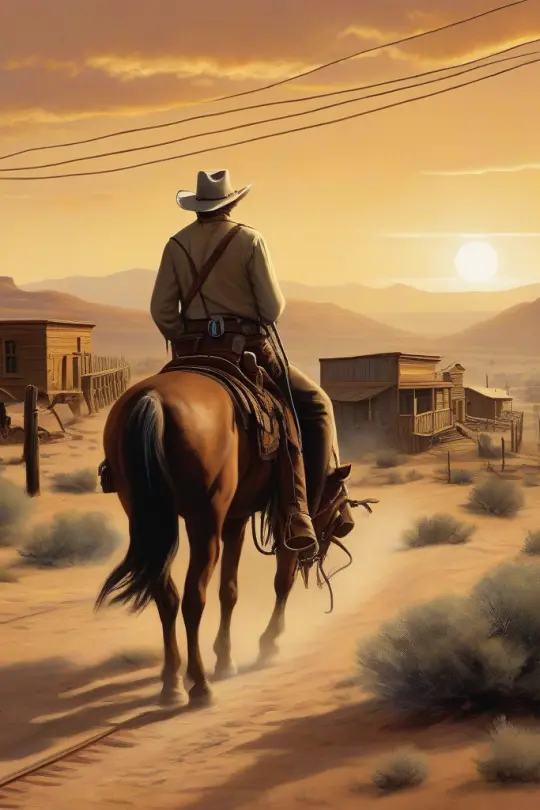
A young telegraph operator in a dusty frontier town overhears a coded plot to rob a train and kidnap a boy. With a veteran cowboy, a clever tinkerer, and a quiet desert guide, she follows the wires into the hills. In the standoff that follows, courage and wit prove louder than any gunshot.
Chapters
Related Stories
Dust and Oath
A retired marshal returns to Cedar Fork to find a corporate scheme threatening the valley's spring. As harassment escalates into arson and abduction, he must choose between old habits of lone violence and leading the town to reclaim its rights through evidence and community action.
Red Mesa Ledger
Maeve Callahan, a widow and homesteader, faces a corporate land grab when a wealthy developer claims the valley's water. With her daughter's safety and the Red Mesa ledger at stake, she must marshal witnesses, steal back proof, and stand the town against hired guns to protect what her community has always relied on.
Sundown at Silver Hollow
In a sun-bleached frontier town, Maeve Calhoun fights to reclaim her community when a railroad company's men seize land and people using forged deeds. A stolen ledger, a borrowed compass, and a ragged band of neighbors become the tools of resistance in this gritty Western about courage, craft, and what it takes to hold a home.
Signal at Red Mesa
When Red Mesa's water rights are threatened by a hungry company and the telegraph line goes silent, Maeve Calder—young keeper of the line—rides through dust and law to retrieve a missing ledger, face hired guns, and stitch a town back together using wire, wit, and stubborn courage.
The Spark Key of Sundown Ridge
In the dusty town of Sundown Ridge, Mara Quinn keeps the telegraph and the depot running. When the town's rails are cut and a land baron moves to seize the water and the deeds, Mara gathers unlikely allies, a spark key, and a stubborn heart to save her home.
The Last Telegraph of Dustwater
In a small frontier town threatened by a ruthless landman, telegraph operator Etta Lark must trade the safety of wires for the dirt of the trail. When her foster brother is taken, she follows the tracks, gains a steadying ally, and fights to reclaim the town’s ledger—and its future. A Western of small courage and the long, slow work of justice.
Other Stories by Victor Ramon
Ratings
Promising premise, but the story plays out like a well-polished outline rather than a fully lived-in world. The opening is vivid—Lin Mei’s brass key, the coffee steam, that forbidden private wire’s low heartbeat—yet those lovely sensory touches don’t translate into sustained tension. The HALDEN—WHEELS—DELAYED—HOLD line is a nice ticking promise of trouble, but the investigation that follows feels oddly procedural and unsurprising: they follow the wires, meet archetypes (veteran cowboy, clever tinkerer, quiet guide), and arrive at a tidy standoff where wit wins instead of bullets. Predictable beats pile up faster than they earn weight. Pacing is a real problem. The excerpt luxuriates over the telegraph office—great—but once the plot kicks in it races. Key questions are glossed over: how did Lin Mei decode the crooks’ plan so quickly? Why is the private railroad wire left so conveniently accessible for plot reasons? The kidnap angle is introduced as high-stakes yet the emotional payoff and consequences after the confrontation are murky. Characters are sketched rather than lived; Isaiah holding his cup is a lovely detail but we never really learn what’s at risk for him or the tinkerer. With a bit more messy unpredictability—more moral friction, clearer motives for the antagonists, and a slower bleed of consequences—this could move from charming to memorable. As it stands, enjoyable in moments but too neat for its own good. 😕
The imagery is probably the best thing here: dawn described as a "quiet scrape of tin signs," the telegraph’s rasp, and that lovely moment where Lone Cactus replies with a lazy tick-tick. I also appreciated the moral center in Lin Mei — she’s competent and quietly brave. That said, the story sometimes leans on familiar Western beats without interrogating them. The cowboy, tinkerer, and silence-of-the-desert guide are interesting on paper but sketched a bit thinly; I never felt fully invested in their arcs beyond their function in the plot. The kidnap/rob train premise is urgent, but the planning and obstacles felt streamlined, so the standoff lacked complexity. It’s a pleasant, readable piece with lovely sentences, but I kept wanting deeper stakes and a clearer sense of consequences after the confrontation. If this had been longer and allowed more room to complicate its characters, it would have been excellent.
I wanted to like this more than I did. The setup is promising — a telegraph operator overhearing a plot is classic and evocative — but the execution sometimes plays it safe to the point of predictability. You get the cue: forbidden wire hums, a neat clue (HALDEN—WHEELS—DELAYED—HOLD), and then one by one the stock cast appears: taciturn cowboy, clever tinkerer, stoic desert guide. They’re all serviceable, but too often feel like archetypes rather than full people. The standoff itself resolves in a way that feels calibrated to be wholesome rather than surprising; courage and wit trumping guns is noble, sure, but the opposition’s motives and capabilities are underdeveloped, which makes the tension less urgent. Also — small world nitpick — Lin Mei touching the private railroad wire without consequences felt like a convenience to push the plot forward. Stylistically the prose is clean and the atmosphere is well done (I liked the water tower shadow), but I wanted more risky choices and messier characters. A solid read, just not memorable.
Short and sweet: Lin Mei is a joy to follow. The telegraph office scenes — coffee steam, sleeves buttoned against dust, and that warm brass key — feel tactile and alive. The author balances suspense with small human moments (Isaiah holding his cup like it might run away made me grin). The private railroad wire’s lower click is a brilliant detail that raised the hairs on my arms. The standoff’s reliance on wit instead of fireworks is exactly my kind of Western. Felt honest and well-paced.
Smart, lean, and quietly confident. The story uses the telegraph not just as plot mechanism but as a character: forbidden hums, private railroad lines, the tactile brass key. I liked the way the author lets a single transmitted line — HALDEN—WHEELS—DELAYED—HOLD —spin out an entire investigation. The team assembled around Lin Mei is well chosen: Isaiah’s veteran calm offsets the cowboy’s grit and the tinkerer’s cleverness; the desert guide’s silence adds gravitas. The scene where they follow the wires up into the hills is especially effective; the landscape becomes a conspirator, the wires guiding both danger and discovery. Pacing is mostly tight, and the standoff rewards the setup by resolving through cunning rather than a noisy shootout. If there’s a critique, it’s minor: I wanted a touch more backstory on the clever tinkerer, but that’s a personal nitpick. Overall, a satisfying, atmospheric Western with brains and heart.
I loved how vividly the opening morning was painted — the fogged windows, the iron stove, Lin Mei’s brass key warm under her fingers. That small domestic precision makes the stakes feel real when she hears the private wire’s lower, forbidden heartbeat. The moment the telegraph taps out HALDEN—WHEELS—DELAYED—HOLD had me sitting up in my chair; you can almost feel the wire humming under the floorboards. Isaiah Cole’s quiet steadiness and the way the veteran cowboy and the tinkerer fall into place around Lin Mei give the story a genuine found-family vibe. The standoff in the hills is tense but never cheapened by melodrama: courage and wit do feel louder than gunfire because the author trusts the characters to outthink rather than outblast their foes. Small details — the jackrabbits, the water tower shadow, Lone Cactus’s lazy tick-tick — stay with you. This is a Western that values subtlety and smarts, and I’m already hoping for more from these people and that wire.