
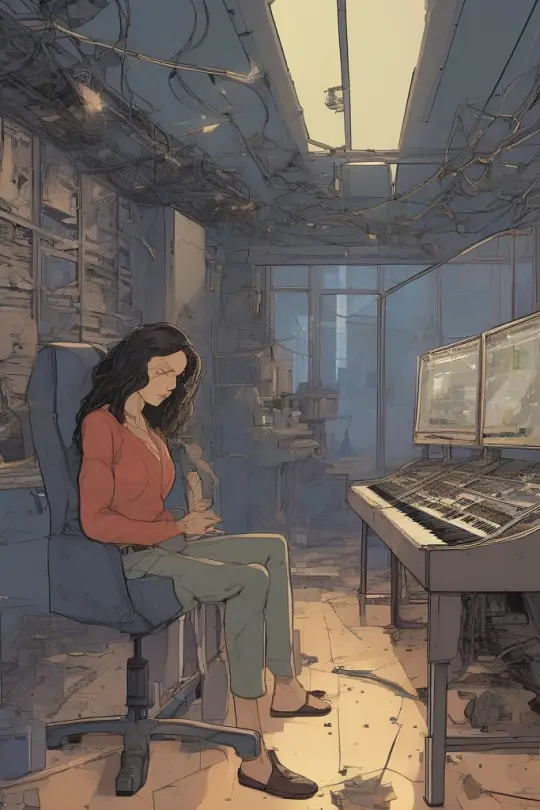
The Mnemonic Key
Join the conversation! Readers are sharing their thoughts:
About the Story
In a near-future port city, a memory locksmith named Nadia unravels a fragmented lullaby that leads to corporate hoarding of public songs. Armed with a crafted harmonic needle and a small ally, she pieces together lost fragments, confronts corporate control, and builds a public seam for remembering.
Chapters
Related Stories
Tethers and Tall Tales
On festival night, aerial rigger Elias Corben tests the rigging he rebuilt to stitch rival balconies together. Under blinked lights, bathtub tuba music, and a ridiculous knitted shawl, sabotage surfaces and a gust threatens the span. Elias must climb, splice, and improvise—using professional skill, neighbors' help, and an absurd raccoon chorus—to save the crossing and, perhaps, find a place among the people he’s held at arm’s length.
Song of the Spire
A returning soundwright confronts a civic instrument that altered nights and memories. In a fogged town of quiet faces and a tall listening column, an unearthed recording sets a choice between restoring comfort, exposing truth, or building consent into a tool that once decided what people could remember.
Seams Between Us
Etta, a practical tailor in a small coastal town, leads the community in replacing a tidy but fragile festival banner with a visible, communal mending cloth. As people stitch their patches and bring small absurdities—the Buttons' Club, a tape-stealing goose—the final seam is set by Etta's skilled hands during a tense public ritual, transforming private repairs into a shared emblem.
Between Tides
A returning clocksmith finds a coastal town whose municipal wheel stores painful days in crystal. As old notebooks surface and citizens split between secrecy, rupture, and technical repair, the protagonist must help decide whether to sacrifice a memory, shatter the archive, or rewire the system. The mood is taut, salt‑stung, and full of small human reckonings.
The Echo Pearl of Brinebridge
In a small harbor town, a brave baker’s helper discovers an underwater library kept by turtles, rays, and a shy octopus. When a museum barge threatens to dredge the bay, the child seeks aid from a kindly engineer and a glowing robot crab, earning the Echo Pearl and rallying community to protect the stories of the sea.
The Hum of Auralis
In Auralis the Spire's low hum binds the city's memories. When a corporation begins harvesting those threads, a twenty-four-year-old courier and audio archivist traces the theft, learns a costly method to restore the hum, and chooses between a private past and a city's future.
Other Stories by Claudine Vaury
- The Walls Lean In
- A Measure of Timber and Sky
- Hands on the Cables
- Between Stops
- Fractured Hours
- Aether Gauge
- Cadence of Brass
- Mornings on Willow Road
- The Loom of Falling Stars
- Lanterns at Low Tide
- Spring at San Miguel Wells
- Fragments of Axiom
- The Toleration Bell of Clatterby
- Windwright of Broken Tethers
- The Recorder's House
Ratings
I had high hopes from the opening image, but the story didn't quite follow through for me. The workshop details and Nadia's habits are lovely — counting silver stars, Mer & Mend's unpretentious sign, the lullaby tucked beneath the bench — yet the larger conflict (corporate hoarding of public songs) feels underexplored. The leap from a private fragment to systemic corporate control is interesting on paper, but in execution it comes across as a bit predictable: a crafted harmonic needle, a confrontation, then a 'public seam' to fix things. I wanted more interrogation of how corporations actually enforce memory hoarding and what that means legally, economically, or emotionally for citizens beyond a few evocative images. Pacing also stumbles a little; scenes that set tone are given room to breathe, while the supposed showdown and its consequences get abbreviated. If you care more about mood and atmosphere than structural depth, this will work. For me, it needed sharper stakes and fewer neat resolutions.
Okay, so I didn't expect to get emotional about a soldering iron, but here we are. 😂 Nadia, Min, and Ivo make a delightful trio — their small routines (Min’s barefoot tray-winking, Ivo humming until she smiles) give weight to the bigger plot about corporate hoarding of songs. The crafted harmonic needle? Genius. The way the story turns a lullaby fragment into both a personal ache and a political weapon is quietly clever. I loved the city details too: rain turning streets to faint gold, the pegboard like ceremonial knives — very cool imagery. If I complain at all, it's only that I wanted more scenes of Nadia actually threading the public seam — but maybe that's because I want to keep living in this world. A witty, warm, slightly melancholic piece that sticks in your head like a tune.
A short, sharp joy. The prose is precise — ‘hands stained the color of burned copper’ is a line I keep thinking about — and the small shop details make Nadia feel lived-in immediately. The lullaby fragment under the bench is a brilliant hinge: such a domestic, secret object becomes an engine for the wider political stakes about who owns public songs. I liked the rhythm of the scenes (ironic, given the theme): little domestic beats leading to a larger, public seam. If you like character-driven SF with a musical heart, this will stick.
As an interactive fiction fan I appreciated both the conceptual leap and the craft. The setting — a near-future port city with mnemonic arrays and corporate hoarding of songs — is concise yet rich enough to let players imagine branching outcomes. Specific moments stood out: counting silver stars spat from the soldering iron, the Mer & Mend sign as a small emblem of honest labor, and the municipal archivist who arrives without explanation. Mechanically, the harmonic needle as a tool feels like fertile interactive fodder: you can picture choices about which fragments to stitch back into public memory and what social cost that entails. The writing is economical but evocative; sensory details (cedar, ozone, rain-washed gold) do a lot of worldbuilding on a budget. My one wish is for a few more playable consequences tied to the corporate confrontation — but even as a story it succeeds: it explores power, nostalgia, and how music anchors communities. Solid, smart, and emotionally resonant.
I loved this. Nadia keeping time with a soldering iron — that first image hooked me so hard — and the way the workshop smells of cedar dust and bitter coffee made the whole city feel alive. The characters are quietly unforgettable: Min's barefoot comet energy, old Ivo humming off-key, and the municipal archivist's crooked hand are tiny, perfect details that reveal a whole world. The idea of a crafted harmonic needle and a lullaby fragment as a key to public memory is genuinely beautiful, and the prose balances warmth with a metallic, near-future edge. I teared up at the scene where Nadia opens the small locked box beneath the bench — the way memory is treated as fragile and salvageable felt hopeful. The ending's hint about sewing a public seam for remembering left me smiling and wanting more interactive paths. This feels like a love letter to memory and music. Highly recommended.