
The Walls Lean In
Join the conversation! Readers are sharing their thoughts:
About the Story
An overnight emergency at a misbehaving apartment block forces structural engineer Elias Hart into the building’s mechanical belly to shore failing jacks and reseat a shattered shear key. Against a soundtrack of chestnut smoke, muzak, and neighborhood absurdities, he must rely on craft and muscle to stop rooms from folding in on their residents.
Chapters
Story Insight
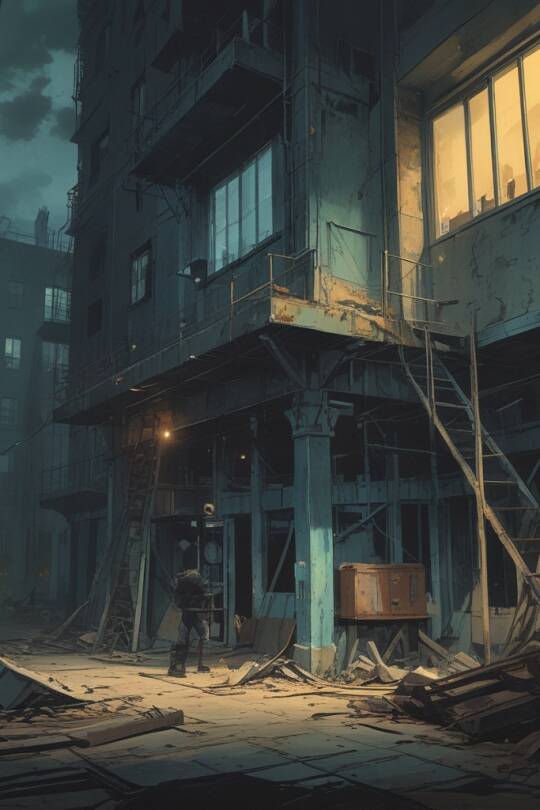
The Walls Lean In unfolds in a city apartment block that begins to rearrange itself—not through ghosts or grand metaphors but by the slow, uncanny agency of rusted hydraulics, tensioned cables and a neglected maintenance spine. Elias Hart, a pragmatic structural engineer, is called in during a rain-softened night to assess a sagging lintel and finds hallways that lengthen, stair flights that tuck like folded paper, and doors opening onto rooms that have shifted their furniture without explanation. The story lives in tactile detail: the warm scent of chestnuts from a street vendor rising through a service shaft, an indoor lamppost that has somehow become part of a living room set, a corkboard where Tenant of the Month stickers list the same name three times, and a radiator that receives biscuits like a grateful pet. Those domestic oddities—elevator muzak offering life-insurance jingles, a pigeon that seems to supervise a gearbox—are not throwaway jokes but part of the atmosphere, small human gestures that balance the claustrophobic mechanical peril with moments of absurd, humane comedy. Where many horrors rely on revelation, this narrative makes its central conflict physical and procedural: the building’s movements create immediate, calculable danger, and the only answer is skilled, hands-on intervention. The bulk of the story is devoted to mapping the building’s rhythm, tracing the mechanics in a maintenance corridor, and assembling improvised shoring and manual rigging. Elias’s work is described with an engineer’s intimacy—wrenches, shims, chain hoists, block-and-tackle, and the slow diplomacy of a crank against a seized worm drive. He is not a mythic savior but a craftsman whose knowledge and steady hands become the instrument of rescue; the climax depends on a risky, technical operation that uses the protagonist’s professional skill rather than a supernatural revelation. Supporting characters—Nora the comedian and dog-walker, Frank the sentimental handyman, Jun the paramedic and Sima the photographer—bring warmth and practical help, trading jokes and biscuits even as they tie off ratchet straps and drive wedges into fragile seams. Their interactions are written to show how community, improvisation and humor are as necessary as technical competence when a place turns hostile. Thematically, the story examines how architecture can shape human fate and how professional responsibility feels when the stakes are bodily and immediate. Its emotional arc moves from fear to a curious attentiveness: the terror of unpredictability gives way to a focused appetite to understand and act. The prose favors sensory immediacy—metal that sings under stress, the smell of oil and lemon cleaner, the tactile satisfaction of a properly seated wedge—and pairs it with small, absurd touches that keep the narrative humane. Structurally compact and deliberately paced across four chapters, the tale will appeal to readers who appreciate grounded, mechanical suspense, hands-on problem-solving, and horror that is felt through pressure and leverage rather than abstract dread. It’s an intimate, carefully researched piece that treats tools and technique with respect while never losing sight of the people whose daily lives are reshaped by a building that will not stay still.
Related Stories
Registry of Absences
Months after crisis, Mara lives as the town’s living registry—tending trays, speaking names, and keeping a fragile civic balance. The municipal reforms have steadied public record, but small erasures persist; Mara’s own private memories have thinned. The final chapter follows her vigil as the town adapts to a new, uneasy normal.
The Ninth Toll
Ava discovers her father’s note demanding a sacrifice to stop a bell that erases people. Confronting the stitched book’s rules, she chooses to answer so her daughter will remember. The town steadies as absences halt, while one witness keeps a stubborn, private memory alive.
The Salt Choir
A young sound archivist travels to a near-arctic island to catalog reels in an abandoned listening post, only to find voices that know her name. With a ferryman’s bone tuning fork and a caretaker’s notes, she faces a cistern that learned to speak—and must make it forget her.
Where the Walls Keep Watch
A conservator returns to her family home when her brother vanishes into a place that rearranges memories into living rooms. As she maps the house and trades pieces of her past to retrieve him, bargains escalate and the cost becomes interior: a lost room in her own mind that changes everything she thought she knew.
The Loom That Listens
A 24-year-old field recordist hears a low tone seeping into all her sounds. When a friend vanishes inside a derelict flax mill, she enters the humming factory armed with a tuning fork and a homemade oscillator. In a city that remembers voices, she must refuse her own to survive.
Counterweight - Chapter 1
A mechanic named Rowan rigs a desperate mechanical trap to stop a predatory presence that haunts his apartment building’s elevator. The tone is tactile and urban: rain-slick streets, dumpling vendors, rooftop succulents, a silly ferret and a dummy called Mr. Buttons. Rowan must use his trade, hands-on skill, and the neighborhood’s odd domestic rituals to confine the thing in the counterweight housing before it can take more lives.
Other Stories by Claudine Vaury
- A Measure of Timber and Sky
- Hands on the Cables
- Between Stops
- Fractured Hours
- Aether Gauge
- Cadence of Brass
- Mornings on Willow Road
- The Loom of Falling Stars
- The Mnemonic Key
- Lanterns at Low Tide
- Spring at San Miguel Wells
- Fragments of Axiom
- The Toleration Bell of Clatterby
- Windwright of Broken Tethers
- The Recorder's House
Frequently Asked Questions about The Walls Lean In
What is the central premise of The Walls Lean In and who drives its conflict ?
An aging apartment block's neglected mechanical spine begins to reconfigure hallways and stairs. The conflict is physical: residents' survival versus moving structure, driven by structural engineer Elias Hart.
How realistic is the mechanical threat in the story and does it rely on supernatural elements ?
The hazard is mechanical and plausible: corroded jacks, tension cables and seized hardware. The menace comes from neglected engineering, not ghosts, so tension is grounded in physical risk.
Who is Elias Hart and how do his professional skills shape the climax ?
Elias Hart is a pragmatic structural engineer. His expertise in shoring, torqueing, load paths and manual rigging enables a hands-on intervention that resolves the crisis through skillful action.
What kind of tone does the story use—pure horror, dark humor, or a mix ?
The narrative blends claustrophobic, tactile horror with dry, absurd humor. Domestic oddities and neighborly banter offset fear, keeping characters human amid mechanical danger.
Are the supporting characters important and how do they contribute to the rescue efforts ?
Yes. Nora, Frank, Jun and Sima supply practical help, morale and coordination—improvised bracing, tool handling, first aid and documentation—making the communal response believable.
Will the ending resolve the building’s problems permanently or focus on a temporary fix ?
The climax delivers a practical, provisional stabilization: braces and re-seated components stop immediate danger. It’s effective and technical, pointing toward necessary professional repairs later.
Ratings
Too many quaint little details slow the opening until the real danger feels both telegraphed and undercooked. I loved the image of chipped teacups on the wall and Elias's gratitude list of tools — they give the building personality — but the story leans so hard on those small-town urban-horror signifiers (chestnut smoke, muzak, a man who pets a furnace) that the plot beats become painfully predictable. You can see the “practical hero fixes things” ending from a mile off. Pacing is the bigger issue: the excerpt luxuriates in vignettes — the TENANT OF THE MONTH flyer, the heater biscuit gag — and then hints at mechanical mayhem (shattered shear key, failing jacks) that should feel brutal and urgent. Instead, the technical crisis reads like someone checked off engineering terms without making the danger visceral. There are also a few logic gaps: how did the shear key shatter without earlier warning signs, and why are the residents so blasé about rooms folding in? Those reactions undercut the stakes. If you tighten the middle, let the mechanical suspense be messier and less neat, and give the residents sharper, more fearful responses, the premise could really land. As it stands, it's atmospheric but disappointingly safe 🙄