
Skysplice
Join the conversation! Readers are sharing their thoughts:
About the Story
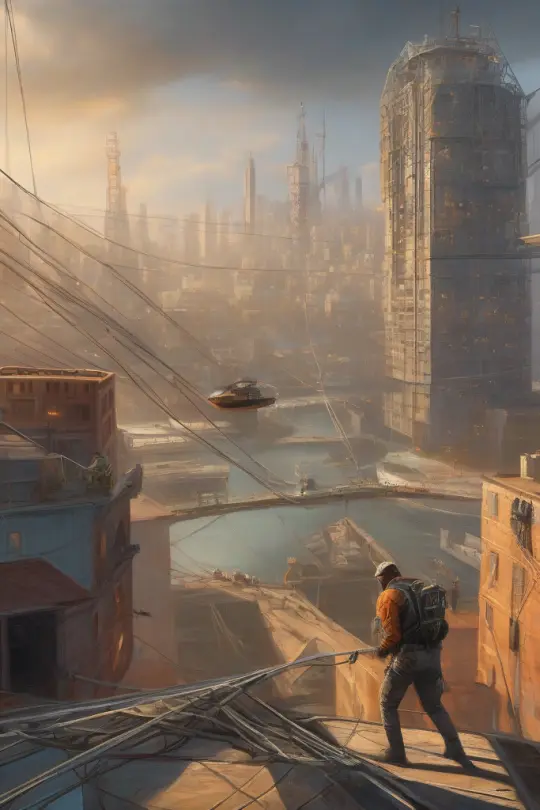
In a tiered city of cables and cabins, veteran rigger Rowan Keel races to secure a failing Midline span. Wind, rivalry and a jarring improvised splice force him into a dangerous crossing, a scuffle for the rescue clamp, and a final, hands‑on decision that stitches a community back together.
Chapters
Story Insight
Skysplice drops into a city built vertically: tiers of neighborhoods stitched together by cables, winches and glass cabins that cross a sky more often than streets. At its center stands Rowan Keel, a veteran highline rigger and elevator mechanic whose job is literal and symbolic—holding lives together with splice clamps, belay lines and muscle memory. The novel stages a compact, high‑velocity rescue when a critical section of the Midline goes unstable during a violent wind surge. That event sets a practical, tactile problem in motion and draws a handful of neighbors into an urgent scramble for tools, technique and moral clarity. The plot pivots on real, hands‑on action—suspended traverses, torque sequences, a scuffle on top of a swaying cabin—and the physics of cables and counterweights is as much a plot engine as personal history. The story places craft and place at the foreground. Details of rigging practice—temporary clamps, saddle seats, controlled hauls and the small rituals that keep an old winch honest—are rendered with craft knowledge that rewards readers who appreciate practical realism in action. At the same time, the vertical layout of the city functions as a persistent theme: living above or below someone alters obligation, proximity and the ways people choose to help. Human textures are everywhere—the smell of fried frond‑bread from a market stall, a slack carnival kite that becomes an absurd hazard, a neighbor’s thermos of kelp‑soup passed along as if it were equipment. Humor softens the tension through a literal‑minded maintenance drone (Patch), a squawking balcony parrot, and small domestic absurdities that puncture fear and build community credibility. Skysplice balances immediate adrenaline with an emotional throughline. Professionals argue over method and pride, neighbors improvise solutions, and a young, impulsive rigger’s desire to perform collides with the patient expertise Rowan brings. The story is tightly structured: the initial emergency compels a practical response, escalation introduces interpersonal friction and hazards, and a culminating physical moment forces a concrete moral choice—an act of labor that doubles as atonement. The writing emphasizes sensory immediacy and mechanical choreography, so sequences feel visceral rather than schematic. Readers who gravitate toward action grounded in tradecraft, stories where social texture is shaped by architecture, and scenes that mix tense rescue work with genuine, often wry human moments will find much to engage them. Skysplice is not an abstract meditation; it is a hands‑on drama about risk, repair and the meanings of being the person who climbs out onto the exposed cable when everyone else looks for shade.
Related Stories
Faultline Run
A burned identity, a halted network, and a city waiting for the consequences. Cole Vance triggers a hardware shutdown on a corporate-controlled platform to stop a synchronized activation that would seize urban infrastructure. The act saves lives but destroys the cryptographic proof that could clear his name; regulators and leaks press Aegis into scrutiny even as personal cost forces him off the map.
Tidebound
In the flooded tiers of Brinegate, scavenger Rynn Kade fights to rescue her brother from a syndicate that weaponizes the city's tide-control lattice. With a mismatched crew, an old engineer's gift, and a temper for justice, Rynn must expose the private lever that decides who survives the storm.
Obsidian Run
A tense, rain-soaked assault on a fortified industrial stronghold culminates in a fight to free a captive and stop a device that can rewrite the city's records. Anya must break into the Foundry, confront a corporate architect of control, and choose how to handle the weapon she once helped build.
Holding the Line
Kade Reyes, a seasoned rigger, must physically stop a series of coordinated sabotages at a city's parade. As anchors fail and a central truss threatens the crowd, Kade uses hands-on splicing and improvisation to reroute loads under extreme pressure. The climax resolves through his professional action amid odd, human moments—and the aftermath reshapes how his community cares for spectacle.
Tetherfall
In a flooded neon city tethered to an ancient orbital Spine, salvage-runner Cass Calder finds a stolen shard of the Spire. Hunted by corporate enforcer Marla Voss, Cass must gather a ragged crew, learn to wield a strange device, and protect a secret that could remake the city. An action-driven tale of risk, loyalty, and hard choices.
Steelwake Protocol
A high-octane urban thriller set in a drowned megacity where a salvage diver, a hacker, and a patchwork crew steal back a life-saving regulator from corporate hands. They expose a secret ledger that privatizes air, triggering public fury, legal battles, and a fragile civic victory.
Other Stories by Marcel Trevin
Frequently Asked Questions about Skysplice
What inspired the vertical city setting and cable‑based Midline in Skysplice ?
The vertical city is a metaphor for how physical space shapes relationships. It also provides kinetic action: suspended spans, cabins and rigging create constant mechanical stakes for Rowan and his rescue.
Who is Rowan Keel and what makes him a compelling protagonist in Skysplice ?
Rowan Keel is a veteran highline rigger/elevator mechanic whose skill and past absence drive the plot. His craftsmanship, guarded humor and moral choices anchor both the action and emotional arc.
How realistic are the rigging and splice procedures depicted in Skysplice ?
The scenes emphasize tactile, plausible methods—temporary clamps, tension testing and manual hauls—rather than technical manuals. They’re grounded in practical tradecraft to heighten credibility.
What role does the community play in the rescue and theme of Skysplice ?
The community is integral: neighbors supply tools, manpower and domestic details. The rescue hinges on collective effort, showing how infrastructure and social bonds are interdependent.
Is Skysplice primarily about action sequences or character development ?
Skysplice balances both. High‑stakes action drives the plot, but the physical rescue is also a vehicle for Rowan’s emotional shift from isolation to connection and teaching others.
How does humor and absurdity feature in an otherwise tense rescue story like Skysplice ?
Light absurdity—Patch the literal drone, a kite snag, a parrot reciting drills—breaks tension and humanizes the crisis. These moments underscore the neighborhood’s personality amid danger.
Ratings
I wanted to like Skysplice more than I did. The premise is solid — a rigger racing to fix a failing span in a vertical city — and some imagery is memorable (the Midline as a taut red thread). But a few things held it back for me. First, predictability: the improvised splice leading to a dangerous crossing, the scuffle for the clamp, and the final hands-on stitch are tidy beats I've seen before. They are well-written, but you can see them coming a mile away. Pacing also felt uneven; the middle sagged where the narrative indulged in atmosphere at the expense of urgency, then rushed the scuffle and aftermath so the resolution landed a bit flat. A small nit: Patch the drone's chirpy voice was cute but sometimes undercut tension instead of adding texture. If you love character-driven technical action, you might enjoy it; I was left wanting sharper surprises and a bit more risk-taking in plot and structure.
I adored the way Skysplice treats its setting as a character. The vertical city — cables and cabins, tense spans and market stalls dangling over empty air — is rendered with such touchstone details that you feel the wind on your face as Rowan climbs. The opening stanza, where Rowan reads the Midline's hum "the way other people read weather," set the tone perfectly: this is a book about someone whose knowledge is embodied and earned. There are so many lovely beats: the vendor shouting offers of "stiff coffee, stiff rope," the Kite Carnival leftovers hanging like flags, Patch the maintenance drone attempting standup. These moments are small, human, and they offset the danger without undercutting it. The improvised splice sequence is tense and believable, and the scuffle for the rescue clamp is frantic — not because the scene is flashy but because of what it means: people depending on each other in a precarious place. Most of all, the ending is satisfying because it prioritizes craft and community over a tidy, cinematic rescue. Rowan's final choice — literally using his hands to stitch things back together — felt like a return to basics, and the book's quiet moral is that skills and care can mend what bureaucracy and neglect fray. I finished feeling warmed and impressed. Would love more stories set in this world.
Skysplice balances suspense and craft with admirable restraint. The pacing never drags; even small worldbuilding moments (wind‑kites, the noodle vendor) serve the scene rather than stall it. The dangerous crossing feels immediate — you can sense the hum of the cable and the give of a bad splice — and the final hands‑on decision is unexpected in its intimacy. I appreciated that the rescue isn't about spectacle but about workmanship and responsibility. Tight, focused, and quietly moving.
This was such a fun ride — gritty, hands-on, and low-key poetic. Rowan is grumpy in the best way, and the vendor with the frond-breads is a perfect bit of local color (I want that fish paste now 😂). The scuffle for the rescue clamp had me picturing a slapstick but high-stakes tug-of-war; it’s tense but also oddly charming. My favorite line: the Midline "sat like a red thread pulled taut across the city’s chest." That imagery kept coming back to me through the whole piece. The ending — that final, literal stitch to bind the community — felt warm without being sentimental. Short, sharp, and a little salty. Great action, great heart.
As someone who loves technical realism in action fiction, Skysplice delivered in spades. The author gets the mechanical language right — the descriptions of tension, winch grinding, and a half-measure splice that "invited trouble" felt authentic and grounded. Rowan's toolkit (prusik loops, heavy‑ringed splice, belay carabiners, a clamp the size of a small dog) is convincing and the way those tools define his movements makes the rescue sequences visceral. The mid-story improvisation is handled well: you can tell exactly why the splice is failing and why Rowan's decision to cross is the least bad option. The scuffle for the rescue clamp was staged logically, with stakes that escalate naturally rather than through contrived danger. Worldbuilding is economical but effective — a drone like Patch adds a light touch of civic technology, and the kite imagery ties cultural detail to the physical environment. Tight, smart, and satisfying for readers who like their action rooted in craft.
Skysplice hooked me from the first line. The Midline as a "red thread" is such a perfect piece of imagery — immediate and tactile — and Rowan Keel is exactly the kind of weathered, sure-handed protagonist I wanted to follow across the rooftops. I loved small moments: the noodle vendor offering "stiff coffee, stiff rope," the grinning whale kite, and Patch the maintenance drone chirping like a civic court jester. Those details make the vertical city feel lived-in. The action sequences are tense without being gratuitous. The improvised splice and the desperate scramble for the rescue clamp had my heart pounding, but it was the quiet, hands-on decision at the end that really landed — that moment when Rowan literally stitches the community back together felt earned and human. Craftsmanship as moral center? Yes please. This is atmospheric, skillful action that values people and place. I devoured it and wanted more of this world.