
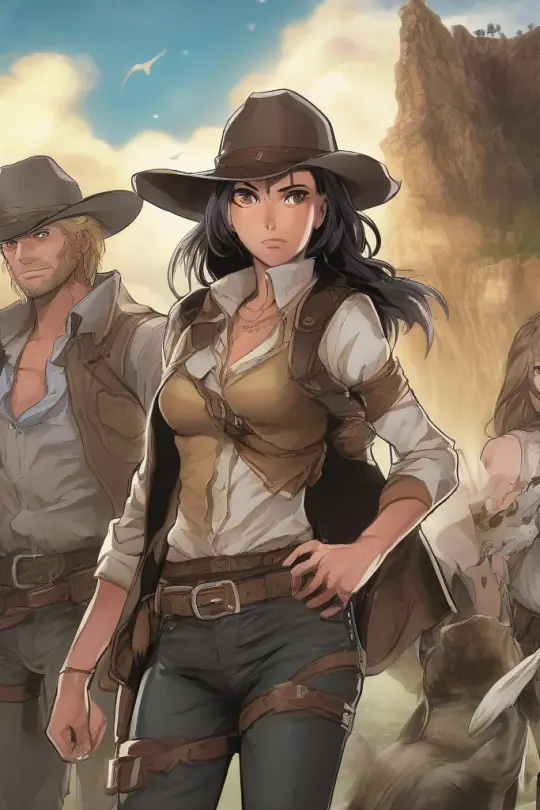
Cedar Crossing
Join the conversation! Readers are sharing their thoughts:
About the Story
Eve returns to protect her family's land from a predatory rancher. The third chapter runs the gauntlet of a daring rescue and a public confrontation at a river crossing, where receipts and witnesses collide with hired muscle. The town's coming together forces a reckoning beneath a wide western sky.
Chapters
Story Insight
Eve Crowe returns to Cedar Crossing to bury her mother and finds the life she knew traded away on a sheet of stamped paper. As an ex-deputy she recognizes the shape of wrongdoing beneath the county seal: forged conveyances, altered clerk’s entries, and a ledger of payments that point to a single, well-funded aggressor. The town is small, its economy tethered to a narrow slice of river and a handful of fields, and when a powerful rancher begins to buy influence with envelopes of cash and hired muscle, the fragile order tilts. The story opens in domestic detail—the cedar chest, the well, the singed siding from a burned shed—then turns those intimate images into the stakes of a larger conflict: water rights, family legacy, and what happens when law becomes a weapon for the wealthy. This is a Western that blends procedural patience with the harsh immediacy of the frontier. The plot is structured as tight movements: an evidentiary search through county records, the slow assembling of neighbors into a reluctant coalition, and a climactic confrontation staged at the river crossing where legal proof and human testimony collide with threats and violence. The narrative pays attention to how paperwork functions as power—receipts, marginal erasures, notarized stamps—and how small acts of courage accumulate into civic force. The tone is steady and tense rather than breathless; moments of quiet grief alternate with tactical reconnaissance and a daring rescue that forces a public reckoning. The moral texture resists easy closure, examining the costs of defending what belongs to a community without becoming the sort of force it opposes. What this story offers is an immersive, weathered portrait of frontier justice: clear-eyed about the practical mechanics of law and the corrosive influence of money, and watchful of the emotional work required to rebuild trust. The characters move with believable limits—an ex-deputy who still knows how to handle a gun but leans on evidence and alliances; neighbors who weigh risk against survival; a sister whose safety becomes the irreplaceable hinge of action. Atmospherically, the prose favors tactile detail—the scrape of wagon wheels, the iron tang of old receipts, the dark ribbon of river at sundown—and a moral seriousness that prizes restraint and public accountability over private vendetta. For readers who appreciate a Western grounded in community, legal nuance, and the slow accumulation of courage, this is a deliberate, satisfying ride: taut where it needs to be, humane where it matters, and concerned with how ordinary people reclaim a place against the pressures of wealth and intimidation.
Related Stories
Wires Across the Dust
A young telegraph operator in a dusty frontier town overhears a coded plot to rob a train and kidnap a boy. With a veteran cowboy, a clever tinkerer, and a quiet desert guide, she follows the wires into the hills. In the standoff that follows, courage and wit prove louder than any gunshot.
Crescent of Dry Creek
A western tale of Clara Hayes, a young blacksmith who defends her town when a ruthless land baron claims its water. With help from an old tinkerer and a tracker, she uses craft, courage, and cunning to expose a forgery, rescue her brother, and restore the town's honor.
The Iron Spring
A former marshal turned rancher guards a desert valley’s single spring as a predatory promoter and his hired muscle move to seize water rights. When forged filings, burned hay and a murderous escalation force the town into action, Jonah must use old skills and new alliances to expose corruption and save the community’s lifeline.
Dust & Ember
A young mechanic in frontier Calico Ridge uncovers a plot to drain the town's water. With a brass tuner, an old engineer, and stubborn neighbors she outwits a railroad magnate, restores the wells, and forges a future from gears, grit, and community.
A Wire Between Strangers
When a telegraph stitches Brier’s Crossing into the wider world, taciturn lineman Silas Hart prefers the company of wire. Sabotage and an approaching payroll coach force him to climb a pole in a storm and splice a makeshift relay. Odd inventions and small kindnesses shape the night.
Lanterns Over Bitterstone
In a drought-stricken frontier town, a young telegraph operator fights a railroad magnate who seizes water and severs the town's voice. Armed with a strange brass lamp and a stubborn band of neighbors, she must ride, signal, and outwit to restore what was taken and learn what it means to lead.
Other Stories by Nathan Arclay
Frequently Asked Questions about Cedar Crossing
What motivates Eve to return to Cedar Crossing and confront the land seizure by Silas Boone ?
Eve returns after her mother’s death to protect the family ranch and river diversion rights. As an ex-deputy she uses legal know-how and frontier resolve to expose forgery and rally neighbors.
Who is Silas Boone and how does he threaten the town ?
Silas Boone is a wealthy rancher and speculator who leverages forged conveyances, paid clerks, and hired hands to seize land. He cloaks coercion in paperwork while using intimidation to silence opposition.
How does the story blend legal strategy with frontier action ?
The narrative alternates careful evidence-gathering—records, receipts, witness testimony—and public exposure with stealth rescues and controlled skirmishes, favoring lawful reckoning over private vengeance.
What role do secondary characters like Mateo and Doc Reed play in the conflict ?
Mateo uncovers archival discrepancies and organizes the town; Doc Reed supplies historical knowledge, medical aid, and moral steadiness. They transform scattered fear into coordinated civic action.
What happens at the river crossing and why is it pivotal ?
The river crossing becomes a public forum where copied receipts and witness statements are unveiled while Lena’s rescue returns a human face to the claims. That exposure draws a marshal and breaks Silas’s grip.
What themes and atmosphere define Cedar Crossing ?
Cedar Crossing is a tense Western of dust, rivers, and hushes—exploring justice versus vengeance, community resilience, land rights, and the human cost of progress beneath a wide, uncompromising sky.
Ratings
Nice writing but predictable. The town’s picturesque details — split-rail fence, church bell, pies on the table — are pleasant, and Eve/Lena have chemistry. But the river confrontation reads like a checklist: receipts? check. Hired muscle? check. Spectators turn hero? check. I kept waiting for a twist or moral grayness, and it never arrived. Feels like a comfort-food western rather than something that challenges the genre.
I wanted to love Cedar Crossing, and there are moments that almost get there — the imagery of the town, the stagecoach arrival, and some of the domestic details are nicely rendered. But the third chapter leaned too hard on familiar western beats. The wake-to-showdown progression felt rushed; one moment we’re in a quiet kitchen smelling lemon jars, the next we’re banking on an improbable public rescue because receipts happen to surface. It strains credibility that so many witnesses conveniently appear and that the hired muscle behave like stock villains without motive beyond bluster. Pacing is another issue. The chapter spends time on atmosphere but then moves into action with a thunk rather than an organic escalation. Characters like Lena and the old watchful man are sketched well, but they’re not fleshed out enough to make the climactic choices fully convincing. For readers who like straightforward frontier justice, this will probably satisfy; for anyone looking for deeper complexity or surprises, it’s a bit predictable.
Short and sweet: I loved it. Eve’s return, the hush of the wake, and that gasp-out-loud river rescue — all done so well. The receipts-as-proof bit was clever, and the community’s stand against the rancher gave me chills. Felt cinematic, emotional, and very satisfying. 👍🌾
There’s a kind of quiet ferocity in Cedar Crossing that I haven’t felt since reading old westerns under my grandmother’s lamp. The third chapter reads like a slice of lived-in world-building, where a split-rail fence and a bell-tolling church tell you as much about the town as any exposition could. Eve’s arrival from the stagecoach is beautifully done—she’s changed, the town hasn’t, and that tension hums beneath every scene. The wake in Mrs. Crowe’s kitchen is the chapter’s heart: neighbors arriving with pies and condolences, hands that rest and then leave their weight; those little actions reveal more than speeches ever could. The pivot to the river crossing is cinematic — receipts shredding the rancher’s lies, witnesses stepping forward, hired hands clashing with regular folk who’ve had enough. Lena’s practicality is a balm and a weapon; her interaction with Eve is layered with childhood memory and present fear. I especially loved how the town itself becomes a force of reckoning. This isn’t just Eve’s fight; it’s communal. The author writes atmosphere and character with equal care, and the rescue scene earned every beat because it grew organically out of the relationships established earlier. If the rest of the book keeps this balance of lyricism and grit, Cedar Crossing will be one of those rare westerns that feels both timeless and immediate.
Okay, so I wasn’t expecting to cheer at a riverbank, but here we are. Cedar Crossing’s third chapter goes from funeral hush to full-on western showdown faster than a stagecoach outta town. Eve’s return, Lena’s no-nonsense greeting, and that little detail of Mrs. Crowe’s lemon-scented jars—chef’s kiss. The hired muscle are predictably awful, but the way the townsfolk line up to back Eve? Classic and satisfying. If you like your justice with a side of dusty sidewalks and likable grit, this delivers. Also, love that receipts play a part—proof over pomposity. Would read again.
Quietly powerful. The third chapter of Cedar Crossing nails the contrast between small-town ritual and sudden violence. I loved the opening—Eve’s dusty coat, the split-rail fence—and the way the wake scene slows everything down before the river chaos. The confrontation at the crossing, with receipts as proof and the town as witness, felt very satisfying. Characters are drawn with minimal strokes but vivid effect. Short, sharp, and emotionally true.
As someone who reads a lot of frontier fiction, I appreciated how Cedar Crossing balances intimate family grief with a larger fight over land rights. The third chapter is where the author’s strengths come together: the slow build of atmosphere on Main Street, Mrs. Crowe’s measured wake, and then the sudden escalation at the river crossing. The sequence where receipts and witnesses collide with hired muscle is especially crisp — the detail of paper fluttering in the current while fists and shouts break out felt both cinematic and believable. What I liked most was the community as a character. The blacksmith’s steady hammer, the old man chewing straw by the post office, even the church bell — they all contribute to the sense that this town has its own moral gravity. Eve and Lena’s reunion, with so much left unsaid, anchors the emotional core, and the rescue is convincing because it grows logically from their relationships. If I have a quibble, the final reckoning leans a touch into righteous melodrama, but that’s almost inevitable in a story about frontier justice. Overall, a tight, well-observed chapter that makes me want to read on to see how the land fight resolves.
I finished the third chapter of Cedar Crossing with a lump in my throat. Eve stepping off the stagecoach—dust on her cuffs, that ache of coming home—felt like stepping back into someone I know. The wake scene in Mrs. Crowe's kitchen is written with such small, honest details (folded aprons, lemon-scented jars) that I could almost hear the pastor’s words sliding off Eve. Then the river crossing — receipts flying, witnesses shouting, the hired muscle closing in — had my heart racing. The daring rescue felt earned because the town’s earlier, quieter moments show why people would risk everything. Lena’s tense, practical ways and the way the community pulls together under that wide western sky gave the climax real weight. Poignant, well-paced, and full of character. A real keeper.