
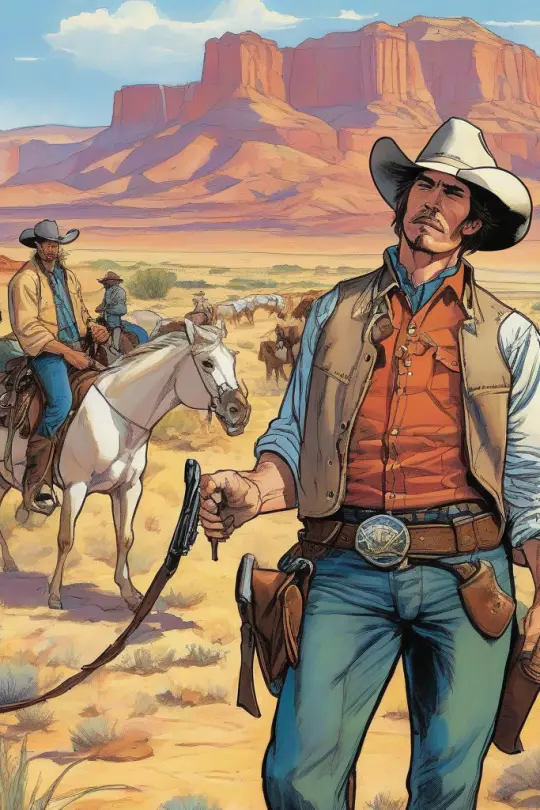
The Iron Spring
Join the conversation! Readers are sharing their thoughts:
About the Story
A former marshal turned rancher guards a desert valley’s single spring as a predatory promoter and his hired muscle move to seize water rights. When forged filings, burned hay and a murderous escalation force the town into action, Jonah must use old skills and new alliances to expose corruption and save the community’s lifeline.
Chapters
Related Stories
Bend of Mercy
Under a dry, pitiless sun, Finn returns to Red Bend for his brother's burial and discovers the communal spring walled off by a powerful landowner. As law drags its slow steps and men with money press, Finn must choose between leaving his vow of violence behind or using force to hold a town together—an urgent, dust‑thick reckoning at the water’s edge.
Sundown Verdict
A young photographer rides into a thirsty New Mexico town and finds a land baron trying to own water itself. When her telegraphist brother vanishes, she follows a trail through quarries and ranch gates, using flash powder and nerve to expose forged deeds, free her kin, and help the townsfolk claim their spring.
Tracks of Copper Dust
A young courier in a dusty railroad town chases stolen payroll and medicine, uncovers a conspiracy tied to a powerful railroad magnate, and learns how courage, cleverness, and a small band of allies can turn a ledger into justice.
Harrow's Run
In a drought-struck frontier town, mechanic and telegraph operator June Harrow races east to reclaim a stolen pocket engine that can power a life-saving pump. With an itinerant engineer, a mechanical pony, and a ragged company, she must outwit a greedy mill owner and bind the town together.
The Ledger of Red Crag
In a dusty frontier town a young mechanic must fight a wealthy cattle baron's legal seizure of land and water. When the baron's men kidnap her apprentice, she gathers the town, a makeshift device, and courage to reclaim what they own. A Western of grit, craft, and community.
Red Mesa Ledger
Maeve Callahan, a widow and homesteader, faces a corporate land grab when a wealthy developer claims the valley's water. With her daughter's safety and the Red Mesa ledger at stake, she must marshal witnesses, steal back proof, and stand the town against hired guns to protect what her community has always relied on.
Other Stories by Xavier Moltren
Frequently Asked Questions about The Iron Spring
Who is Jonah Hale and what motivates him to defend Iron Spring ?
Jonah Hale is a former U.S. marshal turned rancher. Haunted by a past mistake, he’s driven by duty, guilt and a fierce commitment to protect his community’s only water source.
What is the central conflict in The Iron Spring and how does it escalate ?
The conflict pits a small valley community against a wealthy promoter who uses forged paperwork, bribery and hired guns to seize water rights, escalating from legal tricks to arson, murder and an armed stand.
How does the theme Law vs Justice manifest in the story ?
The plot tests institutions: forged filings and corrupt clerks force citizens to combine legal evidence with direct action, exploring when people must defend common good if laws are perverted.
How graphic are the violent scenes and how are they handled tonally ?
Violence is present and consequential but not gratuitous. Scenes focus on consequences, grief and moral cost, keeping tone somber and character-driven rather than sensational.
How historically grounded is the Western setting and its legal details ?
The setting captures frontier life, water scarcity, and municipal records culture realistically. Legal details use plausible concepts—forgery, bribery, affidavits—kept accessible and human-centered.
How is the story structured and what can readers expect from the nine chapters ?
Nine chapters follow rising stakes: discovery, investigation, intimidation, a midstory blow, a rescue, the public auction, a breach, the final stand and aftermath—blending procedural and emotional arcs.
Ratings
Elegant and spare. The author trusts the reader with small details — the folding of Jonah’s reputation, the rake by the barn door — and those domestic touches carry emotional weight when the threatened spring becomes the story’s fulcrum. The opening paragraph is a model of atmosphere: you can feel the dry blue ridges, hear the mare’s hooves. I appreciated how the tale kept the focus on community rather than turning the conflict into a lone-man redemption fantasy; Jonah’s use of allies and the town’s decided action made the climax satisfying. A quietly powerful Western with strong, readable prose.
Nicely written but frustrating on legal and plot mechanics. The forged filings driving much of the conflict felt like a contrivance rather than a carefully laid scheme — how exactly were the forgeries executed, and why didn’t the town seek more legal counsel sooner? Jonah exposing corruption by leaning on old marshal contacts reads as convenient; alliances form rapidly when the narrative needs them to. I also found the pacing uneven: lush, contemplative description in the opening gives way to a compressed resolution. That said, the prose is evocative (the spring imagery is lovely) and the moral core — defending a community’s lifeline — is compelling. It works as a character-driven Western but stumbles when attempting procedural plausibility.
This one hit me unexpectedly hard. I came for the guns and dust but stayed for the people. The scenes of the children down by the wash — Tom throwing stones at a tin can, the laughter — make the spring feel sacred, not just property. When the promoter’s men burn hay and try to claim the spring with forged filings, you feel the community’s breath catch. Jonah is a quiet hero; his restraint, the way he watches and waits, makes his moments of action meaningful. The revelation where he uses both his old marshal instincts and the trust he’s built with neighbors to expose corruption felt earned. There’s tenderness here alongside grit: that hat on the peg, the tea kettle humming, the image of the spring as a cold pinprick of life. I was smiling and tearing up in parts. A heartfelt, human Western.
Enjoyable enough if you don’t mind a Western checklist: ex-marshal, loyal horse, single spring, evil promoter, burned hay, crowd gathers for a showdown. It’s like the author ticked boxes off a genre bingo card. The reveal of forged filings was supposed to be clever, but felt obvious to anyone who’s read more than a handful of prairie tales. Still, the prose has moments — the mare’s hooves as a clock was neat — so it’s not a total loss. Could’ve used more surprises.
I wanted to love this more than I did. The setting and some passages are beautiful — the spring described as a "pinprick of water" and Jonah’s sensory relationship with the land are well done — but the plot often leans on familiar Western tropes to the point of predictability. The arc (marshal past, rancher present, villain threatens water, town rises) follows a template without surprising it. The burned hay and forged filings feel like convenient escalations to push the town into a showdown rather than arising organically from character decisions. Pacing drags in the middle; we spend a lot of time in reflective scenes and then get a hurried resolution. If you’re new to Westerns you’ll probably enjoy it, but long-time readers might find it a little by-the-numbers.
This story handles its central themes — law versus justice, community resilience, and redemption — with confidence. The promoter and his hired muscle are classic Western antagonists, but the narrative earns the conflict by layering in believable pressure points: forged filings that undermine legal recourse, an arson that threatens livelihoods, and a town pushed to the edge. Jonah’s arc, from taciturn ex-marshal to reluctant leader, is convincing because the author gives him room to observe and to act. My favorite scene is Jonah walking the fence and remembering his father’s hat: a small, almost silent moment that says more about duty than any speech. If you like your Westerns grounded and morally clear, this one will hit the mark.
Wow — this gave me everything I want in a Western and then some. The author writes with such care for small things: the tea kettle, the hat on the peg, the way Jonah keeps his pack saddle tight. Those are the details that make the later threats (burned hay, forged filings) land hard. Jonah’s history as a marshal haunts him in the right ways; he’s not a caricature of a retired lawman but a man learning to live with a smaller reputation and a bigger responsibility. I loved Tom — quick with stones, quick with heart — and the town’s slow-burn anger turning into action felt honest. The final confrontation, where Jonah combines old skills and new allies, was satisfying and emotional. Also, the imagery of the spring — cold, silver, stubborn — is gorgeous. Highly recommend for folks who want grit, heart, and a strong sense of place. 🙂
Short and effective. The prose is lean, the world tactile — horsehide, iron, the low places that remember moisture. Jonah is a character you want to root for from that first scene with the mare and the fence. The stakes (the spring) are clear and intimate, and when violence escalates the urgency feels real. A neat, heartfelt western.
A solid Western that balances atmosphere with plot urgency. The writing shines in descriptive moments — Jonah trailing his hand along the fence, the spring as the valley’s heart — but the book also moves when it needs to: forged filings, burned hay, the hired muscle turning up the heat. I appreciated how the story frames water rights as both legal and moral conflict; the promoter isn’t just greedy, he’s systemic. The town’s collective action is believable because of the slow accumulation of small details (the hat, the mare, Tom’s quick habit of throwing stones). My only minor gripe is that the antagonist’s motivations could use a touch more nuance, but the showdown and Jonah’s use of both badge-work and neighbor-trust make for a satisfying finish.
I loved the quiet, patient opening — "the valley opened to Jonah Hale like a hand he had learned to read by touch" is the kind of line that stays with you. The author does a beautiful job of making the landscape a character: the spring flashing like silver, the mare’s careful steps, the tea kettle on the stoop. Jonah’s transition from marshal to rancher feels earned; you can feel the weight of his past in the small objects he notices (the hat on the peg, the rake). The community scenes — especially the boys by the wash and the children’s laughter — ground the stakes when the promoter’s corruption turns violent. I was especially moved by the way Jonah uses old skills and new alliances; the final expose of forged filings and the town’s decision to fight felt cathartic. A lyrical, humane western about justice, sacrifice and what it means to protect a community’s lifeline.