
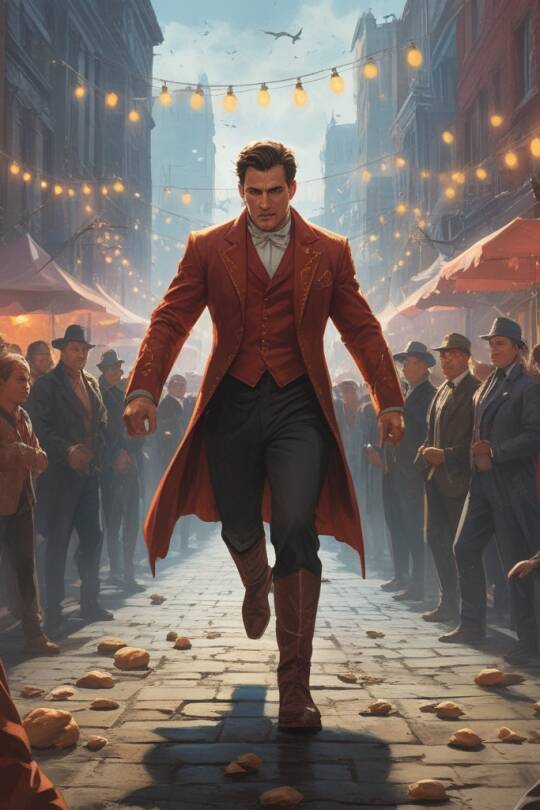
Smoke and Gears: The Final Performance
Join the conversation! Readers are sharing their thoughts:
About the Story
Under festival lights and the scent of fried dough, a veteran illusionist uses his rigging skills to stop a violent sabotage aimed at his signature spectacle. As the city watches a staged finale, Cass chooses to confront danger with mechanical mastery, risking everything to save the crowd and reconnect with his daughter.
Chapters
Story Insight
Cass Rook is a stage illusionist whose language has always been rope, counterweight and timing. When the city’s Founders Day festival becomes the scene of a deliberate sabotage, Cass has to turn the tricks he learned for applause into tools for survival. The narrative opens amid frying batter, paper kites shaped like cogwheels, and a small mechanical pigeon that honks confetti at the worst possible moments; it’s an action story rooted in a vivid, tactile world. Cass’s estranged daughter, Elena, works triage nearby and their terse, practical exchanges anchor the emotional stakes—this is a story about skill used to protect people rather than spectacle used to deceive them. The immediate mystery of who wants the main show to end in disaster propels the plot, but the tension is always physical and procedural: weakened brackets, severed pawls and synchronized triggers that must be countered with bolts, levers and perfectly timed muscle-work. Where many thrillers lean on conspiracy or revelation, this one makes craft the decisive force. Action scenes are built from believable stagecraft: climbing trusses while tightening a ratchet, sliding manual cams into place, jury-rigging emergency braces beneath a canopy of banners. Those technical beats are written with an attention to detail that feels lived-in—tools clink, grease smears palms, and the timing of a lever pull is as exacting as any shot on a clock face. The story’s voice mixes wry humor and absurdity (a proud automaton that insists on stealing a bun) with visceral set pieces: grapples on a swaying catwalk, a manual sequence inside a living machine, and small human rescues among spilled chairs and vendor cries. Emotion moves from guarded solitude toward repaired trust; the protagonist’s arc is practical and intimate rather than sentimental, and loyalty is earned through action and steady hands. This is a compact, lean three-part action tale for readers who appreciate kinetic, mechanics-first suspense and the texture of a real working world. It will appeal to anyone who enjoys fight choreography that depends on gear and leverage as much as on fists, and to those who value human relationships formed in crisis—an improvising apprentice, a stubborn daughter who does triage, and a motley crew that learns to rely on expertise. The payoff emphasizes earned competence: the critical moment is resolved by practiced procedure rather than an all-explaining twist. Throughout, the prose balances technical clarity with human warmth, so the pleasures are both intellectual (the cleverness of the fixes) and emotional (reconciling a life spent backstage). If you like action grounded in craft, with touches of dry humor and a world rich in smell and sound—salt air, fried dough, tinkling gears—this story offers a precise, satisfying blend of danger, wit and hands-on heroism.
Related Stories
Crosswire Protocol
Jaxon Hale and Kade Mercer mount a high-risk assault on Vale's Pulse Tower to sever the master relay of the Crosswire protocol and rescue Nadia Holt. Inside Vale's server vault they face Valkyrie-precision security, a public narrative engineered to frame Jaxon, and a desperate digital gambit that forces splintered choices. As Kade deploys a kill vector to isolate the master and Jaxon wrestles the relay loose, the building convulses with alarms and a fatal scramble for control.
Harbor-9: Tidebreak Run
In a storm‑lashed port megacity, parkour courier Jae Park stumbles onto a corporate plot to cripple the tidal gate and drown the Lower Harbor. With a retired mechanic, a sharp‑tongued drone pilot, and a magnetic grappling glove left by his missing diver sister, he races across cranes and skybridges to expose the scheme and fight through the Gate Spine.
Crossfire Protocol
A rain-slick city, a stolen Arc Core, and one man forced to choose: Rowan Vale must rescue his sister and stop a staged demonstration that could cripple the grid. Tension cuts through polished civic theater as sabotage and public spectacle collide in a tense, high-stakes assault where every second counts.
Nodefall
On a rooftop above a restless city, a former extraction specialist risks everything to free the living anchor of a corporate neural broadcast. With time counting down, a small, fractured team breaks into a fortified tower, forces a destabilizing misalignment into the network, and exposes damning evidence—buying a narrow rescue at steep cost.
Crimson Vector
A battered courier is pulled back into a lethal chase when a stolen prototype core and a kidnapped ally set off a high-stakes countdown. In a neon-industrial city, he must board an airborne command platform to stop a public demonstration that could reroute civic systems—buying time with sabotage, risking everything for a single live handshake.
Scarlet Protocol
A fast, tense cyber-action set in a near-future city. Mara Cade, a scarred former operative, is pulled back into a net of corporate power after a mysterious module links her past to a sweeping infrastructure takeover. As evidence is exposed and streets erupt, she must choose between personal ruin and stopping a silent seizure of the city's systems.
Other Stories by Nathan Arclay
Frequently Asked Questions about Smoke and Gears: The Final Performance
What is Smoke and Gears: The Final Performance about ?
A veteran illusionist, Cass Rook, must use his rigging, timing and mechanical know‑how to stop a coordinated sabotage at a city festival, saving crowds while facing personal stakes.
Who is Cass Rook and what specific skills does he bring to the conflict ?
Cass is a mid‑career stage engineer and illusionist, expert in rigging, cams, counterweights and emergency shoring. He improvises mechanical fixes under pressure and moves with practiced physical skill.
How does the story blend action scenes with believable stagecraft and mechanical detail ?
Action stems from real technical work: climbing trusses, re‑seating cams, jury‑rigging braces and timing lever sequences. These procedural beats create suspense and make solutions feel earned.
What role does the relationship between Cass and his daughter Elena play in the plot ?
Elena is a festival medic whose terse, practical presence raises emotional stakes. Their strained, work‑first interactions push Cass to choose protection over solitude and reconnect through action.
Is the climax resolved through skillful action rather than a late expositional twist ?
Yes. The finale hinges on Cass executing a manual sequence—precise cam resets, counterweight choreography and timing he alone knows—solving the threat through practiced expertise.
What tone and atmosphere should readers expect from the festival setting and the use of humor ?
A tactile, sensory festival world—fried dough, salt air, gear‑shaped kites—paired with dry, absurd touches like a confetti‑honking automaton. Humor punctures tension and becomes tactically useful.
Ratings
The sensory writing here is excellent — I could almost taste the fried dough and hear the harbor-breeze tugging at the paper kites shaped like cogwheels. The author clearly knows how to set a scene: the festival’s colors, the brass bread stalls, even the automaton Percival’s faint smell of brass polish are all vivid touches that make the world feel lived-in. Where the story falters is structural. The central sabotage plot arrives with little setup; motives, methods, and the antagonist’s presence are sketched thinly. That matters because the story asks us to root for Cass to risk everything. His mechanical ingenuity is convincingly described (the cams, counterweights, and the singing rope are highlights), but the leap from skilled artisan to near-miraculous problem-solver in the climax strains credibility. A few scenes hint at past failures or costs of his trade, but they’re not developed enough to make his sacrifice feel costly. The father-daughter dynamic is another missed opportunity. We get the emotional hook (Cass reconnects with his daughter), yet the timeline and emotional history between them remain vague; so the reunion reads as tidy closure rather than earned reconciliation. Minor plot holes — how the saboteur got past security, why the rigging was vulnerable in one specific way — also knocked me out of the moment. Still, I’d recommend this to readers who enjoy mechanical detail and atmospheric festival settings. With tighter plotting and deeper emotional beats, it could have been great rather than just good.
I wanted to like this more than I did. The premise — veteran illusionist uses rigging skills to stop a sabotage — has promise, but the execution often trips over obvious beats. The story loves its stagecraft vocabulary (which is cool) but then expects us to swallow a last-minute mechanical wizardry stunt that feels a bit too convenient. Yes, Cass can make a rope sing and convince sprockets to cooperate, but the sabotage’s logistics and the way he neutralizes it happen with more faith than explanation. Also: the daughter subplot — that big emotional hook — lands with a thud. One glance from the crowd, a wrench, and suddenly everything is forgiven? Maybe in a short action piece that’s allowed, but it still felt tacked on. Nice atmosphere, charming Percival moment, but ultimately predictable and a little sentimental for its own good. Meh. 😐
Short and honest: this story scratched the exact itch I came for. The imagery — lacquered copper streamers, gear-buns, and that oddly specific smell of rope and harbor — was tactile and fun. Cass’s mechanical competence is the real star: watching him reroute cams and lean on counterweights to stop the sabotage felt clever and believable. Percival is adorable and oddly heartbreaking in three paragraphs 😂. The finale’s tension is mostly effective (I was legit worried for the crowd), and the father-daughter angle gives the action stakes beyond spectacle. Nicely done — brisk, smart, and full of character.
I appreciated how the story foregrounds craft over spectacle. The author doesn’t just tell us Cass is good at rigging; they spend time showing the language of his work — sprockets and cams, damp hemp ropes singing under load. Those are concrete details that anchor the more cinematic beats: the staged finale, the sabotage, the risky counterweight maneuvers. Specific moments stuck with me: Percival waddling with a spool in its beak (a small, humanizing prop), the debate about spiced tea versus fried dough (lovely local color), and the pivot when Cass chooses to confront danger rather than hide. The scene where he improvises with trusses and safety cable to protect the crowd is constructed with believable mechanical logic — the best kind of action, because you feel the engineering behind it. My only quibble is that the daughter’s relationship felt a bit under-explored for an emotional centerpiece; we get strong hints but not quite enough backstory to make the reunion fully earned. Still, well-paced, admirable technical writing, and a satisfying marriage of stagecraft and heroism.
Smoke and Gears: The Final Performance landed right in my chest. The opening — dawn like “a tired performer,” the smell of fried dough and machine oil, the little boy flying cogwheel kites — immediately set the scene in a way that felt lived-in. Cass is the kind of protagonist who earns your quiet respect: the way he listens to a rope ‘sing’ and cajoles stuck pins free made me feel the craft in my bones. Percival the automaton is such a lovely touch — equal parts comic relief and poignant reminder of Cass’s life in bits and rivets. The finale had me holding my breath. When the sabotage starts and Cass begins re-routing cams and counterweights mid-show, the combination of stagecraft details and personal stakes (the moment he looks toward his daughter in the crowd) made the action both technically satisfying and emotionally true. I loved that heroism here isn’t about flashy powers but about mastery and risk — literally rewiring fate with a wrench. Smart, warm, and tense. A real treat for people who love mechanical detail and quiet father-daughter moments.