
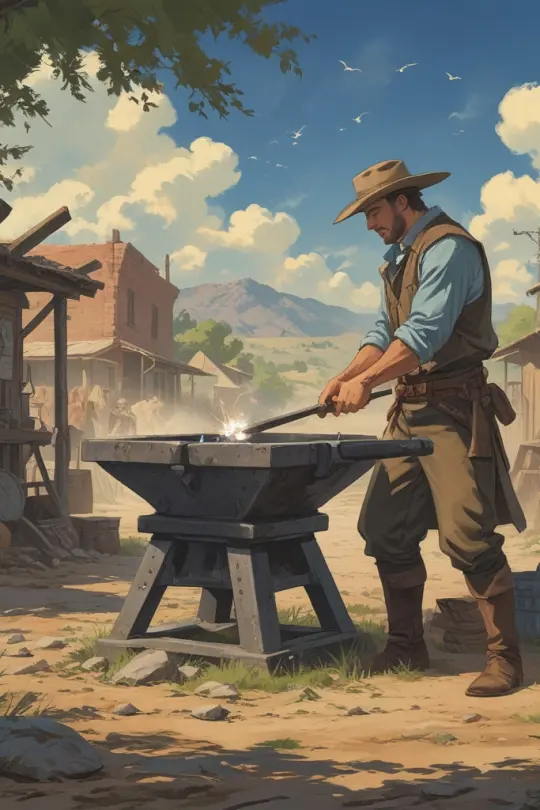
Anvil at Sundown
Join the conversation! Readers are sharing their thoughts:
About the Story
Anvil at Sundown follows Silas Hale, a solitary blacksmith in a drought-prone Western town, as his craft becomes the community's defense when sabotage threatens their spring. Heat, iron and hands answer danger while stubborn humor and small rituals hold neighbors together.
Chapters
Story Insight
Anvil at Sundown places a solitary blacksmith at the center of a small Western valley whose survival depends on a single spring. Silas Hale keeps his forge as much to keep himself company as to keep the town's gates and tools functional; when a local rancher and his hired hands escalate from intimidation to sabotage, the choice forced on Silas is practical and moral at once: translate his craft into instruments that protect and bind a community, or bend his skills toward making things that harm. The story introduces a compact, believable cast—Etta Calder, the stagecoach driver who keeps the town connected; Tuck, the eager teenage apprentice whose tinkering supplies comic invention; Bixby, an absurdly earnest armadillo in a squeaky horseshoe harness; and Rowan Dunlow, a charismatic antagonist who prefers leverage to argument. These figures move through everyday textures—molasses buns, pickled peaches, a clockwork rooster, and a patched flume—so the conflict never feels abstract. Instead it grows out of ordinary needs: water for animals, work for families, and the quiet dignity of people who fix things. The narrative pays close attention to the blacksmith’s work as both literal and symbolic action. Close, sensory scenes show coal breathing, iron glowing, the hammer’s arc and the exacting temper of a bolt; those technical details are not window dressing but the means by which Silas makes moral choices tangible. A central sequence hinges on a technically demanding, physically dangerous task that relies on heat, timing, and the practical rules of metalwork—here, skill resolves crisis rather than revelation or luck. The story balances that kinetic sequence with quieter chapters of teaching, barter, and watch-building: Silas runs workshops at his bench, neighbors learn to care for sluices, and Etta organizes practical defenses rather than summoning outside muscle. Laughter and small absurdities—an armadillo deputized for good humor, a mechanical rooster that crows at the wrong hour—break tension and humanize the town, so stakes feel real without becoming melodramatic. This is a compact four-chapter arc designed for readers who appreciate Western settings grounded in craft, social detail, and hands-on problem solving. The tone is plainspoken and wry rather than heroic-spectacular; dialogue reveals relationships and motives through exchanges that feel like daily life rather than exposition. The writing treats trade knowledge seriously: hammer angles, quench timing, and the ways iron contracts under pressure are handled with the sort of informed attention that makes the climax credible. At the same time the book keeps its focus on the communal consequences of those decisions—how supplies, favors, and trust circulate in a small town—and how practical teaching can be both protection and a form of belonging. If you look for a Western where courage is measured by craft and cooperation as much as by confrontation, and where humor and small rituals make danger human-scale, this story offers a tightly paced, honest reading experience with tactile detail, modest warmth, and a clear emotional arc from solitude toward connection.
Related Stories
The Ledger of Red Crag
In a dusty frontier town a young mechanic must fight a wealthy cattle baron's legal seizure of land and water. When the baron's men kidnap her apprentice, she gathers the town, a makeshift device, and courage to reclaim what they own. A Western of grit, craft, and community.
Spring at San Miguel Wells
A farrier named Nora Hart rides into San Miguel Wells to find her brother accused of robbing a stage. Tracking signs, clever allies, and a roan mare lead her to a hired gun and a water baron choking the town. In dust, rain, and gunfire, Nora fights to free her kin and return the well to its people.
Pitch and Horseshoes
Joss Thorne, a taciturn blacksmith and farrier, wakes to a town buzzing with the fever of a newly found resin—pitchbloom. When an outsider offers wealth in exchange for tools that would enable rapid extraction, Joss must decide how his craft will be used. Tension tightens as thefts, makeshift rigs, and a hungry pump threaten the valley’s fragile hold on its land. The last stand is fought with anvils, calked shoes, and the steady hands of a man who bargains in iron.
Water for Dusty Bend
A young schoolteacher in a hard-bitten desert town takes a stand when a cattle boss tries to steal the water. With a veteran’s wisdom, a roper’s skill, and a town’s resolve, she faces schemes, a dam, and a showdown. Law arrives, the wall falls, and Dusty Bend finds its voice and future.
Hammer, Barrel, Heart
A solitary gunsmith’s quiet life is jolted when stolen rifles and a vengeful gang threaten his town. He refuses to tune weapons for violence and instead forges non-lethal defenses. When the raid comes, his craft—cam locks, nets, a crude punch tool—becomes the means to stop bloodshed and rescue someone he cares for.
The Spark Key of Sundown Ridge
In the dusty town of Sundown Ridge, Mara Quinn keeps the telegraph and the depot running. When the town's rails are cut and a land baron moves to seize the water and the deeds, Mara gathers unlikely allies, a spark key, and a stubborn heart to save her home.
Other Stories by Marcus Ellert
Frequently Asked Questions about Anvil at Sundown
What is Anvil at Sundown about ?
A lean Western about Silas Hale, a solitary blacksmith whose trade becomes the town's defense when saboteurs threaten the single spring. It combines craft‑centered action, community stakes, and practical problem solving.
Who is Silas Hale and what role does his trade play in the plot ?
Silas is a quiet, skilled blacksmith who refuses to forge weapons. His knowledge of metal, heat, and timing becomes the decisive tool—literally and morally—for protecting the town's water and uniting neighbors.
Is the climax resolved through the protagonist's skills rather than a sudden revelation ?
Yes. The story's pivotal moment depends on Silas applying specific blacksmithing techniques—hot forging, fitting a plug, and timed hammering—to physically stop a breach and buy time for repairs.
What tone and emotional arc can readers expect from the story ?
The tone mixes plainspoken toughness, small‑town warmth, and dry humor. Emotionally it moves from isolation and cynicism toward connection as Silas shifts from solitary craft to communal responsibility.
Are there humorous or absurd elements in the narrative ?
Yes. The plot includes light absurdity—an armadillo in a squeaky horseshoe harness, a clockwork rooster, and Tuck’s inventions—that provide comic relief and humanize tense scenes without undercutting urgency.
How long is the story and who will enjoy it most ?
This is a tight, four‑chapter Western focused on craft and community. Ideal for readers who value tactile detail, skill‑based climaxes, quiet moral choices, and small‑town dynamics rather than large battalions or epic scope.
Ratings
This story is a love letter to making things by hand and to the quiet heroism of neighbors who patch a town together. The writer understands how to turn function into lyric: the hinge cooling on the anvil, the flume’s wooden boards that only a local would know how to read, and the hammer’s ring folded into the canyon wind. I especially appreciated how the threat to the spring stakes out moral ground — it’s not just survival, it’s the erosion of shared trust — and how Silas’s craft becomes the town’s defense in a very literal and moral sense. The drifter scene is economical and tense, and the humor (Etta’s molasses scolding, the town’s appetite jokes) keeps the tone from tipping into doom. A finely wrought Western with real heart and the smell of coal baked into its sentences.
Beautiful sentences, but I kept waiting for the central conflict to grow teeth and it never quite did. The sabotaged spring premise promises a high-stakes race, yet much of the middle reads like a series of vignettes around the forge. Nice touches (the sugared biscuits, Etta’s line) but the flume’s sabotage felt convenient when it mattered. Also, a lot of telling about Silas’s skill instead of showing it in a longer, sustained scene. Not a bad read, just undercooked for what it could have been.
I wanted to like this more than I did. The writing is evocative in places — the hammer as metronome, the smell of coal and molasses — but the plot felt a little telegraphed. The sabotage angle is interesting on paper, yet the culprit and motive (from what I read) are hinted at in ways that made the conflict predictable rather than surprising. The drifter with the battered rifle, for example, checks a lot of Western boxes: whiskey smell, holes in the jacket, a thud on the bench. Those are archetypes done well sometimes, but here they felt a bit clichéd. Pacing also wavered: the opening reveries about craft are lovely but slow the momentum when the danger should be building. Still, the characterization of Silas is strong, and the atmosphere is well-rendered. If the story tightened its plot logic and avoided leaning on tropes, it could be great.
Loved the voice here. Silas’s steady, deliberate motions — setting the hammer down with intent, treating a rifle “like a sleeping child” — made him instantly sympathetic. The story balances the threat (sabotaged spring) with the domestic (molasses biscuits!) in a way that feels real and lived-in. I laughed out loud at Etta’s molasses zinger and felt my chest tighten during the drifter scene. The ending (without spoiling) gives enough closure while preserving the town’s everyday future. This one got me good. Folk who like craft-heavy Westerns should pick it up.
Anvil at Sundown is the rare Western that treats everyday labor as dramatic material. The prose luxuriates in the details you might otherwise skip — the scent of coal and leather, the stubborn sweetness of molasses, the way Silas wipes his soot-blackened hand. Those small rituals become emotional currency: when the town’s spring is threatened you feel the stakes because you already know what the community will lose. The author’s handling of craft is superb; Silas’s knowledge of the flume and his intuitive sense for where a plank will rot convey a lifetime of hands-on wisdom, which frames his role as the town’s defense in a believable, earned way. The drifter’s arrival is handled with economy — one thud of a rifle, one measured pickup — and the tension unfolds from character decisions rather than contrived action scenes. I especially liked how humor undercuts the heat and dread: Etta’s molasses gripe, a neighbor’s practical joke, small comforts that keep people human. If there’s a complaint it’s that I wanted more time in some of the quieter scenes — a few moments end just when I wanted to linger — but that’s also a compliment: the writing leaves you wanting more of the same. A warm, muscular story about craft, community, and the small rituals that bind people together.
Short and sweet: I adored this. Silas is the kind of gruff, competent lead who doesn’t need to shout to be heroic. The molasses biscuits and the clink of the hammer made me feel like I was on the porch watching. The drifter scene (rifle thud!) gave me chills. Warm, funny, and quietly tense — yes please. 😊
Tight, precise, and quietly powerful. The author does a lot with a little: three paragraphs and you know where Cresswell’s priorities lie, how the flume threads through daily life, and why Silas matters. I appreciated the focus on craft — the hinge cooling on the anvil, the hammer as metronome — as a narrative engine rather than mere detail. The sabotage subplot is effective because it’s personal; it threatens the literal source of survival, not some abstract villain. Pacing is measured, character economy strong. My only nitpick is I wanted a touch more on the saboteur’s motive, but that’s minor. Highly recommended for readers who like character-driven Westerns.
This story grabbed me from the first line — “The anvil woke before the town did” is one of those images that sticks. Silas is such a quietly compelling protagonist: the way the hammer’s rhythm becomes his heartbeat, his hands knowing the flume like the grain of his hammer handle. I loved the small domestic touches, too — the tin of sugared biscuits, Etta’s molasses complaint — which root the high stakes (the spring being sabotaged!) in everyday life. The scene where the drifter drops the rifle on Silas’s bench felt tense without being showy; you can feel the town’s fragile trust. The prose is spare but warm, and the atmosphere of heat, iron, and friendship held me through to the end. A lovely Western that honors craft and community.