
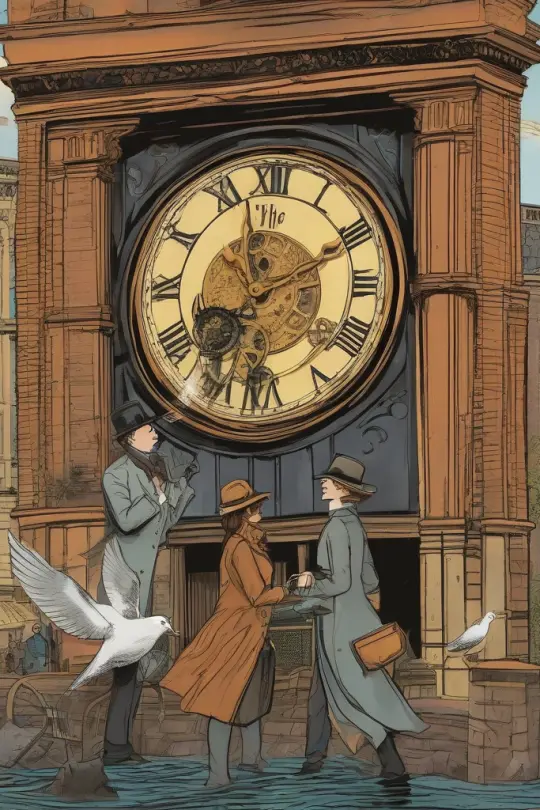
The Clockmaker's Lullaby
Join the conversation! Readers are sharing their thoughts:
About the Story
A young watchmaking apprentice in a river city faces a developer’s plan to erase the old clock tower. When the bell falls silent, Mira accepts the charge to restore it. Guided by an eccentric master, an archive intern, and a curious automaton dove, she confronts sabotage—and time—at Founders’ Day.
Chapters
Related Stories
The Tidebook
In a near-future harbor city, Leila finds her grandmother’s tidebook and, with a retired engineer, a swift teen, and a conflicted official, reawakens forgotten floodgates beneath their neighborhood. Through risk, negotiations, and grit, they alter a redevelopment plan—and teach the city to breathe again.
The Last Photograph
A small-town house keeps a loose secret: a hidden photograph and a string of payments that link a late father to another family. Nora returns to settle his affairs, discovers the ledger, and confronts a quiet history of protection and omission that will force her family and neighbors to reckon.
Frequencies of Home
In a tenement threaded with murals, a former stage sound technician rigs a communal ‘listening’ system meant to soften daily friction. When smoothing tech misroutes private voices, she must rewire the building’s audio and its rules, turning her craft into a ritualized practice of attention.
Where Glass Meets Sky
Fogged river air, frying dough, and the clink of harness metal set a morning where a seasoned high-rise window cleaner crosses a gulf between buildings to save a volunteer during his estranged daughter's rooftop installation. Sam's tools — knots, anchors and patient hands — become the means of rescue and unexpected reconnection.
Rooms We Don't Open
A returning filmmaker confronts a town's long-buried choices after finding a locked box in her father's attic. As documents surface and a local inquiry unfolds, loyalties strain and quiet lives become public. The atmosphere is damp with guilt and stubborn care, the protagonist juggles evidence, family duty, and the risk of fracturing a fragile community.
Where the Light Holds
A restorative drama set in an industrial coastal city: a glass conservator named Elias fights a quiet theft of the city’s light after his mentor’s work is broken. He gathers unlikely allies, confronts a corporate antagonist, and pieces the community back together—one shard at a time.
Other Stories by Marcus Ellert
Ratings
I had high hopes because the opening is lovely, but by the end it felt like a well-made cliché. Everything about the city is cute — the river smell, the bakeries — and Mira is too-perfectly plucky to be fully convincing. The eccentric master, the helpful archive intern, the quirky automaton dove — it’s all a little too tidy. The sabotage subplot is predictable (someone wants to erase history, shocker), and the climax at Founders’ Day ties up too cleanly. I enjoy gentle, character-driven stories, but this one coasted on atmosphere while skimming over character depth and the messy realities of activism or heritage preservation. A nice read for a rainy afternoon, but that’s about it.
Pretty writing, bland drama. The prose is charming in spots — I liked the gear metaphors and the way the workshop smelled — but the story suffers from predictability. Mira’s arc (apprentice rises to save the day) hits all the expected beats, and the developer-as-villain trope is deployed without nuance. The sabotage feels contrived, and the reveal at Founders’ Day reads like an obligatory climax rather than an earned revelation. I also found a few plot holes: how exactly does a single apprentice manage the tower logistics so quickly? Where are the city officials? Small details, but they jarred me out of the otherwise pretty atmosphere. Not bad, but not memorable.
I wanted to love this more than I did. The atmosphere is excellent — the brass dust, the lamp, the city smells — but the plot felt a bit thin for the stakes it sets up. The developer’s plan to erase the tower comes across as fairly generic antagonist territory, and the sabotage subplot is resolved a little too conveniently at Founders’ Day. Characters like the archive intern and Jakub have nice moments but aren’t developed enough to make the emotional payoff land fully. Also, the automaton dove is such a cool image that I wished the story either leaned into its mystery more or explained it; instead it flits in and out. Good writing, but the narrative needed tighter focus and deeper consequences.
Delightful little gem. I wasn’t sure how a story about clock repair could carry emotional weight, but Mira and her tiny, tense victories do the job. The scene where the escapement clicks and Mira’s skin lifts — that’s the kind of sensory writing that gets me. The developer threat is the right kind of antagonist: boring on paper but effective as pressure on the community. The archive intern and especially the automaton dove inject just enough whimsy to keep the mystery lively. It’s cozy, a tad wistful, and very well paced for the length.
The Clockmaker’s Lullaby reads like a hymn to small, careful work. The story’s pleasures are mostly compositional: close-up passages of Mira at her bench, the precise language around gears and escapements, the ritual of listening before looking. That quiet rigor mirrors Mira’s emotional arc — from tentative apprentice to someone who accepts responsibility for the tower. Szymon’s age and frailty are rendered without sentimentality, and Jakub’s youthful interruptions provide relief from the shop’s hush. The sabotage subplot introduces real jeopardy at Founders’ Day, and the automaton dove serves as an eerie, almost folkloric presence. It’s not flashy, but it lingers: a minor miracle of craft and restraint.
Short and sweet: I’m obsessed. The writing is tactile — I could feel the brass dust — and Mira is an immediately sympathetic lead. The dynamic with Szymon (that small, trembling hand) is beautifully handled, and the automaton dove? 10/10. Founders’ Day actually made my stomach clench. Highly recommend if you love atmospheric urban dramas. 🙂
This was such a cosy, bittersweet read. The imagery — the lamp’s cone, the milky halo, the river breeze — hooked me immediately. I adored Szymon’s gentle corrections and Mira’s small victories (that tooth finally coming clean felt like a win for both of them). The automaton dove is charmingly odd; it made me smile every time it showed up. The stakes feel personal (heritage, craft, community) rather than abstract, and the Founders’ Day scene where the bell falters is genuinely tense. Overall a thoughtful coming-of-age rooted in the rhythms of a working city. Would recommend to folks who like character-driven drama and attention to craft.
Subtle, tender, and smart. This felt like watching someone patch an old watch — slow, precise, and utterly engrossing. I particularly liked the way Mira listens before she looks; the line captures her whole approach to life and her craft. Szymon is written with so much affection (that mustache twitch!) and Jakub’s skateboard moments add levity. The archive intern and automaton dove give the mystery texture without overwhelming the emotional core. The Founders’ Day climax is suspenseful in a quiet way — not a race against bombs or bullets, but against erasure. Lovely character moments, believable city life, and a real sense of time as both mechanic and metaphor.
The Clockmaker’s Lullaby is an economical, atmospheric drama that balances craft detail with civic stakes. The opening paragraph — lamp, brass dust, the loupe and that worried tooth — sets a microscopic attention to mechanics that pays off narratively: the repair of the tower is both literal and symbolic of preserving a communal tempo. Szymon’s mentorship provides a gentle counterpoint to the antagonistic developer, and scenes like Jakub’s skateboard interruption and the automaton dove circling the workshop ground the story in an urban, lived-in reality. The pacing tightens notably toward Founders’ Day, where the sabotage subplot gives the protagonist a tangible obstacle to overcome. The prose is clean, often tactile; the only thing I wanted more of was the developer’s motive beyond profit. Still, a satisfying, inward-facing drama about heritage and apprenticeship.
I loved this story. It feels like someone turned a sepia photograph of a city into sound — the lamp buzzing above Mira’s bench, the brass dust on her finger, the tiny triumph when the escapement finally clicked. Mira’s patience and Szymon’s quiet mentorship are the heart of the piece; that scene where he wipes oil from her cheek like it’s an old family ritual made me tear up. The automaton dove is a delightful, slightly uncanny touch that kept the mystery playful rather than sinister, and the looming Founders’ Day deadline adds real pressure without feeling manipulative. I could smell the river and the bakeries while reading. A warm, character-driven coming-of-age with real stakes and lovely craft details — I’ll be thinking about that fallen bell and Mira’s steady hands for a while.