
Pitch and Horseshoes
Join the conversation! Readers are sharing their thoughts:
About the Story
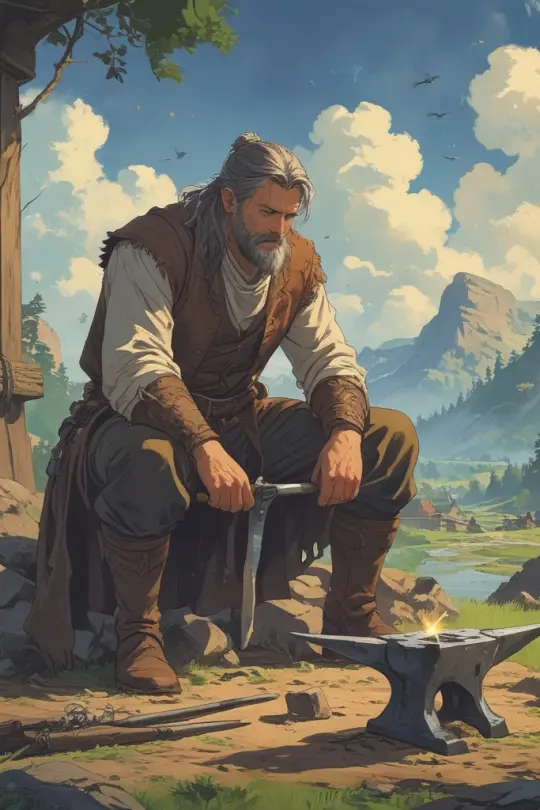
Joss Thorne, a taciturn blacksmith and farrier, wakes to a town buzzing with the fever of a newly found resin—pitchbloom. When an outsider offers wealth in exchange for tools that would enable rapid extraction, Joss must decide how his craft will be used. Tension tightens as thefts, makeshift rigs, and a hungry pump threaten the valley’s fragile hold on its land. The last stand is fought with anvils, calked shoes, and the steady hands of a man who bargains in iron.
Chapters
Story Insight
Pitch and Horseshoes places a practical, quietly stubborn blacksmith at the center of a frontier valley’s sudden temptation. Joss Thorne is a farrier and smith who has built his life from the muscle of animals, the ring of hammer on anvil, and the simple, small-scale bargains that keep a community fed and dry. When a resin called pitchbloom is found in a nearby wash—a substance that seals leather, preserves metal and promises quick profit—the town's routines tilt toward urgency. An outsider entrepreneur arrives with plans and buyers, and the make-or-break choices shift from speeches to ironwork: what kind of couplings and clamps will be forged, who gets access to the seam, and how fast will the hill be drawn dry? The conflict is local and immediate rather than political theatre: it plays out in shop benches, wet mules, ledger coins, a stolen half-finished piece, and the small, absurd interruptions that make a community human—most memorably a mischievous goat named Grease and a string of pickled peaches that somehow keeps tempers in check. The narrative explores the economics of an unusual resource with the specificity of someone who knows metalwork by feel. Forging choices become moral acts; tempering a wedge, filing a cam, or fitting a shoe are the tangible, tactical answers to abstract questions about stewardship and greed. The story treats craftsmanship as civic responsibility: the smith’s knowledge of tolerances, clinches, calks, and the cadence of pumps is the instrument by which the valley negotiates its future. Humor and small absurdities are threaded throughout to cut tension and reveal character—the comic interludes do more than entertain, they show how communities use levity to survive high stakes. Dialogues are lived-in and not merely expositional: they show alliances, compromises, and the kind of neighborly bartering that shapes choices as effectively as any contract. The book avoids a simplistic confrontation with a faceless system; instead it stages conflict among people whose livelihoods, pride, and survival are intertwined. The prose favors tactile, sensory detail—smoke and coal, the rasp on a hoof, the smell of rosemary from the boardinghouse—so the reader experiences the valley by touch and sound as much as by plot. Pacing is deliberate: tension accrues across four chapters through thefts, small victories, and escalating machinery rather than a rash of gunfights. The climax is earned through action built on skill; the decisive moment hinges on vocational expertise rather than revelation, making the resolution satisfyingly active and concrete. Pitch and Horseshoes will appeal to readers who value grounded moral dilemmas, authentic tradecraft, and community-minded storytelling with a sly streak of humor. It’s a Western that emphasizes the work of keeping a place livable—wrought in steel, bound by custom, and lightened by the occasional, perfectly timed absurdity.
Related Stories
Cedar Crossing
Eve returns to protect her family's land from a predatory rancher. The third chapter runs the gauntlet of a daring rescue and a public confrontation at a river crossing, where receipts and witnesses collide with hired muscle. The town's coming together forces a reckoning beneath a wide western sky.
Red Mesa Reckoning
A returning rancher comes home to find his father's land threatened by a ruthless local power who controls water and routes through money and men. As quiet legal efforts fail, the town organizes a defense. Violence erupts, loyalties are tested, and a final showdown forces a community to reclaim its valley.
Sundown Ridge: The Iron Key
In a sun-baked frontier town, telegraph operator Mae Hollis fights to save Copper Spring after a powerful company claims its water. With an old engineer's skill, a tough mare, and neighbors who will not yield, she risks law and bullets to bring the water home.
Anvil at Sundown
Anvil at Sundown follows Silas Hale, a solitary blacksmith in a drought-prone Western town, as his craft becomes the community's defense when sabotage threatens their spring. Heat, iron and hands answer danger while stubborn humor and small rituals hold neighbors together.
A Wire Between Strangers
When a telegraph stitches Brier’s Crossing into the wider world, taciturn lineman Silas Hart prefers the company of wire. Sabotage and an approaching payroll coach force him to climb a pole in a storm and splice a makeshift relay. Odd inventions and small kindnesses shape the night.
Sundown on Hollow Ridge
A muted frontier evening; a woman with a violent past stands between a town and a wealthy claimant who seeks their water. When stamped papers and arson bring law and conflict, Etta must choose restraint or vengeance as the valley's future is decided by ledgers and deeds.
Other Stories by Sabrina Mollier
Frequently Asked Questions about Pitch and Horseshoes
What is the central conflict in Pitch and Horseshoes and how does it unfold ?
The core conflict asks whether Joss will forge tools that enable rapid extraction of pitchbloom or craft limiters to protect the valley. Tension rises through an outsider’s offers, thefts, makeshift rigs and escalating machinery until Joss acts with his trade.
Who is Joss Thorne and what role does his craft play in the story ?
Joss Thorne is a taciturn blacksmith and farrier whose hands and tools carry authority. His expertise in shoes, cams and plugs becomes the pragmatic mechanism for community decisions, making craftsmanship the means to shape outcomes.
How does pitchbloom affect the valley's economy and social dynamics ?
Pitchbloom introduces sudden demand and easy money, splitting neighbors between immediate relief and long-term stewardship. It reshapes labor, invites outside buyers, provokes theft and forces the town to negotiate access and rules.
What tone and style can readers expect from this Western ?
Expect tactile, workmanlike prose focused on sensory detail—forge heat, hoof rasp, stew aromas—mixed with dry humor. Pacing is deliberate, driven by practical problem-solving and community interactions rather than melodrama.
Is the climax resolved through action or revelation in Pitch and Horseshoes ?
The climax resolves through action and vocational skill: Joss physically installs a metering plug, shoes mules for slippery banks and uses his smithing to choke a pump. The turning point depends on craft, not an abstract revelation.
Are there recurring elements of humor or absurdity in the story and why ?
Yes. Recurrent comic touches—a sticky goat named Grease, Silas’s schemes, pickled-peach interludes—diffuse tension and reveal how neighbors use levity to sustain cooperation while facing serious economic decisions.
Ratings
I admire the attention to farrier details, but the plot reads a little like a checklist of Western tropes: new resource found, outsider offers wealth, town frays, thefts, final stand. The writing is pretty, especially the forge scenes, but the moral dilemma gets treated as a foregone conclusion — too neat and precious. Characters other than Joss feel sketchy; Etta is charming but a bit one-note. If you like a slow, tidy Western where craftsmanship equals virtue, this will hit the spot. If you want moral ambiguity and surprises, you might find it a tad clichéd.
I wanted to love this; the premise is promising and the opening paragraph is lovely. But the middle sagged for me. The pitchbloom conflict escalates in ways that felt a bit predictable: outsider shows up, town gets greedy, thefts happen, makeshift rigs appear — there wasn't enough surprise or complexity in the choices people made. Joss is compelling in scenes at the forge, but his inner life could use more texture; we see his craft more than his doubts. The "hungry pump" and the environmental angle are interesting ideas, yet they often felt underexplored — the stakes are described rather than excavated. The last stand has good imagery (anvils, calked shoes) but the payoff lacked emotional depth for me. Worth reading for the atmosphere but be ready for a story that plays its beats by-the-numbers.
This one gutted me in the best way. The mornings at the forge felt like a ritual I could step into — I loved Etta’s open window and the way her biscuits softened the forge’s heat. Joss’s hands, the rasp, the clinched nails — all of it is lovingly observed. The tension around the pump and the valley’s hold on the land felt painfully real, and the thefts escalate the stakes without turning anyone cartoonish. The final scene — a last stand with anvils and calked shoes — left me tearing up; it’s the kind of ending that honors labor and community. Gorgeous and human. ❤️
As someone who enjoys the craft of writing as much as its plot mechanics, Pitch and Horseshoes is exemplary. The author clearly understands how to fuse atmospheric detail with ethical tension: the temper-streaked window, the rasp’s rhythm, the smell of leather and coal — all small things that assemble a convincing valley at risk. The narrative arc from curiosity (the wooden box, the stranger) to exploitation (makeshift rigs, thefts) to resistance (the last stand with anvils, calked shoes, steady hands) is satisfying because the motives are rooted in character. Joss Thorne’s taciturnity is used well; he’s not a cipher but a man whose silence speaks through his labor. The thematic core — whether craft should be an instrument of wealth or preservation — is handled without sermonizing. My only quibble would be a desire for a bit more on the outsider’s backstory, but that’s a minor note in an otherwise robust, well-paced Western.
Okay, imma admit — I came for the anvils and stayed for the biscuits. 😂 But seriously, this story nails that low, grinding tension of a town smelling quick money for the first time. The wooden box that rattled down Main? Perfect ominous prop. The outsider’s offer feels precisely corrosive; you can almost see neighbors glancing at their hooves like they suddenly measure fortune in ounces of resin. Also big kudos for the farrier detail — I learned more about shoes than I thought I’d care to. Delightfully unflashy and stubbornly human.
Short and sharp: I loved how small actions carry weight here. The bit where Joss wipes his hands and smiles at the neat line of clinched nails — that little victory says so much about him. The pitchbloom storyline raises real ethical stakes without melodrama. Tight prose, believable town, memorable final showdown. Would read again.
The prose in Pitch and Horseshoes is quietly luminous. I was struck by how the book makes the quotidian feel epic: a rasp’s metronome becomes the heartbeat of a town on the verge of change. The moral dilemma around the pitchbloom is rendered in intimate increments — men arguing in saloons, the rattling wooden box, an outsider with a rolled canvas promising wealth— and the subsequent corrosion (theft, makeshift rigs, a hungry pump) is no longer abstract but tactile and claustrophobic. The scene where the pump threatens the valley’s hold on its land is handled with a real sense of ecological paranoia; it's less about villains and more about a community learning the cost of short-term gain. The final sequence, fought with anvils and steady hands, felt earned. I admired how the author chose to end not with fireworks but with the sounds of metal and careful labor — it’s a brave, thoughtful Western.
Really dug this one. The opening got me — "hot coin" light on the forge window, the rasp singing, that detail about Etta’s molasses glaze biscuits — so vivid. Joss is taciturn but you feel him: when he fittings the shoe "like a thought" I actually felt proud with him. The pitchbloom stuff added real tension without turning the story into a full-on action flick; the thefts and hungry pump escalate naturally. The last stand with anvils and calked shoes? Classic and oddly emotional. Solid work — felt like a slow-burning campfire with sparks. 🔥
Measured and quietly fierce. Pitch and Horseshoes wins by trusting its quiet moments: Joss rasping a mule’s hoof, the coals’ breath, Etta’s biscuits drifting through the doorway. The conflict over the pitchbloom is handled without melodrama — the outsider’s offer and the town’s feverish response are believable because the author shows how greed erodes ordinary habits, not because of grand speeches. I particularly appreciated the technical details of farriery and the scene where makeshift rigs start sprouting around the valley; it grounds the story’s stakes. Pacing is patient but rarely dull. Recommended for readers who like Westerns that prioritize craft and character over spectacle.
This felt like sitting on a stool at Joss’s forge, smelling coal and biscuits and listening to the rasp sing. The opening scene — the morning light through the temper-streaked glass and Joss fitting the mule’s shoe with that practiced economy — is so tactile it stuck with me. I loved how the story treats craftsmanship as a language: the clinched nails, the neat line of bent nails as Joss’s grammar. The moral choice about the pitchbloom never felt forced; instead, it grew out of small, human moments (Etta calling him to eat, the wooden box that rattled down Main). The climactic last stand with anvils and calked shoes is pure, grounded Western poetry. Warm, deliberate, and humane — a bookish, honest sort of Western I didn’t know I needed.