
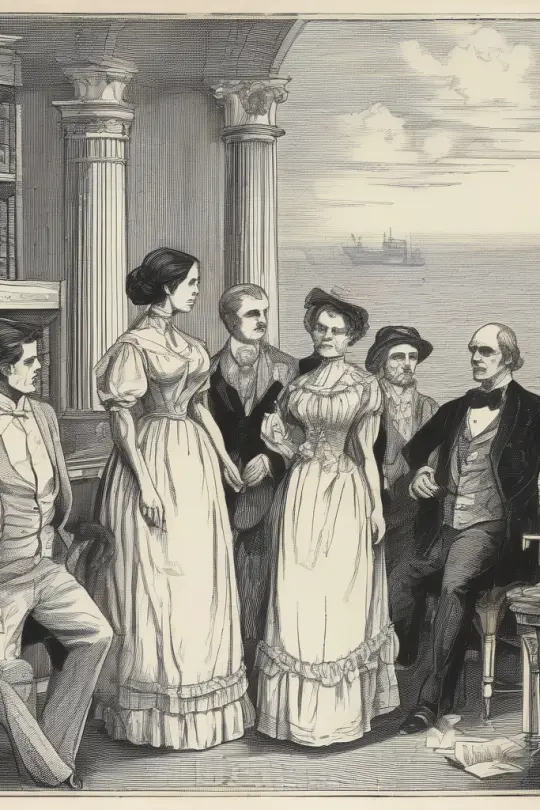
The Harbor's Charter
Join the conversation! Readers are sharing their thoughts:
About the Story
In a mid‑19th‑century coastal town, widow Miriam Calder turns communal memory into evidence to resist a plan that would enclose the eastern slip. A discovered family folio, legal hearings and a frayed community lead to a tense negotiation before a pragmatic court order pauses construction and forces a conditional settlement.
Chapters
Related Stories
The Beacon of Valparaíso
Fog, salt and the steady turn of a lighthouse define the atmosphere. Catalina, a practical lighthouse keeper, faces a harsh choice when a wounded childhood friend arrives with a coded plea. Between mechanics and politics, her decision will shape a single night and a town’s fate.
The Last Croft
In the waning days of the Highland Clearances, Aileen MacTaggart brings a fragile indenture to challenge an estate sale that threatens her family’s croft. Legal filings, a divided township, and a factor’s uneasy aid set a race for documents that will buy time and demand costly choices.
Margins of Justice
Revolutionary Paris is both theater and machine in which Claire Moreau, a meticulous copying clerk, slips an arrest slip into her apron and finds a trail of requisitions funneled to private pockets. Inquiry, public scenes and private grief force her into a small, stubborn fight to keep records human.
The Last Forge
In a village edged by presses and proclamations, a young master of a family forge faces a public reckoning. Amid inspections and offers, she must bind tradition to a new livelihood. The atmosphere blends heat and hush, the protagonist’s resolve and the hush of a community gathering to witness a fragile choice.
The Bellmaker of San Martino
In a coastal Italian town, a young apprentice bellmaker uncovers a hidden charter within the great bell and must defend the town's voice against a wealthy foundryman's designs. A historical tale of craft, law, and courage where sound and solidarity hold a community together.
The Last Inn on the Road
Ruth Hargreaves refuses a hush payment and drives an inquest into her son’s death at a railway cutting, confronting contractors, threats, and the law. The final chapter follows the court proceedings, the verdict, and the village’s uneasy reckoning as railways and livelihoods collide.
Other Stories by Isabelle Faron
Frequently Asked Questions about The Harbor's Charter
What is The Harbor's Charter about and who is the central protagonist ?
The Harbor's Charter follows Miriam Calder, a widow in a mid‑19th‑century coastal town, who leads her community to defend customary moorings against an investor’s dock project.
When and where is The Harbor's Charter set and what atmosphere does it evoke ?
Set in a mid‑19th‑century English coastal town, the novel evokes salt‑air industry, close‑knit harbor life, legal corridors and the slow tension between tradition and development.
Who are the main antagonists or forces opposing Miriam Calder ?
The principal antagonist is Silas Marwood and his Marwood & Company—capital, legal power and economic modernization that threaten communal mooring rights and local livelihoods.
How does the discovery of the 1698 parish fragment and the Marwood folio affect the plot ?
The fragment and folio turn custom into evidentiary proof, shifting the conflict from rumor to court; they prompt discovery, hearings and a negotiated legal compromise.
What legal strategies and institutions appear in the story and why do they matter ?
Petitions to a magistrate, sworn affidavits, discovery of private papers, county court hearings and a Harbor Commission all shape outcomes by translating custom into enforceable measures.
Is The Harbor's Charter historically accurate or fictionalized regarding law and custom ?
The book blends historical legal practice and plausible customs—equity, customary moorings and discovery procedures are realistically portrayed but dramatized for narrative effect.
Ratings
I wanted to love this because the premise is strong — communal memory as legal evidence, a mid‑19th‑century coastal setting, a widow who refuses to vanish into widowhood — but the execution left some frustrations. The pacing in the middle section falters: the hearings that should ratchet tension instead become repetitive testimony scenes where the stakes aren’t always clear. I also had unanswered questions about the folio’s legal efficacy; how was chain of custody established, who authenticated those annotations, and why did the court accept communal recollection as decisive without a more rigorous evidentiary procedure? The settlement’s conditionality feels plausible, yet the “pragmatic court order” that pauses construction comes across as convenient rather than litigated. Character-wise, Miriam is vivid, but several peripheral figures remain underwritten; Eve, for instance, has interesting impulses but too few interior moments to make her transformation convincing. Good writing and atmosphere, but the legal mechanics and some pacing choices weakened my engagement.
Well, it reads pretty, but I can’t pretend I wasn’t a bit underwhelmed. The widow-as-defender trope is serviceable, but the plotline where a single family folio saves the entire eastern slip feels a hair too neat — like the author reached for a tidy lever to resolve the conflict. The legal hearings drag in places; I kept waiting for sharper blows or higher stakes beyond town pride. Miriam’s shop and the oak box are lovely details, don’t get me wrong, but the community feels shorthand at times: the frayed edges never quite become messy enough to matter. Enjoyable for fans of quiet historical fiction, but if you want courtroom fireworks or surprising turns, this isn’t that book. 🤷♂️
I finished this with a strange, satisfied ache. The prose is patient — much like the harbor at low tide — and it allows the town to reveal itself in gestures rather than headline events. Miriam Calder is quietly heroic: the oak box carved by her husband, the brass fittings kept like reliquaries, her morning ritual catalogued in tiny sensory beats. Eve is a youthful counterpoint, restless and useful, learning the ledger of favors as if it were a map out of town. The discovered family folio is treated not as a deus ex machina but as the physical embodiment of communal claim; the legal hearings become a crucible where memory is tested and translated into law. I loved the sequences where neighbors testify not just to ownership but to shared life — the hinge squeak, the child’s cough, the ledger entries — these are the proof that matters. The pragmatic court order that pauses construction and forces a conditional settlement is a satisfying outcome because it feels negotiated, earned and imperfect in all the right ways. One of the best portrayals I’ve read of how archives and affection intersect with civic conflict. Highly recommended.
This one stuck with me. The harbor scenes hit the senses — mud and silver, hulls settling like animals — and then the story flips into a slow‑burn courtroom drama that doesn’t cheapen the emotions. Miriam’s stubbornness (refusing to shutter the shop) vs. the town’s frayed communal ties makes the negotiation scenes tense and believable. The folio reveal felt earned, and I smiled at the small victory: a pragmatic court order pausing construction and forcing a conditional settlement. Not everything ties up neatly, but that’s the point — history’s messy. A recommend for fans of character-led historical legal drama. 👏
Quiet, precise, and intimate. I enjoyed how small domestic details — a creak of a hinge, a child’s cough — are clues to a town’s inner life. Miriam’s chandler’s bench holds history and livelihood in equal measure, and the folio-as-evidence twist is handled with tact rather than drama. The legal hearings don’t feel like a courtroom soap but like careful negotiation; the pause on enclosing the eastern slip makes sense within the story’s moral logic. Short, elegiac, and convincing — a lovely piece of historical fiction.
A sharply observed historical drama. The author balances sensory detail (the tar and lemon oil, gulls squabbling over dried fish) with procedural tension: the discovered family folio functioning as documentary evidence is a neat conceit, and the legal hearings are staged with a restraint that avoids melodrama. I particularly liked the courtroom rhythm when communal anecdotes are converted into affidavits — it foregrounds the messiness of memory versus the cold logic of law. Miriam’s refusal to close the shop after her husband’s death reads as a believable act of agency rather than a plot convenience; the oak box and brass fittings operate as objects of evidence and grief. My only quibble is that some of the community’s divisions could be sketched more deeply, but the conditional settlement and pragmatic court order that pauses construction is a satisfying, realistic resolution. Well paced, literate, and thoughtful about archives as civic power.
I adored the opening scene — that low tide image where the harbor “discovered itself in stages” is such a beautiful, patient way to set tone. Miriam Calder feels utterly lived-in: the detail about her husband’s oak box and the brass fittings labeled in his hand made me ache for the life she’s keeping together. The way communal memory becomes literal evidence (the folio!) is genius — I loved the courtroom scenes where the town’s private histories are pulled into public law. The negotiation and the pragmatic court order that pauses construction felt honest, neither melodramatic nor improbably triumphant. Eve’s restlessness adds the right counterweight to Miriam’s steadiness. A moving, quietly furious historical read that honours labor, memory and small-town stubbornness.