
Margins of Justice
Join the conversation! Readers are sharing their thoughts:
About the Story
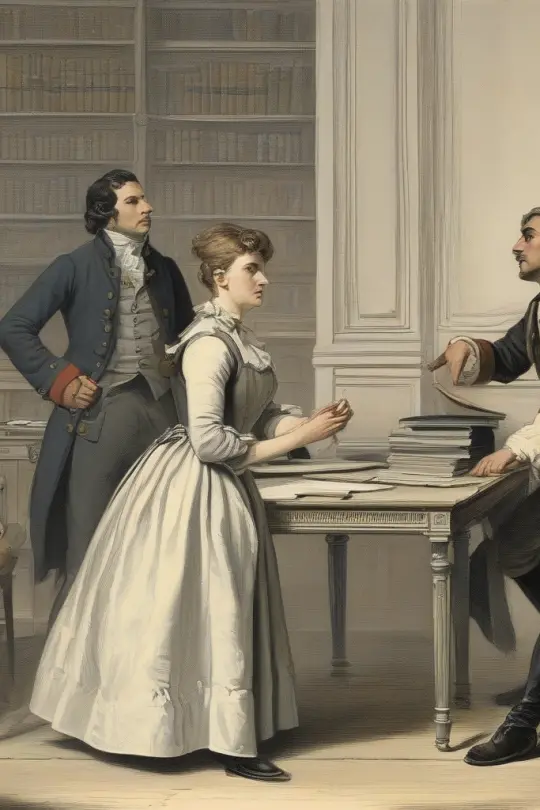
Revolutionary Paris is both theater and machine in which Claire Moreau, a meticulous copying clerk, slips an arrest slip into her apron and finds a trail of requisitions funneled to private pockets. Inquiry, public scenes and private grief force her into a small, stubborn fight to keep records human.
Chapters
Related Stories
Saint-Laurent's Loom
In an early-industrial French town, Claire Moreau, a weaver’s daughter, hides a register of mutual aid after her father’s arrest. When authorities seize papers and begin rounding up workers, she makes a desperate decision to deny a list’s power — an act that reshapes the town’s bonds and the way care is kept.
Between Hem and Horizon
In a coastal 19th‑century harbor, Beatrice Voss, a master sailmaker, must act when a brig founders on a reef and lives hang on her craft. Hands, ropes, and a stubborn stitch set the pace; a small sewn patch hints at someone she once lost. Salt, lantern light, and a goose keep the night human.
The Charter of Gullhaven
In a 17th-century coastal parish, Maia Alden, a shipwright's apprentice, fights to reclaim her village's ancient charter after it is seized in the night. She learns to read tides, gathers witnesses, and faces a lord's claim in court. A historical tale of craft, courage, and community.
Embers on the Left Bank
In spring 1871, a seamstress on Paris's Left Bank turns her craft into concealment when a packet of urgent papers arrives. As bombardment and smoke sweep the streets, she must shelter testimony inside garments and decide what to save when the barricades fall—an intimate portrait of survival in a city undone by conflict.
The Last Ballad of Kinloch
Peat smoke and low clouds hang over a Highland glen where estate 'improvements' threaten roofs and songs. Eilidh, a singer and midwife, must decide whether to stay with her father and neighbours or to carry the community's melodies away to a city and its presses.
Bell and Parchment
A grey dawn, a stolen fragment and a woman who will not let her village be fenced away: Adeline Hart stands before a squire, a magistrate and a crowd to force a reckoning. The mood is cold and taut, the green a contested memory, and the first act of resistance will decide who keeps the land.
Other Stories by Theo Rasmus
Frequently Asked Questions about Margins of Justice
What is the plot of Margins of Justice and who is the main protagonist ?
Margins of Justice follows Claire Moreau, a meticulous copying clerk in Revolutionary Paris who discovers a hidden arrest order for her brother and uncovers a pattern of requisitions diverted into private hands.
When and where does the story take place, and how does the setting shape the conflict ?
Set in late‑18th‑century Paris during the Revolution, the municipal offices, markets and watchrooms create a bureaucracy where lists translate into arrests and seizures, turning paperwork into a weapon.
How does Claire alter official records and what practical risks does that involve ?
Claire subtly changes outward copies and adds marginal notes to delay arrests, buying time. Risk includes discovery by clerks or commissary, criminal charges, and exposing allies like Marcelle and Mathieu.
Which institutions and historical practices are central to the narrative ?
The novel centers on arrondissement surveillance offices, commissary orders, municipal requisition, the municipal watch, neighborhood committees and public assemblies — showing how records and procedure enforce power.
Who are Claire’s main allies and antagonists, and what roles do they play ?
Allies: Mathieu, a retired clerk who preserves old dockets; Marcelle, a vendor and networker; Captain Valois, a cautious watch officer. Antagonist: Commissaire Lucien Beaufort, who exploits requisitions for gain.
Is Margins of Justice inspired by real events or archival practice from the French Revolution ?
The story is fictional but grounded in historical practice: it draws on real‑world mechanisms like requisition orders, municipal registers and local committees to create an authentic bureaucratic backdrop.
Ratings
I wanted to love Margins of Justice — the premise is strong and the historical setting feels promising — but it never quite crossed the line from atmospheric vignette into a satisfying narrative. The prose is lovely at times (that first paragraph is cinematic), yet the plot feels a bit too predictable. Claire slipping an arrest slip into her apron, discovering requisitions stolen to private pockets, then facing public inquiry: I could see each beat coming well in advance. Pacing is the main problem. Long, meticulous descriptions of the office ritual are evocative but slow the story’s momentum; by the time the moral confrontation arrives, the emotional payoff feels muted. Secondary characters, like Hélène and the thin man muttering prayers to ledgers, are sketched prettily but remain flat — they’re there to color the scene rather than complicate Claire’s choices. There are also a couple of contrivances around how Claire’s actions avoid detection that strained my suspension of disbelief. Not a bad read if you enjoy mood and detail, but if you want a tighter plot or more unpredictable stakes, this won’t satisfy.
Margins of Justice is a subtle, carefully structured study of how record-keeping intersects with conscience. The opening paragraph sets tone and texture — the charcoal air of Paris, carts creaking, and that excellent metaphor of the copying ritual as liturgy. Claire Moreau is rendered with precise economy: a woman both ordinary and stubbornly principled. The scene construction is where the story shines. The office on Rue des Carmes functions like a stage, and the author stages several important moments there: Claire aligning pages as if assembling a cabinet, the shared motions with Hélène, the rubber stamp’s regular percussion. These small domestic details make the later moral discoveries — requisitions funneled to private pockets, the quiet corruption of public order — land with weight. I particularly appreciated the public-private contrasts: the ceremonial violence on the streets versus the intimate grief that follows inquiry. That private grief humanizes the stakes; it prevents the story from becoming an abstract polemic about bureaucracy. Pacing is deliberate; readers wanting fast plot may find it measured, but the slowness is an aesthetic choice that suits the archival theme. At its heart, this is a moral drama about the stubbornness required to keep records, and therefore people, human. A thoughtful and moving historical tale.
What a deliciously sharp little book. Revolutionary Paris as a machine of paperwork? Yes please. Claire Moreau is delightfully stubborn — she doesn’t swing a sword, she squares a ledger, and somehow that feels way more subversive. I laughed out loud at the image of clerks doing a ‘liturgy’ of stamping and folding; bureaucratic piety never looked so theatrical. 😉 The scene where Claire tucks an arrest slip into her apron belongs in a museum of tiny rebellions. Also: the city smelling of boiled cabbage forever — chef’s kiss to atmospheric writing. The discovery of requisitions being siphoned off to private pockets is handled with great, quiet fury. No fireworks, just steady, infuriating truth. Short, smart, and emotionally honest. If you like your revolutions intimate and your heroes low-key, this one’s for you.
Margins of Justice is a finely observed piece of historical fiction that treats paperwork as both plot engine and moral battleground. The author cleverly uses the copying office on Rue des Carmes as a microcosm of Revolutionary Paris: the clerks’ ritual—fold, number, stamp—becomes a liturgy that anchors Claire and the reader amid political chaos. Two strengths stand out. First, the sensory detail: the sour tang of boiled cabbage, the pitted windowpanes, the distinctive thump of the rubber stamp. These moments ground the narrative and make bureaucratic life tangible. Second, the thematic clarity: the book interrogates how records shape justice, and how tampering with requisitions can corrode public trust. Claire’s discovery of requisitions diverted to private pockets is handled with credible detective work; the manuscript respects archival practice (marginalia, docket sequencing) in a way that will please readers interested in history-of-records. If there’s a quibble, it’s that the secondary characters could use slightly more development—Hélène is sketched beautifully but remains, at times, an emblem rather than a person. Still, the prose is clean and the moral stakes are compelling. A well-crafted, thoughtful story about the small resistances that keep justice human.
I finished Margins of Justice with my throat tight and a head full of ink-stained images. Claire Moreau is the kind of quietly heroic woman who lodges in your chest — not because she storms barricades, but because she insists on the humanity of paper. That moment when she slips an arrest slip into her apron felt like pulling a seam on a well-made coat: one small tug and the whole garment shows its worn parts. The detail in the Rue des Carmes office — the pitted panes, the rubber stamp’s thump, Hélène’s soft efficiency beside Claire — made the clerks feel alive. What I loved most was the book’s insistence that bureaucracy is not neutral. The margin notes, the shorthand of petty mercies and petty cruelties, are treated like characters themselves. The scene where Claire notices requisitions being funneled to private pockets turned what could have been a dusty ledger drama into an urgent moral fight. The public inspections and the smell of boiled cabbage outside are vivid enough to taste. This is a humane, quietly furious story about small acts of resistance. It left me wanting more from Claire — which, in my book, is the highest compliment.