
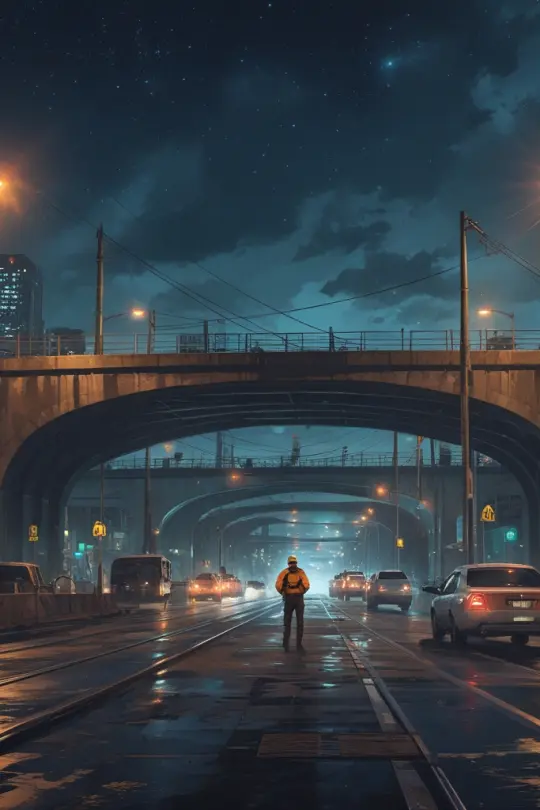
Under Neon Bridges
Join the conversation! Readers are sharing their thoughts:
About the Story
A veteran transit inspector races to stabilize an aging interchange beneath the festival lights. As an aging arch inches toward failure, a tight team of inspectors, a rubber-chicken mascot, and a stubborn rope-access specialist perform a night operation that tests skill, endurance and community ties.
Chapters
Story Insight
Under Neon Bridges follows Eleanor “Nell” Price, a seasoned transit inspector whose work lives in the city’s underbelly: a braided network of brick arches, service cavities and maintenance walkways hidden beneath festival lights and street vendors. On a routine inspection she finds a hairline displacement in an old arch that, under the wrong conditions, could become catastrophic. The story opens in vivid sensory detail—the cold, dense air beneath platforms, the smell of morning broth from a market pocket, a teal-painted mural of a hard-hatted cat—and quickly ties those textures to technical realities. Nell’s tools and habits matter: rope-access rigging, torque sequences, jacking and cribbing are shown with granular clarity so the reader feels the work as a series of precise, physical acts. Supporting figures—Jonah with his battered rubber chicken mascot, Cassian the market organizer, Dr. Amara Singh the structural consultant, and Mallory, the politically pragmatic chief inspector—anchor the stakes in a neighborhood that depends on the line for livelihoods, not headlines. The narrative structure tightens around a central moral and professional dilemma: shut the line and deliver immediate safety with tangible economic harm, or attempt a high-risk field stabilization that relies on skill, timing and human endurance. Instead of resolving tension through conspiracy or revelation, the story makes the protagonist’s professional competence the decisive force. Scenes escalate logically and authentically from anomaly to emergency—an unstable stair here, a displaced stringer there—so the reader understands how maintenance decisions ripple through a built environment. Themes thread through the action: how physical spaces govern daily life, the ethics of stewardship under scarce resources, and the dignity of craft work as moral action. Emotional currents move from Nell’s practiced cynicism toward a renewed sense of purpose; humor and small absurdities—most notably Jonah’s Spanner and whimsical municipal stickers—relieve pressure and humanize the operation without undercutting danger. What stands out is a careful balance of technical authority and human immediacy. The writing privileges tactile detail and procedural competence—jacks settling under load, the cadence of a coordinated haul, the microdecisions of a cramped crawlspace—while keeping community consequences in view: a market that must open, a worker who needs income and a neighborhood that cannot simply pause. Pacing is economical: three compact chapters that set up the discovery, amplify the strain, and culminate in a night operation where a skilled intervention, not an exposé, secures survival. This is a thriller grounded in craft and social texture; it rewards attention to detail, appreciation for infrastructural realities, and a taste for narratives where moral choices are executed with hands-on expertise and practical ingenuity.
Related Stories
The Helios Shard
In a near-future harbor city, a mechanic named Anya uncovers a missing sister's memory shard tied to a corporate trade in stolen recollections. With an old neuroscientist's decoder and a ragged crew, she breaks into archives, fights corporate security, and brings her sister back—exposing the market that would sell people's pasts.
High Job
At dawn on the Beacon, Nora and her small crew intercept a scheduled tension ramp that could snap in gusty wind. Using her rigging skill, she stages a live load transfer under pressure, confronting another climber and Sam's tangled intentions while the city's morning life hums below.
No Trace
A forensic analyst refuses to accept her sister’s ruled death and uncovers a corporate service that erases and rebuilds identities. As she and an uneasy ally force Lacuna’s secrets into the open, a live exposure fractures public truth and reveals the personal cost of restoring lives.
Vanish Protocol
An auditor uncovers a corporate program that turns people into administrative artifacts—erased in paperwork and rehomed under private contracts. As evidence goes public, a fragile coalition of a detective, a reporter, and a whistleblower wrestles with legal backlash, public hearings, and the personal cost of exposing disappearance.
The Wheel and the Whine
Eva, a structural acoustician in Prague, hears an illegal tunnel’s signature near the metro during a festival. With a retired signalman and a brass key to a forgotten floodgate, she descends into service tunnels to outwit a corporate sabotage that would flood stations. A thriller of sound and steel.
At the Edge of Glass
On the night of a glittering building gala, a rope-access technician named Cass and a ragged team convert a criminal façade route into a controlled trap. When the extraction goes early and a tenant is hauled across the city’s glass like contraband, Cass uses his hands and skill to arrest the fall, improvise a rescue, and force a messy, human confrontation. Humor—Jonah's rubber chicken, Mrs. Peabody's gnome semaphore—and the smell of street pancakes and municipal paint cushion the tension as community bonds and ropecraft collide in a tense, physical climax.
Other Stories by Marie Quillan
- Whoever Holds the Switch
- Between Floors and Family
- Counterweights & Company
- The Fifth Door
- Rivenreach: Hollow Bargain
- The Accidental Spectacle
- The Little Star That Lost Its Way
- The House That Counts Silence
- The Lattice Beneath
- The Last Line
- The Littlest Lantern
- The Quiet Register
- The Night the Wind Fell Asleep
- Mila and the Night-Stitch
Frequently Asked Questions about Under Neon Bridges
Who is the main protagonist in Under Neon Bridges and what is her role in the story ?
Nell Price is a veteran transit inspector and rope-access specialist. She detects structural risk in an aging interchange and must stabilize it using technical skill while balancing community impact.
What is the central conflict and how does it relate to the city’s physical infrastructure ?
A failing brick arch threatens service and safety. The conflict forces a choice between shutting the line—hurting local livelihoods—or attempting a risky on-site stabilization to keep the neighborhood moving.
How realistic are the technical details about shoring, jacking, and rope-access work in the book ?
Technical scenes—ring-beam placement, hydraulic jacks, cribbing, torque sequences and manual shimming—are portrayed with tactile detail that reflects real maintenance craft and field procedures.
Does the story focus on a conspiracy or on hands-on professional intervention ?
The thriller centers on professional action. Tension is resolved through skilled, coordinated engineering and manual interventions under pressure, not through uncovering secret conspiracies.
How does humor, such as Jonah’s rubber chicken, influence the tone and pacing of the thriller ?
Light absurdities—Jonah’s rubber chicken Spanner, pigeon stickers and municipal biscuits—punctuate tense moments, humanize the crew and provide emotional relief without undercutting stakes.
What themes about community, responsibility, and the built environment does Under Neon Bridges explore ?
The story examines stewardship, civic responsibility and how infrastructure shapes daily life. It shows how technical choices ripple into economic and social consequences for a neighborhood.
Ratings
A decent premise hampered by a few avoidable issues. The idea of a community rallying to stabilize an interchange under festival lights is compelling, and the initial imagery — Nell’s rope coils, Jonah waving the pigeon sticker — is sharp. But the story keeps pulling toward obvious emotional buttons: the rubber chicken that ‘keeps ghosts busy,’ the cartoon mural watching over everything. Cute, but sometimes it reads like shorthand for depth. The moral choice hinted at doesn’t feel fully explored. Who in the council allowed the arch to reach this state? Why are there no earlier interventions? The rope-access scenes are suspenseful in places but also include moments that strained my suspension of disbelief. Overall: nice atmosphere and a few strong character beats, but I wish the plot had been less tidy and the stakes less telegraphed.
I wanted to love this more than I did. The setting is vivid — the hum of transformers, the market stalls under the bridge — but the plot leans a bit too hard on familiar heroics. The aging arch inching toward failure is a strong image, yet the team’s night operation felt predictably staged: rope-access specialists, a mascot for levity, the stubborn veteran inspector — I could almost map the beats before they happened. There are nice moments (Cassian’s cardamom-scented hands, the pigeon sticker), but pacing flagged for me around the midpoint when exposition crowded the action. Also, some technical choices read like plot conveniences rather than real constraints; I craved either fuller technical grounding or less tidy resolutions. If you want atmosphere over surprise, this fits; if you want fresh twists, it stumbles.
A tight, atmospheric read. The opening with the mural cat and pigeon sticker immediately set a tone of municipal whimsy mixed with melancholy. The tension under the festival lights is expertly done — I especially liked the scene where the gate rattles "like teeth" and Nell checks her kit. It's a story about infrastructure, sure, but more importantly it's about the people who keep cities running and the moral choices they face. Short, thoughtful, and surprisingly moving.
This is the kind of urban thriller that sneaks up on you and refuses to let go. The Old Junction isn’t just a backdrop — it’s a character: brick, iron, and the tired serpents of train lines, alive with the smell of vendor broth and the hum of transformers. I admired how small human moments are threaded through the technical crisis: Cassian’s floury hands, kids running between crates, the market retrofitted into a maintenance alcove. Those details made the eventual night operation feel less like set-piece bravado and more like a communal act of care. Nell’s rope-access skill is written with respect; the author doesn’t romanticize risk but conveys the economy of motion and the heavy responsibility of each clip and knot. Jonah’s Spanner — a rubber chicken with a hole where the squeaker once was — could be an indulgence, but instead it becomes the team’s superstition and comic relief, precisely timed to break tension when needed. Where the book really shines is in its ethical undercurrent. The arch isn’t merely a failing structure; it’s a test of priorities. The inspectors are asked to weigh public safety against political apathy, and the community’s presence — market stalls, hand-soldered lamps, laughing kids — makes each decision feel consequential. I finished wanting more: more backstory on some characters, a longer epilogue with the market after the repair — but maybe that’s the point. The repair is a night: messy, heroic, and imperfect, like community itself. Top marks for atmosphere, craft, and heart.
Quirky, tense, and oddly sweet. I didn’t expect to care about a rubber chicken, but Spanner is perfection — a battered mascot that keeps ghosts (and the crew’s nerves) at bay. The contrast between festival lights overhead and the cold dense air under the platforms makes for striking imagery, and the author times the action well: you can feel the arch’s movement the way you feel a bad toothache getting worse. There were flashes of humor (Jonah’s exaggerated bow with Spanner) that I loved because they humanize the team without undercutting the danger. The moral choices — who to risk, who to protect — land hard. If you like thrillers that root suspense in community and craft, this one’s for you.
Short and sincere: this story nailed atmosphere. The Old Junction as a hidden layer under the city is so vividly drawn — I could smell the morning broth and hear the transformers hum. That tiny pigeon sticker beside the cat mural? Brilliant detail. The team dynamics are warm and believable, especially the scene where Cassian calls from the market pocket while Nell prepares for the rope-access work. Felt real, felt urgent. Loved it. 🙂
As an engineer I appreciated the attention to procedural detail here. The description of Nell’s kit — rope coils at her waist, the handheld tablet in a weather sleeve, the gauge rig over her shoulder — reads like someone either lived the job or did solid research. The sequence where the team times their moves around the market’s bustle and festival lights felt realistic: maintenance teams often coordinate around public events and the added pressure is palpable. The novel’s true strength is how it marries technical suspense with human stakes. The arch’s slow failure is described with mechanical specificity but framed as a moral choice: who gets prioritized, what risks become acceptable. Jonah’s optimism and Spanner’s ridiculousness offset the tension without undermining it. Pacing is tight, atmosphere rich — a convincing urban thriller that respects the labor behind our city’s veins.
Under Neon Bridges surprised me with how tender it is beneath its grit. The scene where Nell shoulders the gauge rig and moves with that rope-worker’s economy — no wasted step — made me stop and picture every careful motion; it felt lived-in and true. Jonah’s Spanner, the rubber chicken with a ripped wing, could have been a throwaway joke, but it becomes a small, human talisman in the face of the arch inching toward failure. I loved the market pocket too: Cassian’s cardamom hands, candles in tin cups, kids shouting about a stolen rubber chick — those moments ground the high-stakes repair in real community life. The night operation under festival lights is tense and cinematic without ever losing the emotional center: people depending on one another, choices that feel moral as much as technical. The writing balances craft and heart; the hum of transformers and the mural cat watching from a bulkhead are images I won’t forget. A compact, compassionate thriller that made me care about infrastructure in a weirdly big way.