
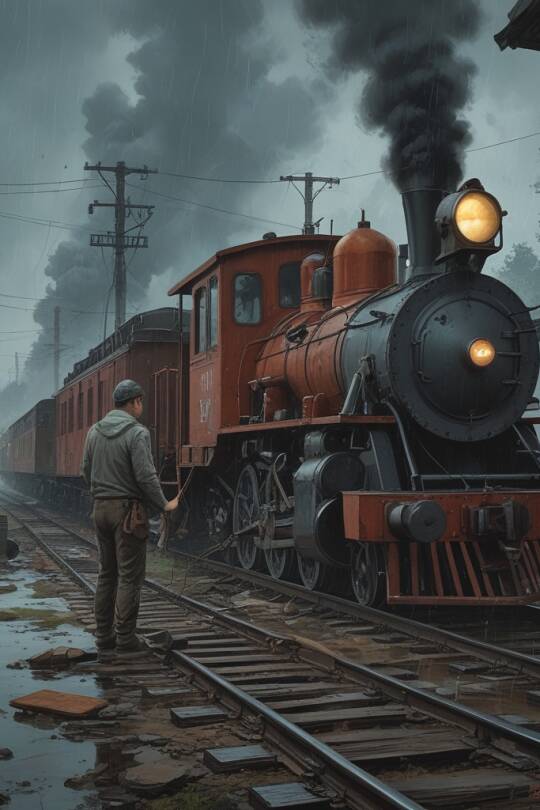
Whoever Holds the Switch
Join the conversation! Readers are sharing their thoughts:
About the Story
Rain-soaked and careful, signal technician Cass Havel rigs a jury bypass to divert a relief train bearing purifiers and presses to a neighboring town. Tension and ingenuity mingle with small absurdities and the day's work of hands and tools — a tight, tactile struggle for salvage and connection.
Chapters
Story Insight
Cass Havel lives by tolerances and torque in a derelict switch tower, a person who understands relationships between metal parts the way others understand people. When Asha, her younger sister, asks for help rerouting a relief train carrying water purifiers and greenhouse presses, Cass faces a precise moral problem: stay hidden in the measured safety of solitude, or risk the fragility of hands-and-iron work to reconnect towns that depend on that cargo. The setup is immediate and tactile—collapsed viaduct, a weather-pressured timetable, a jury-rigged bypass built from scavenged plates and planks—and the story’s tension comes from tradecraft as much as from stakes. Cass’s companions are practical and human: Lena Voss, an engineer who trusts old signals; Harkin, a retired rigger with a knack for comic timing; a ragged crew of volunteers; and the Cone Devotees, an absurd little collective that blesses traffic cones with knitted crowns. Small details anchor the world—market carts selling fermented kelp cakes, children practicing whistle-calls, a makeshift solar-still—so that the ruins feel lived-in rather than theatrical. This three-chapter tale treats profession as metaphor and action as ethics. Rather than dramatic revelations or sweeping ideological battles, the narrative rests on muscle memory, improvisation, and the apprenticeship of skill: threading block-and-tackle, shaping a shim from a spoon, balancing a counterweight so a single person doesn’t bear catastrophic momentum. Those mechanics are not technical window dressing; they structure the moral argument. Cass’s choice is not abstract; it’s a sequence of pulls, wedges, and timing cues where a misstep means real loss. Humor and human absurdity thread through the strain—Spanner, a buzzy patched wrench with a sarcastic hum, the knitted-cone coronation, an unexpectedly painted garden gnome among the cargo—so that the story never becomes only grim. Emotional beats move from weary isolation to the fragile warmth of shared labor, with apprenticeship and ordinary rituals forming the bridge. The reading experience is hands-on and grounded: the prose favors the sensory and kinetic—grease, rain, the way a flange sings under pressure—over grand exposition. The structure is compact but full, with a tight arc that privileges craft, communal problem-solving, and the small, stubborn persistence of everyday rituals after disaster. The story will appeal to readers who value post-apocalyptic fiction that focuses on practical ingenuity, quiet moral decisions, and the texture of rebuilding—those who appreciate clear-eyed depictions of how skill and cooperation reshape a broken world, and who enjoy a touch of absurdity woven into earnest work.
Related Stories
Latch League
In the salt-scoured ruins of a vanished sea, mechanic Nessa Rell breaks a water baron’s hold to save her settlement. She braves salt storms, con artists, and the belly of a desalination fortress, aided by a radio witch, a limping engineer, and a snappish drone. As flood meets thirst, she must choose between chaos and community.
Ashwater Garden
In a salt-scarred world where water is currency and hope a fragile crop, a young hydroponic technician steals a vital filter to save her brother and her community. Her journey across ruined roads, through negotiation and small betrayals, plants the first green of a new ordinary.
Breath of Ashmere
In a drowned coastal ruin, boatwright Rin scavenges and fights to restore clean water. Given a fragile living filter and an unlikely drone companion, she confronts the Valves who hoard desalination. A dangerous, human story of repair, small miracles, and community resilience.
The Ferryman's Signal
In a fractured coastal world, a young radio mechanic, Etta, embarks from her barge to coax light back into her settlement. She bargains, fights, and learns to stitch communities together with fragile technology and harder choices. A post-apocalyptic tale of barter, courage, and shared light.
Ash & Root
Ash & Root follows a reluctant agronomist, a scavenger, and an orphan as they find a buried seed repository that requires a living human context to awaken. In a tense standoff with a resource band, they attempt an experimental distributed memory upload, forcing a costly, personal reckoning as new shoots push through ash.
The Last Garden of Static
In a ruined port-city, a clockmaker named Mirella sets out to retrieve a rumored pulse-seed that can revive salt-ruined soil. She negotiates with keepers of memory, earns a test, and returns to root a fragile hope into a tram-top greenhouse—transforming fear into shared stewardship.
Other Stories by Marie Quillan
- Under Neon Bridges
- Between Floors and Family
- Counterweights & Company
- The Fifth Door
- Rivenreach: Hollow Bargain
- The Accidental Spectacle
- The Little Star That Lost Its Way
- The Lattice Beneath
- The Night the Wind Fell Asleep
- The Last Line
- The Littlest Lantern
- The Quiet Register
- The House That Counts Silence
- Mila and the Night-Stitch
Frequently Asked Questions about Whoever Holds the Switch
What is Whoever Holds the Switch about and who is the protagonist ?
A rain-soaked post-apocalyptic novella following Cass Havel, an ex-signal technician who must rig a jury-rigged rail bypass to divert a relief train and reconnect neighboring communities.
How does Cass’s profession as a signal technician shape the story's central conflict ?
Cass’s mechanical skills create the plot: knowledge of levers, counterweights, and timing makes her the only person able to attempt the risky diversion. The conflict resolves through applied tradecraft.
Does the plot emphasize practical action or emotional development ?
Both are balanced: tense, physical sequences of rigging and timing drive the action, while emotional threads grow through shared labor, teaching, and the gradual return from isolation to community.
What themes and emotions does the novella explore ?
Themes include responsibility versus safety, profession as metaphor, community rebuilding, and ingenuity under pressure. Emotionally it moves from guarded loneliness toward connection and practical hope.
How realistic are the technical details and depiction of railwork ?
The story grounds its craft in believable mechanics—splices, block-and-tackle, manual throws—presented accessibly for readers while prioritizing dramatic pacing and hands-on problem solving.
Will readers find humor and human moments in this bleak setting ?
Yes. Small absurdities—knitted cone coronations, a buzzy patched wrench, a painted garden gnome—provide comic relief and human warmth amid tense, tactile work and survival stakes.
Ratings
I wanted to like Whoever Holds the Switch more than I did. The writing is tactile and occasionally brilliant — the gouge on the handrail, the buzz-buzzer on Spanner, and the feel of a failing tooth in a bronze drive are all evocative — but the story felt contained to a fault. The central action (rigging a jury bypass to divert a relief train carrying purifiers and presses) raises big moral and logistical questions that never get fully addressed. Who decides which town gets help? How will supplies be redistributed? The narrative skirts these consequences as if the choice exists only in isolation. Pacing also falters. The middle is dense with tool porn — which is charming for a while — but it slows the forward momentum so the diversion's fallout feels undercooked. A few scenes read like vignettes rather than parts of a whole, and Cass, for all her competence, is oddly opaque; I wanted more of her interior life beyond workmanship. In short: beautiful writing in spots, but ultimately too small for the moral stakes it raises. Feels more like a fragment than a fully realized piece.
There is something almost liturgical about the way this story treats workmanship. Cass's mornings are a ritual: a cabin of tools, the familiar gouge on the handrail, the bronze teeth of a drive that need delicate persuasion. The prose is full of small rites — oiling a shaft, coaxing a pawl — and through those gestures the author creates a community and a morality. The diversion of the relief train is not just a plot point; it is a moral act carried out with grease-stained fingers and a sense of gravity that never slips into melodrama. I loved how ordinary details function as anchors: roasted mushroom skins cooling on a windowsill, a buzzer that makes Spanner 'talkative,' the kettle lights that keep towns steady even when boilers are patched with shoe leather. Those domestic notes turn the devastated landscape from a backdrop into a lived world. Cass is quietly heroic because she understands how systems — social and mechanical — are held together by patient, sometimes lonely labor. The ending (subtle, unbroadcast) leaves you with tactile echoes: the click of a semaphore, the damp smell after rain, a choice made that will ripple in ways the story only hints at. It's lovely, humane, and quietly fierce.
This one is a lovely little wrench-twister of a story. Who knew I could get so invested in a handrail gouge? The author has a sharp eye for the ridiculous: a buzzer on a spanner because Harkin thinks tools need to be "talkative" is peak post-apoc charm — Spanner could start a podcast and I would subscribe. Cass is competent in a way that feels believable rather than superheroic; the scenes where she jabs oil into bronze teeth and listens for a failing pawl are tense without melodrama. The moral choice to rig a jury bypass and steer the purifiers elsewhere lands exactly where it should — messy, necessary, awkwardly human. If you like trains, greasy hands, and a little dry humor with your bleakness, this is delightful. Also, more sentient wrenches, please. 🙃
Short and sharp. I loved the quiet attention to tools and touch — Cass measuring gaps by feel, coaxing a stuck pawl free — it made the world feel lived-in. The scene with the buzzer on Spanner made me smile; it’s those silly human touches that keep the story from being bleak. The diversion of the relief train felt morally dense without getting preachy. The prose is spare and tactile, and the fogged flats and mushroom skins make the setting vivid in just a few lines. A restrained, satisfying read. I'd happily read a longer piece set here.
I appreciated the craft in Whoever Holds the Switch. The piece reads like a manual for living in a ruined world: meticulous, tactile, and morally complicated. The jury bypass plot is compact but dense — diverting a relief train of purifiers and presses is a high-stakes technical decision that the story makes visceral by showing the exact motions: opening the maintenance hatch, feeling for a failing tooth, cradling a relay while swapping a contact. Those micro-actions are where the narrative tension lives. The author builds atmosphere economically; a neighbor's breakfast smells anchor the rail tower to community and keep the narrative from sliding into pure technician fetishism. I also liked how humor creeps in (Harkin wiring a buzzer onto Spanner) to humanize otherwise technical sequences. If there's any critique, it's that the wider logistical fallout of diverting the train is hinted at rather than examined — a deliberate choice, perhaps, to keep the focus on Cass. This is a short, focused slice of post-apocalyptic life that rewards readers who like character through craftmanship rather than broad exposition.
I fell in love with Cass Havel on the first page. The opening line — the tower's gears sighing like something alive — set the tone: quiet, stubborn, and tender. I kept picturing her running a hand over that gouge on the handrail and feeling the memory of the storm; those small scars tell you everything you need to know about who she is. The jury bypass and the choice to divert the relief train are handled with such pressure and restraint that my chest actually hurt during the moments when she braces the semaphore and waits for the signal to hold. What stood out was how tangible everything felt: the buzz-buzzer on Spanner, the smell of roasted mushroom skins, the way oil finds a stuck tooth. This is a salvage story that trusts its readers to notice the details, and it pays off. The humor — little absurdities like a talkative wrench — kept it from being dour. Warm, tense, and ultimately humane. 🙂