
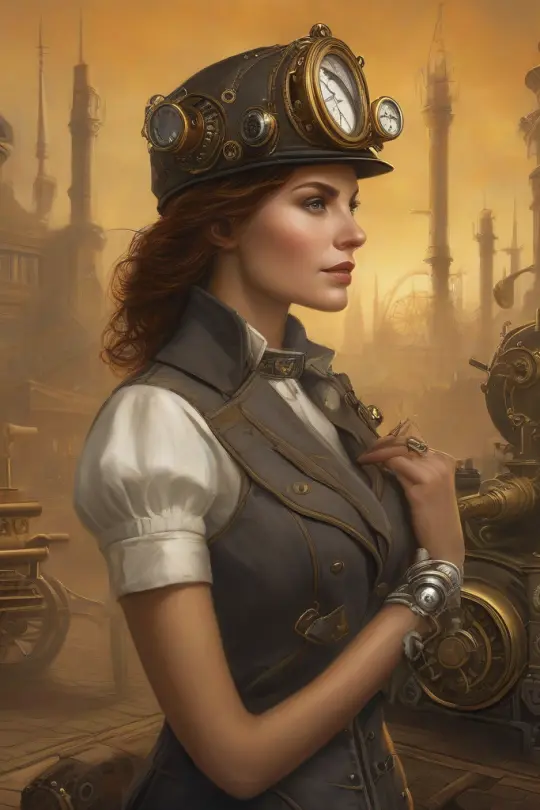
Gears of the Aurelian Sky
Join the conversation! Readers are sharing their thoughts:
About the Story
In smog-thinned Gearhaven, 23-year-old inventor El Hartwell uncovers the theft of a Nimbus Cog—an engine tooth that keeps the city aloft. She assembles unlikely allies, faces a powerful industrialist, and restores the city's breath with brass, cunning, and a newfound community of tinkerers.
Chapters
Related Stories
Aether Gauge
After Lina is taken into the Aurel Spire's stabilization chambers, Rowan Hale assembles a ragged crew to infiltrate the city’s heart. They discover the lattice stores living phase-fragments and attempt a desperate reverse feed that requires a living harmonic anchor. The final operation forces Rowan into the role of instrument: guiding stolen fragments into resynthesis cradles while the system fights to conserve itself. Sacrifice, exposure and the machine’s moral cost converge in a storm of brass and circuitry.
The Bridgewright's Concord
A market bridge in a steam-city sings with strain as rerouted freight and a coming storm test its bones. Rowan Pike, a solitary bridgewright, must use his hands and peculiar craft—lace-tensioning, counterweights, and an ear for harmonics—to hold lives together while neighbors, automatons, and a stubborn guild watch and wait.
Aurelia Finch and the Lattice of Brasshaven
In a vertical steampunk city, young mechanic Aurelia Finch must clear her father's name after the Lattice—the network of air currents that keeps the city aloft—is sabotaged. With a clockwork fox and a band of unlikely allies, she uncovers a corporate plot and restores the city's balance.
Regulator of Ether
In a brass-and-steam city, clocksmith Mira Calder uncovers the Regulator's hidden role: distilling citizens' memories into power. When her brother is taken as a calibration subject, she must infiltrate the heart of the machine with a mechanical Lark and an old family cipher to stop a synchronized harmonization.
Clockwork Covenant
In a city held together by a vast engine called the Cogheart, a tinker’s discovery of a child automaton and a shattered memory vial reveals that the machine runs on pieces of lived lives. Confronted with evidence that her father’s designs are part of the system, Evelyn joins a salvage crew to infiltrate the spire and trigger a radical reconfiguration. The climax forces a terrible choice—sacrifice an automaton and risk infrastructure failure to return memories to the people. The aftermath leaves the city altered: the Cogheart remains but is rebalanced through distributed nodes, and citizens begin to reclaim fragments of themselves amid ongoing repairs and contestations.
Cadence of Brass
Beneath Bellwrought’s Spire, a salvage engineer’s desperate offering forces the city’s great engine to hear a human voice. As alarms flare and automata clash with citizens, a delicate reconfiguration begins: a pilot test of voluntary memory anchors, public leaks of withheld ledgers, and the slow building of relay vaults that let neighborhoods choose how memories are used. The city’s governance trembles; old authorities bargain for control, while new oversight and communal repair reshape how technology draws from private life.
Other Stories by Yara Montrel
Ratings
I wanted to love this more than I did. The premise — a missing Nimbus Cog threatening the city's very lift — is neat, and the images (the Great Clock's gong, Brass the automaton cat) are vivid. But the story leans on familiar beats: the young inventor prodigy, the shadowy industrialist antagonist, the ragtag team of tinkerers who rally at the end. There's a comfortable predictability to El's arc that undercuts some of the tension. Pacing is also uneven. The opening workshop scenes are gorgeously paced and detailed, but when the plot kicks into its central mystery, it sometimes feels rushed; certain creative solutions are handed to the reader rather than earned through earlier setup. A few secondary allies remain sketches rather than full people, which lessens the emotional payoff when the community bands together. That said, the writing sparkles in moments, and the world has real potential. With tighter plotting and deeper characterization of the supporting cast, this could have been exceptional rather than merely pleasant.
I came for the steampunk aesthetics and stayed for the characters. El is the kind of protagonist who wins you over not by grand speeches but by elbow grease and stubborn curiosity: the workshop scenes — her file against the gear, the automaton cat leaning into the hum — are some of the best character work here. You can feel her learning not just about machines but about trust. The worldbuilding is confident without being showy. Gearhaven's Great Engine and the Aurelian Array are described with clarity and a poet's eye. The theft of the Nimbus Cog is a clever premise; it hooks you with both immediate peril (the city's air failing) and metaphorical weight (a community's fragile balance). The coalition of tinkerers is a joy — each ally brings a practical skill and personality that complements El, and the final push against the industrialist has teeth because it's technical ingenuity against oppressive wealth. Style-wise, the prose flirts with lyricism but stays grounded in craft. I especially appreciated the small, human moments: the charcoal scrawl on the news-board, the automaton's mica eyes, the midday gong resonating through metal and marrow. If you like your adventure threaded with invention and quiet camaraderie, this is a very satisfying ride.
A lovely, quiet triumph. The imagery of sunlight painting "copper ribbons" across the bench and the click-and-whirr of Brass made me physically relax into the story. El's attention to small things — lining up tiny cogs, listening to the boiler's sigh — gives the book a meditative patience. The central mystery (the missing Nimbus Cog) provides real stakes without sacrificing the novel's reflective mood. The ending, where the tinkerers come together, felt earned and warm. A short but very sweet read.
Gears of the Aurelian Sky is an immersive piece of speculative fiction that balances intricate worldbuilding with a satisfying emotional arc. From the opening paragraph the author demonstrates a command of sensory detail: the "sharp lamp oil" and "polished mica" conjure the olfactory and visual textures of Gearhaven so convincingly that the city becomes tactile. The narrative architecture is solid. The theft of the Nimbus Cog is an elegantly chosen problem — it's both mechanically specific and narratively symbolic: a missing tooth in the city's jaw that unbalances more than just airflow. The excerpt's pacing is deliberate but never indulgent; scenes like the automaton cat absorbing the bench's vibration or the Market Row headline stamped with urgency are short, precise beats that move character and plot forward. El Hartwell's development from solitary tinkerer to leader of a ragtag community is handled with restraint. Her ingenuity isn't a constant stream of deus ex machina fixes; instead, solutions emerge from collaboration and incremental ingenuity. The industrialist antagonist reads as a believable force — a reminder that progress, in this world, is often entangled with corporate ambition. The novel's strongest asset is its ability to make technical descriptions feel lyrical without losing clarity. If the book has a weakness, it is occasionally conventional in its choice of obstacles, but even familiar tropes are rendered fresh by the prose and craft. For readers who appreciate atmospheric, mechanically rich storytelling with a heart, this is a rewarding flight.
Short and sweet: this is steampunk done right. The prose smells like oil and possibility — literally, with that "hands smelled like tomorrow" line which stuck with me. El is a heroine I want to build contraptions with; Brass the automaton cat deserves its own merch. Loved the Market Row headline moment — that charcoal scrawl under the official notice is such a good touch. The community of tinkerers felt warm and earned. Gave me major airship-daydream vibes. Read it on a rainy afternoon and grinned the whole time. 🛠️✨
A thoughtful, well-constructed steampunk adventure. The author nails the small mechanics that make the world believable: the half-assembled atmospheric regulator on El's bench, the sequence of tiny cogs "like teeth out of a sun," and the automaton cat's micro-movements. These details do the heavy lifting of immersion. Plot-wise, the theft of the Nimbus Cog is a neat inciting incident; it's not merely a MacGuffin but a logical threat to the city's balance. The Great Engine and the Aurelian Array are well-conceived concepts, and the political undercurrent — an industrialist with disproportionate power over civic infrastructure — grounds the stakes. I also appreciated the pacing: the early workshop vignettes slow the story long enough to establish mood before accelerating into the mystery and the alliance-building. The reveal and resolution (El assembling unlikely allies and restoring the city's breath) read as earned, thanks to incremental technical problem-solving rather than deus ex machina. If I have one critique, it's that certain secondary characters could benefit from sharper distinctives earlier on; they feel archetypal at first, though many receive satisfying development later. Overall, smart, mechanically affectionate, and emotionally resonant.
I fell into Gearhaven like someone slipping through an open hatch — and I didn't want to climb back out. The opening lines alone (El's hands smelling "like tomorrow") set the tone: intimate, metallic, full of curious longing. I adored Brass the automaton cat; the little moment where it leans into the bench's vibration made me grin. The city itself is a character — the noon gong of the Great Clock, the grime-streaked panes, the news-board scrawl 'NIMBUS COG MISSING' — everything hums with attention to detail. El's mix of stubbornness and tenderness felt honest; her workshops scenes, filing a gear while listening to the city's sighs, are quietly powerful. The confrontation with the industrialist and the eventual rallying of tinkerers is deeply satisfying — not because it's flashy, but because it celebrates community and craft. This is a coming-of-age that smells of oil and possibility. Highly recommend for anyone who loves atmospheric steampunk with heart. ❤️