
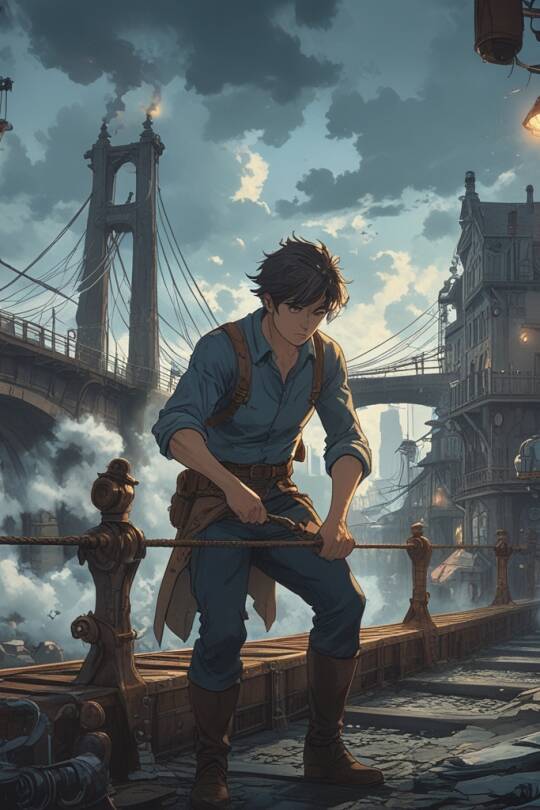
The Bridgewright's Concord
Join the conversation! Readers are sharing their thoughts:
About the Story
A market bridge in a steam-city sings with strain as rerouted freight and a coming storm test its bones. Rowan Pike, a solitary bridgewright, must use his hands and peculiar craft—lace-tensioning, counterweights, and an ear for harmonics—to hold lives together while neighbors, automatons, and a stubborn guild watch and wait.
Chapters
Story Insight
Set in a rain-slick, brass-laced steampunk city where trams reroute like tides and market awnings clap against iron, The Bridgewright's Concord centers on Rowan Pike, a middle-aged bridgewright whose life is ordered by rivets, tension calipers, and a peculiar instrument he calls a ratchet-harp. The immediate crisis is deliberately local and urgent: freight reroutes combined with a coming squall push a neighborhood’s Market Span into dangerous harmonics. A modest petition from neighbors—led by the pragmatic Juno Voss and watched over by the guild inspector Harrum Keel—asks Rowan for a removable walkway. That small engineering request forces a moral calculation: adhere to slow, exacting guild procedure, or improvise in time to protect people who cannot wait. The novel privileges hands-on craft: lace-tensioning techniques, counterweights fashioned from salvaged tram anchors, calibrated wedges and gussets are described with tactile clarity. Everyday urban details—candied valve-caps, clockwork buskers, lamplighters’ rituals—anchor the technical sequences in a lived-in culture, and moments of absurdity (a clockwork goose named Sprocket, a vaudeville automaton troupe bartering cogs) keep the tone warm and wry even as stakes rise. The story treats profession as a language of ethics and belonging. Rowan’s technical expertise becomes the means by which social ties are maintained or remade: neighbors form human chains, bakers crank improvised winches, and performers lend theatrical hands for steadying counterweights. The conflict is intimate rather than ideological—the tension arises from procedural caution, reputational risk, and Rowan’s own fear of past errors—so the moral questions are felt in callused palms and measured breaths, not in sweeping manifestos. Emotionally, the arc moves from isolation toward connection; trust is built through shared labor and the practical exchange of skills. Humor and absurdity interrupt the seriousness at precisely human moments, offering relief without undercutting the technical drama. Importantly, the climax hinges on professional action: the resolution comes from manual retuning, strategic counterbalancing, and a bridgewright’s judgment under pressure, not from an exposé or sudden revelation. For readers who appreciate steampunk grounded in plausible mechanics and small-scale stakes, this novel offers a satisfying balance of detail, heart, and restraint. The prose often mirrors the rhythm of work—measured, focused, and observant—so scenes of labor read with the same embodied precision as the engineering itself. The depiction of tools, procedures, and improvised field fixes demonstrates a confident, informed approach that lends the city’s problems credible texture; at the same time the narrative keeps its attention on people in motion: neighbors trading favors, automata adding comic choreography, and a bridgewright learning to accept apprenticeship and community. If steady pacing, tactile worldbuilding, wry humor, and moral choices enacted through craft appeal, The Bridgewright's Concord offers a warmly human, mechanically literate visit to a city where engineering and belonging are inseparable.
Related Stories
Blueprints at Dawn
In smoke-dark Cinderford, Evelyn Thorne rigs Ambrose Hale’s Alabaster Engine to reverse a trade in stolen recollections. As she becomes the living key to a mass restoration, the Conservatory’s polished cruelty unravels into public exposure, mechanical collapse, and the wrenching cost of memory redistributed.
The Brass Meridian
In a soot-stained steampunk metropolis, cartographer-inventor Iris Vane races to recover fragments of the stolen Meridian Key. With a clockwork raven, an old captain, and a ragged crew, she confronts a power-hungry councilor to restore her city's balance and reshape its future.
Brass at Noon
In a city governed by a monumental Sundial Engine that steadies life by siphoning tiny moments from its citizens, an inventor named Ada Larkin discovers the Engine’s mneme reservoir and leads a small resistance to retrieve stolen fragments of memory. Amid public hearings and mechanical sentinels, Ada faces a wrenching choice: bind herself to the machine as a living regulator to redistribute reclaimed minutes, or risk partial, technical restitution. The climax unspools in the Engine’s core as mneme flows back into neighborhoods and the cost of restoration reveals itself in intimate, irrevocable ways.
Clockwork Bloom
After a contested seizure and a raid, Tamsin Hargreave and the Steamwrights launch a daring plan during the Coal Tithe to prevent House Crowthorn from turning the Clockwork Bloom into a citywide governor. A distributed network of Bloom-buds, a sabotage inside the Vellum Spire, and a sacrificial bridging of Ivo's spring force a new protocol: the Bloom's control can only arise through many hands, not one. The city's mechanics and people must now learn to tend this fragile, communal system amid political backlash.
Regulator of Ether
In a brass-and-steam city, clocksmith Mira Calder uncovers the Regulator's hidden role: distilling citizens' memories into power. When her brother is taken as a calibration subject, she must infiltrate the heart of the machine with a mechanical Lark and an old family cipher to stop a synchronized harmonization.
Clockwork Concord
After a nearly disastrous rehearsal, Elias the clocksmith performs a high-stakes, hands-on repair mid-performance to save a theatre premiere. The climax relies on his horological skill—filing a gear tooth, re-tuning an escapement, improvising a coupling—while absurd companions and neighborhood customs thread humor and warmth through the tense night.
Other Stories by Clara Deylen
Frequently Asked Questions about The Bridgewright's Concord
What is The Bridgewright's Concord about and what makes its plot distinctive ?
This steampunk tale follows Rowan Pike, a bridgewright who must improvise technical fixes to save neighbors when freight reroutes and a storm strain the Market Span. The drama hinges on craft, community, and hands-on action.
Who are the central characters and how do they interact with Rowan Pike in the story ?
Rowan works with Juno Voss, a pragmatic courier and community catalyst; Harrum Keel, a guild inspector enforcing rules; Bea and neighbors who provide practical support. Their relationships grow through shared labor and trust.
How accurate and detailed is the engineering and steampunk technology in the narrative ?
The book emphasizes plausible field engineering—lace-tensioning, counterweights, gussets, ratchet-harp diagnostics—presented with tactile detail. Technical scenes are crafted to feel authentic without overwhelming readers.
What emotional and thematic arc can readers expect from the novel ?
Emotionally the story moves from solitude to connection. Themes include responsibility versus procedural caution, the ethics of improvisation, and how profession can become a bridge to community and belonging.
Is there humor or absurdity in the story, and how is it balanced with serious stakes ?
Yes. Comic elements—Sprocket the clockwork goose, an automaton troupe, and barter-for-parts scenes—relieve tension and humanize characters while the engineering crisis remains urgent and consequential.
Does the climax rely on revelation or on Rowan’s professional skills and actions ?
The climax is resolved through Rowan's practical expertise: retuning harmonics, re-routing loads, and rigging counterweights. The rescue depends on skilled action rather than exposé or sudden insight.
Are there content warnings or sensitive themes readers should know about before reading ?
The story contains tense engineering danger and storm scenes but avoids graphic violence. It emphasizes community rescue, technical problem-solving, and procedural conflict rather than trauma-focused content.
Ratings
Honestly, I wanted to like this more than I did. The premise — a bridge singing under strain and a lone craftsman trying to hold it together — is promising, but it leans too hard on cozy tropes. Rowan’s taciturn heroism and the warm, bustling market feel a touch familiar: the kindly baker, the quirky mechanical pet, the stern but noble guild. By the time the storm is mentioned, the tension reads like a checklist rather than a real threat. Cute moments (Sprocket’s rivet caper, clockwork buskers) distract from the fact that the story doesn’t challenge its characters much; I wanted a clearer idea of why the guild hesitates or what real consequences a failing bridge would have beyond neighborhood inconvenience. Pacing drifts in places and certain guild motivations feel undercooked. Pleasant to read, but not as ambitious as the setup suggests.
Careful, economical worldbuilding and a strong central image make this piece sing. The Market Span scene is a masterclass in economy: a few well-chosen details (caramelized gear-nuts, molasses tea, children with goggles) conjure an entire neighborhood. The author’s choice to foreground Rowan’s listening — not to gossip but to metal — gives the narrative a distinctive POV and anchors the technical aspects emotionally. I admired the balance: tools and schematic-scratchings coexist with small interpersonal gestures (Bea’s flour-smudged wrist, the teacup habit). Even the humor is purposeful — Sprocket’s rivet-scatter is a nice beat that humanizes Rowan without flattening the stakes. Overall, tidy, thoughtful, and satisfying.
Lyrical, tactile, and utterly human — The Bridgewright’s Concord reads like a hymn to small-scale craftsmanship. The opening lines where Rowan listens to iron and catches the seam’s barely audible ping are so sensory they stopped me. The Market Span becomes a living instrument: banners clacking like percussion, steam turning gutters into lazy fog, and harmonics from a ratchet-harp that suggest a city in constant quiet tune. I especially loved how the technical language — lace-tensioning, counterweights, braid cords — never feels like an info-dump. Instead it’s intimate vocabulary, the way a painter knows pigments or a potter knows clay. Scenes such as Sprocket nosing rivets ask for a smile, while moments of preparation for the coming storm tighten your chest; the bridge’s strain mirrors Rowan’s solitary but stubborn resolve. The found-family element is handled gently but resonantly: Bea’s tea, the festival banners, even the clockwork buskers are threads in a communal tapestry. The author balances humor and peril, and the prose itself hums a little like the bridge. I’d happily follow Rowan into longer repair logs and festival mornings.
This story made me chuckle more than once. Who knew a bridge could be dramatic? From the clockwork buskers making lamp-posts wobble to Sprocket the goose playing saboteur with the rivets, the author sprinkles in little comedic beats that keep the steam-city from ever feeling grim. Rowan’s quiet competence — his thumb, the neat script on the ratchet-harp tuner, the coils of braided steel like sleeping eels — is a joy to watch. I loved the exchange with Bea slipping a tea into his hands; it’s such a lived-in, small-town moment that softens the mechanical grit. There’s genuine suspense as freight gets rerouted and a storm approaches, but the tone stays warm: this is community-saving-first, melodrama-second. Good fun and oddly moving.
Short and sweet: this felt like a cozy, clever steampunk postcard. I loved the little domestic beats — Sprocket tops the list — and Bea’s bergamot-scented laugh is everything. The bridge’s ‘song’ and Rowan’s hands-on craft gave the piece heart and real tension. Would read a whole novel about these people. 😊
As an engineer-nerd, I appreciated how the story makes craft into character. The lace-tensioning and counterweights aren’t just technobabble — they’re woven into Rowan’s way of seeing the world. That opening sequence where he listens to the seam and the static prickles up his forearm is a concise masterclass in showing not telling. Worldbuilding is compact but convincing: laundry vents fogging the gutters, brass lattice shining like honey, clockwork buskers with a tune that makes lamp-posts wobble. Even small props — the ratchet-harp tuner, Sprocket’s rivet spill — tell you who Rowan is. The scenes where the bridge itself seems to sing under strain were especially effective; the author conveys harmonic tension in sensory terms I could almost hear. Pacing is generally solid; the community elements (Bea’s stall, festival banners) balance the technical stakes. If you like fiction where engineering isn’t an afterthought but the emotional spine, this is for you.
I fell in love with Rowan Pike on the first page. The way the author writes listening as a craft — Rowan running his thumb along a half-riveted plate and reading that tiny ping — is just beautiful. That opening image set the tone: a city that’s alive in metal and steam, the Market Span shimmering like honey, children chasing mechanical pigeons. What really got me was the found-family warmth: Bea’s laugh, the teacup routine, Sprocket the brass goose nosing rivets across the floor. It felt like the bridge is almost another character, singing under strain as the storm approaches. The technical bits (lace-tensioning, counterweights, harmonics) are handled with love and clarity; you can feel the tension in the cords and in Rowan himself. There’s humor and tenderness in equal measure — the clockwork buskers making lamp-posts wobble made me grin — and when the freight gets rerouted and the storm looms, the stakes feel genuinely human. Cozy, inventive, and quietly heroic. I want more of this world.