
The Residual Chorus
Join the conversation! Readers are sharing their thoughts:
About the Story
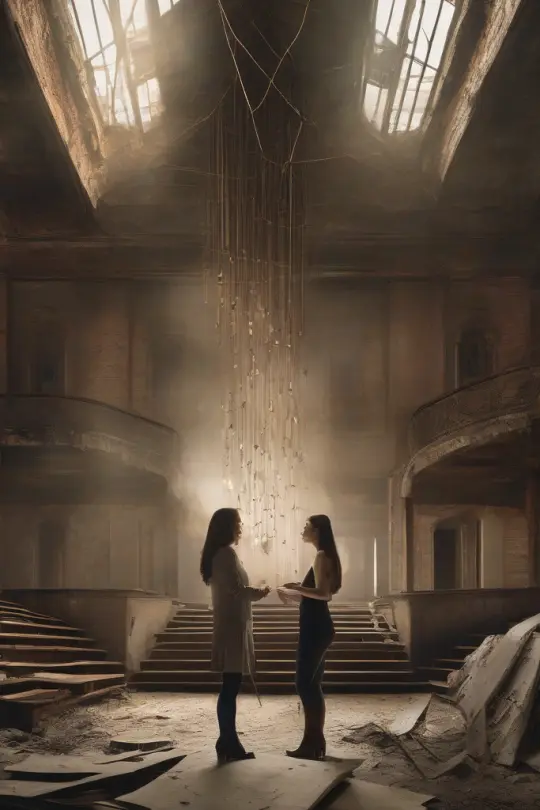
Urban acoustics graduate Mara Chen and former opera sound engineer Edda Volkov confront a sentient resonance nesting under a derelict opera house. When Mara’s friend vanishes, the city’s echoes turn predatory. Armed with a tuning fork and a makeshift phase inverter, they detune the hall before demolition—and learn how to let rooms be empty.
Chapters
Related Stories
The House That Counts Silence
Leah Hargrove, a young sound restorer, inherits a coastal house whose brass machine keeps 'hours' by extracting silence and hoarding voices. To save a town's softened noises she must bargain with the house's ledger, face a ledger-shadow, and trade time for memory.
The Registry
In a town where civic papers anchor reality, records clerk Mara Lyle finds her sister’s file erased and memories fading. She uncovers an Index that trades names like currency. Determined to restore Liza, Mara confronts a ledger that balances existence with ruthless arithmetic.
The Hush in the Vault
In a fogbound city, a young archivist discovers a forbidden tape that erases names and memory. Joined by a retired engineer and volunteers, she must confront an experimental transmitter turned ravenous. A nightly struggle to reclaim voices becomes a cost paid in small, ordinary losses.
Shadows of Wren Street
Nora returns to her aunt’s house to settle an estate and discovers a house that collects small, precise losses of memory. As jars and ledgered remnants surface, the community confronts a failing chest that demands a living anchor. Tension rises as memories return while something in the corners hungers.
The Fifth Door
Evelyn makes the final, terrible exchange with the house that keeps people behind small doors. She charges tokens with the most intimate memories of her sister and watches Lina re-enter the world as the town’s records smooth to accommodate it. The recovery is exacting: every memory surrendered erases the ways Evelyn knew Lina, and the house balances its ledger in the quietest, most intimate currency — the sensory details that make a life recognizable.
The Quiet Below
A conservator of photographs unearths an album that eats memory. As faces return to prints, something in the city grows hungry. To stop it she bargains with an old seeing glass, and pays a private price. A horror about what we keep and what we lose to save others.
Other Stories by Mariette Duval
Ratings
The Residual Chorus is one of those stories that sneaks up on you: it begins as a field-recording exercise and turns into an elegy for empty places. The opening paragraphs are precise and tactile — Mara clutching the recorder, the river’s greasy groan, the grate that “exhaled a constant, damp current” — and they do important work establishing a world where ordinary urban sounds are loaded with meaning. The bond between Mara and Edda is handled with restraint but real feeling. Edda’s history as an opera sound engineer isn’t just backstory; it informs the climax and lends emotional weight to the detuning ritual. I particularly liked how the story treats the tuning fork and phase inverter: not as magic trinkets but as tools that require knowledge, patience, and a willingness to accept vacancy. The author avoids sensationalism; the horror comes from attention — the city’s echoes becoming predatory is terrifying because it transforms familiarity into threat. Thematically, the idea of learning “how to let rooms be empty” elevates the piece beyond a simple haunted-building yarn. It’s about consent, about the ethics of occupying space, and about knowing when to step away. The prose is often lyric without being precious, and specific moments (the waveform creeping across the recorder, the banner announcing emergency demolition) add a lived-in quality that kept me invested. If you like slow-burn horror with smart, female-driven protagonists and a focus on atmosphere over gore, this is a fine example. It left me thinking about the sounds of my own city for hours afterward.
I wanted to like this more than I did. The premise — urban echoes turning predatory — is cool, and those first few pages are vivid (the vent, the waveform, Graybridge’s hulking profile). But the story leans heavily on atmosphere and then skims over a few plot things that bugged me. The friend’s disappearance is supposed to be the catalyst, yet we don’t get much emotional fallout or explanation beyond ‘it happened’ — felt like a missed opportunity to deepen stakes. Also, the phase-inverter/tuning-fork solution tips into neat little deus ex machina territory: it’s clever, sure, but too tidy given how cosmic the threat is framed earlier. Pacing sags in the middle; a few scenes wander without adding new tension. I enjoyed the writing and some of the imagery, but wanted sharper character beats and a less convenient ending. Not bad, just a bit undercooked for what could have been a truly haunting tale. 👎
Short and lovely — the story’s strength is sensory writing. That opener with Mara holding the recorder “like a votive candle” and the city buzzing “like hornets” made me shiver. I especially liked the moment she leans in until her cheek is chilled by the vent; it’s intimate and unsettling. Edda’s presence anchors the plot; the detuning with a tuning fork and phase inverter felt inventive and true to the theme. The last line about letting rooms be empty is quietly devastating. This one stayed in my head long after I finished. ❤️
As an audiophile and former live-sound tech, I appreciated how meticulously the story handles acoustic detail. Lines like “Her breath scrolled fat across the screen” and the description of the vent exhaling a low pressure you felt in your teeth are small but authoritative touches that sell the premise: sound as an invasive intelligence. The author doesn’t just name-drop gear — the waveform, the tuning fork, the phase inverter — they show how these tools change what the characters perceive, which is crucial for a concept hinged on resonance. Pacing is deliberate; it lets tension accumulate rather than trying to manufacture shocks. The demolition deadline (ONE WEEK) is an effective time constraint that keeps the plot moving toward the detuning operation. Edda’s background as an opera sound engineer gives plausible expertise for the resolution and allows for interesting mentor-protégé dynamics with Mara. The final idea — learning how to let rooms be empty — feels thematically consistent with the acoustics: silence as a form of consent or closure. Minor quibbles: a few scenes could have used more dialogue to break up dense description, but overall the craft and atmosphere more than compensate. A solid, technically literate horror piece.
I devoured this in one sitting. The Residual Chorus feels like someone took the city’s hush and sharpened it into a blade. Mara crouching by the grated vent with the recorder was such a precise opening — I could feel the spray on her cheek and the waveform crawling across the screen. The imagery of the old Graybridge Opera as a “sleeping animal” and the tone that felt “like a voice sung through syrup” stayed with me. The relationship between Mara and Edda is quietly wonderful: a grad student’s curiosity paired with an ex-opera engineer’s jaded expertise. I loved the practical bits — the tuning fork, the makeshift phase inverter — they grounded the horror in craft, making the final detuning feel earned, not just spooky theatrics. The vanishing friend raises the stakes emotionally rather than just adding jump scares, and the ending’s lesson about letting rooms be empty is unexpectedly elegiac. Atmospheric, creepy, and smart — a great horror story that actually listens to its own noises. Highly recommend for anyone who likes slow-burn urban horror and sensory detail. 😊