
Obsidian Reach
Join the conversation! Readers are sharing their thoughts:
About the Story
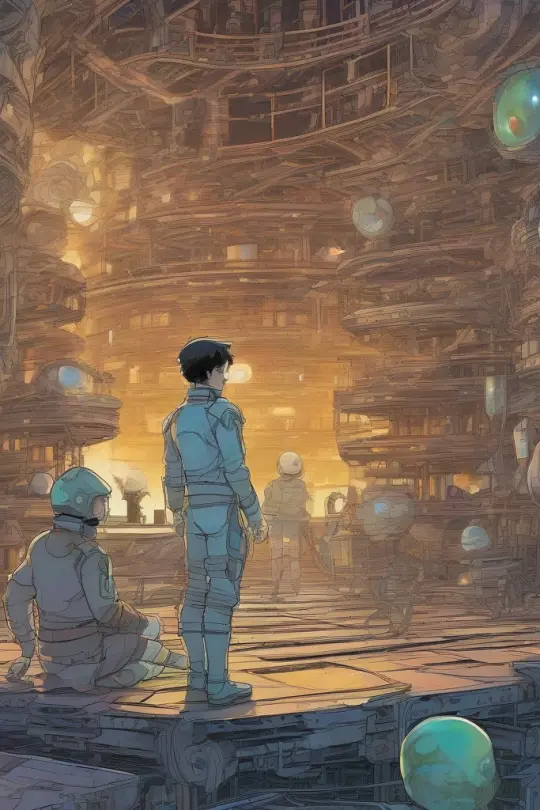
A salvage captain discovers a derelict orbital platform that houses an active memory lattice — a living repository of preserved minds and communal histories. Among its stored presences is the footprint of the captain’s missing sibling. The lattice can restore or copy individual memories, but it can also be coerced into rewriting collective recollection. The central conflict opposes a personal quest for closure against the ethical duty to protect the autonomy of many and to prevent a powerful corporation from seizing and weaponizing living memory.
Chapters
Story Insight
Obsidian Reach begins with a salvage run that turns into a perilous moral dilemma. Captain Juno Reyes, who makes her living among broken hulls and obsolete satellites, boards a derelict orbital platform and encounters the Mneme lattice: a living, layered repository that preserves memory-patterns and communal histories. Among its encoded presences is a faint imprint that resonates with Juno’s own private absence—traces that hint at her missing sister without offering straightforward recovery. The platform itself reads like a monument to careful engineering and stubborn grief, and the crew’s routine cataloging soon collides with the corporate machinery of Helion Syndicate, which treats preserved recollection as a commodity to seize, sanitize, and sell. This work interrogates memory as both technology and human stake. The Mneme in Obsidian Reach is presented as an embodied system—its returns are sensory and fragmentary, offering tastes, textures, and domestic moments rather than neat transcripts. Access demands attunement: a living mind must offer a private, unsent memory as a key, and that requirement becomes a narrative pressure point. Technical plausibility sits alongside moral urgency here. The story examines how consent, custody, and legal forms interact with emergent tech: a former records minister with a history of redaction, an engineer who values protocols, and a medic whose volunteer probe is harmed during a forced breach all complicate the simple binary of salvage versus theft. Instead of treating memory as a metaphoric device, the narrative lays out plausible mechanisms—attestation, governance metadata, authenticated registry entries—and shows how such mechanisms can be used defensively or abusively. What distinguishes Obsidian Reach is its mix of close, emotional detail and procedural rigor. Scenes move from cramped salvage corridors to tense uplink sequences; domestic fragments—cups, a painted stair—sit beside cold legal language and routing algorithms. The Mneme’s responses are quietly intimate, and the book uses those touches to explore broader questions: who owns recollection, what counts as identity when continuity is mediated by code, and how grief reshapes risk calculus. Atmospherically, the story favors a taut, contemplative tone: moments of technical improvisation and physical danger are balanced by scenes of confession and quiet witness. The ending avoids neat reconciliation, instead offering a hard-earned shift in public stakes and a private, bittersweet closure that respects the complexity of loss. For readers drawn to speculative fiction that frames ethical questions through lived experience, Obsidian Reach offers a textured experience. The prose privileges sensory specificity and plausible systems design over spectacle; interpersonal conflict grows from believable professional and emotional pressures rather than melodrama. The narrative also pays attention to the lesser-seen aspects of near-future crisis—legal attestation, the politics of records, and the practicalities of salvage—so those who enjoy speculative tech grounded in procedural detail will find material to ponder. Its strengths lie in the way it asks difficult questions without pat answers, and in the careful craft of its small, intense scenes: a salvage bay at night, the quiet of a tethered platform, the crackle of an uplink under attack. Obsidian Reach is best approached as a compact, morally inquisitive piece of space fiction that treats memory and responsibility with equal seriousness.
Related Stories
The Ring That Sings
Orbiting a storm-wreathed giant, an acoustic cartographer breaks a quarantine to answer a derelict ring station’s heartbeat. With a grinning pilot, a stubborn botanist, and a mothlike drone, she negotiates with the Caretaker AI to free seeds and sleepers—and learns to carry its song.
The Lightseed Drift
Salvage tech Rhea Solano steals a humming canister as corporate security sweeps her orbital scrapyard. With an old navigator, a stubborn drone, and a mythic “Lightseed,” she slips into hidden lanes, finds rogue scientists, and faces a principled adversary. A new kind of sail decides whom to trust. Windows open, kitchens fill, and air changes hands.
Ninth Relay
A drifting survey crew finds an ancient transit node that can fold space and anchor minds. Captain Mira Sol navigates technical marvels and political appetites when the Relay offers survival by reshaping identity. Pressure from a consortium, an engineer’s disappearance into the node, and ethical peril force the Peregrine to choose containment, sacrifice, and a precarious new path toward consensual preservation.
Hearth in the Hollow Sky
In a ring-city orbiting a gas giant, apprentice horticulturist Maris fights to save a vital bioluminescent seed from corporate greed. She and a ragtag crew confront salvage lords and a consortium that commodifies life. A story of repair, resistance, and guardianship in space.
Chorus at Periapsis
On a listening station above a ringed gas giant, young acoustics engineer Nova Jeong hears a human-taught rhythm inside a dangerous magnetospheric tangle called the Chorus Verge. Disobeying orders, she joins a retired radio savant, a botanist, and a plucky maintenance robot to tune a hidden microgate, rescue survivors—among them her former mentor—and broker an uneasy truce with a salvage captain.
Singular Offering
On the brittle frontier of Eiren’s Hold, salvage captain Sera Kade confronts a failing settlement and an ancient lattice that can fold habitable space—if anchored by a single mind. As corporate forces close, Sera faces an impossible choice amid urgent containment and political pressure.
Other Stories by Mariette Duval
Frequently Asked Questions about Obsidian Reach
What is the Mneme lattice and how does it function within Obsidian Reach ?
The Mneme lattice is an emergent memory repository woven from resilient filaments. It encodes preserved minds and shared histories, requiring consented neural attunement to access layered content and relational patterns.
How does Juno's personal quest intersect with the larger ethical conflict in the story ?
Juno's search for her missing sister turns a routine salvage into an ethical crucible: she must choose between pursuing private reunion and protecting multiple stored identities from corporate seizure and manipulation.
What role does Helion Syndicate play and why are they a threat to the Mneme lattice ?
Helion treats memory tech as proprietary capital. They pursue forced extraction and legal claims that risk destructive bypasses, scrambling preserved patterns and privatizing communal memory for profit.
Are the preserved presences in the lattice full people or fragmentary records in Obsidian Reach ?
The lattice stores pattern-based imprints—embodied fragments and relational topologies rather than literal bodies. It preserves identity traces and continuities, but not straightforward, biological resurrection.
What is the significance of Asha Var's attestation and sacrificial action ?
Asha uses her records credential to legally authenticate the Mneme ledger and streams governance metadata to public registries. Her immersion risks personal harm but creates verifiable proof that counters Helion's claim.
How does Obsidian Reach explore themes of memory ownership, consent, and corporate control ?
Through the salvage conflict the story interrogates who owns recollection—individuals or corporations. It foregrounds consent for accessing stored minds and highlights the dangers of commodifying collective history.
Ratings
Cute idea, gorgeous lines, but ultimately a lot of this feels like a checklist of sci-fi tropes: derelict station, grieving salvage captain, memory tech that’s ‘moral/weapon.’ The ethical dilemma is interesting at first, but the narrative beats predictably march toward the inevitable corporate threat and last-minute moral choice. I also rolled my eyes at the convenient reveal that the lattice houses the sibling’s footprint — a little too tidy. That said, the writing is frequently lovely (“meteor-bruised exoskeleton,” the magnetized rails), and the scene-setting works. If you’re after atmosphere more than surprises, it’ll scratch that itch. If you wanted something that upends the genre, maybe temper your expectations.
I wanted to like Obsidian Reach more than I did. The premise — a memory lattice that can be restored, copied, or weaponized — is compelling, and the opening descriptions are vivid (the platform as a cathedral is a strong image). But the story leans too much on familiar beats: the lone salvage captain with a missing sibling, the shadowy corporation that wants to exploit tech. It becomes predictable: Juno’s internal conflict between closure and duty is telegraphed early and the resolution feels a bit on the nose. Pacing is another issue. The first act luxuriates in atmosphere (which is lovely) but then the middle stalls with explanation about how the lattice works instead of deepening character relationships. I also noticed a few logic gaps around how the lattice’s protections could be bypassed — the corporate threat sometimes feels like a plot convenience rather than an organic escalation. Still, there are strong sentences and a few genuinely affecting moments (the airlock smell, Kai’s thumbs-up). With tighter plotting and more subversion of the tropey elements, this could be great.
I loved the atmosphere here. The cathedral-in-space imagery made my chest tighten, and the small tactile details — warm salvage tendrils, the ozone-scented airlock, brittle stripped panels — are gorgeous. Juno’s grief for a missing sister is written with restraint but real ache; that private map she keeps is the story’s heart. The ethical tension about whether to use the lattice’s power to restore or rewrite memories is handled sensitively. The corporate angle gives the plot teeth, too — it’s not just grief, it’s a danger to other people’s lives. Felt cinematic and intimate at once. ❤️
This story does the hard work of merging a tightly described salvage operation with a moral problem that could not be more timely. The notion of a living memory lattice — an archive that is simultaneously personhood and data — is handled with both imagination and restraint. The storytelling is strongest when it keeps close to Juno: the way she catalogues damage, folds the secret of her sibling into herself, and walks through the airlock where silicate lies like old paint. Those small, sensory moments sell the larger ethical questions that come later. I particularly admired how the lattice’s capacities are framed not as technobabble but as ethically fraught: it can restore, copy, or be coerced into rewriting collective recollection. That last capability turns memory into a weapon, and the corporate threat feels credible and terrifying. Scenes where the Kestrel crew debate whether to pry into the lattice are tense because the stakes are personal and communal at once. The only structural weakness is a desire for more interiority after the discovery — more scenes of the lattice’s presences speaking back. Still, this is a thoughtful, emotionally intelligent piece of space fiction that stays with you.
Witty, haunting, and just a touch heartbreaking — I didn’t expect to teary up over salvage tendrils but here we are. The author sneaks in human details (Kai’s thumbs-up, Juno’s practiced professional distance) that make the reveal about the memory lattice land hard. Also, “face shaped for engineering” is a great throwaway line. Loved it. More please. 🙂
Short and evocative. The opening image of Obsidian Reach as a deliberate geometry “built to be remembered” stayed with me. Juno’s internal fold of a secret map — her sibling’s footprint in the lattice — provides an emotional anchor that lifts the ethical stakes beyond abstract debate. I liked the pairing of professional salvage procedure (tethers, structural nodes, Kestrel’s manifest) with very intimate memories (a sister’s smile), and the contrast works. Clean prose, believable crew dynamics (Kai Ren is a lovely detail), and a satisfying moral tension about autonomy vs closure. Would read a full novel set in this world.
Obsidian Reach nails a tricky balance: it’s both a salvage procedural and a philosophical parable. The prose is economical but vivid — “meteor-bruised exoskeleton,” “magnetized rails” — and those little details anchor the larger speculative idea of the living memory lattice. The lattice itself is the star: conceptually rich (stored presences, footprints of missing people) and narratively versatile (restore vs copy vs coerce collective memory). That triad drives the central ethical dilemma with compelling clarity. The salvage beats are convincing — Kai Ren’s engineering gestures, the Kestrel’s approach tether, the airlock’s tactile descriptions — which earns you the right to care when the stakes sharpen toward corporate weaponization. I appreciated how the author resists easy answers; Juno’s personal grief is believable and conflicts organically with the duty to protect others’ autonomy. The only minor quibble is a bit of exposition-heavy explanation around how the lattice functions, which slows the middle. Still, the thematic payoff — particularly the idea that memory can be both sanctuary and battlefield — is well worth the read.
I fell for Obsidian Reach from the first paragraph. The image of the platform “hung like a cathedral lost in shadow” is wrenching — that line alone sets a tone of reverence and melancholy that the rest of the story lives up to. Juno Reyes is written with enough professional distance to feel authentic, but the moment she remembers a younger sister while her boots click along magnetized rails is heartbreaking and immediate. I loved the sensory details (the airlock smelling of ozone and dust, the warm salvage tendrils against her palms) which make the salvage work feel lived-in. More than a space-op, this is an ethical fable about memory and ownership. The memory lattice is a chillingly original device: a repository of lives that can be restored or rewritten. The conflict — Juno’s private quest to find her sibling’s footprint versus protecting the autonomy of all stored minds — is handled with real moral weight. The corporate threat feels palpable without turning into cardboard-villain melodrama. There’s a quiet human core beneath the sci-fi set-pieces. I wanted more scenes inside the lattice, more of Kai Ren’s reactions (that thumbs-up is such a human beat), but overall this is one of the more thoughtful space stories I’ve read recently. Warmly recommended.