
Where Glass Meets Sky
Join the conversation! Readers are sharing their thoughts:
About the Story
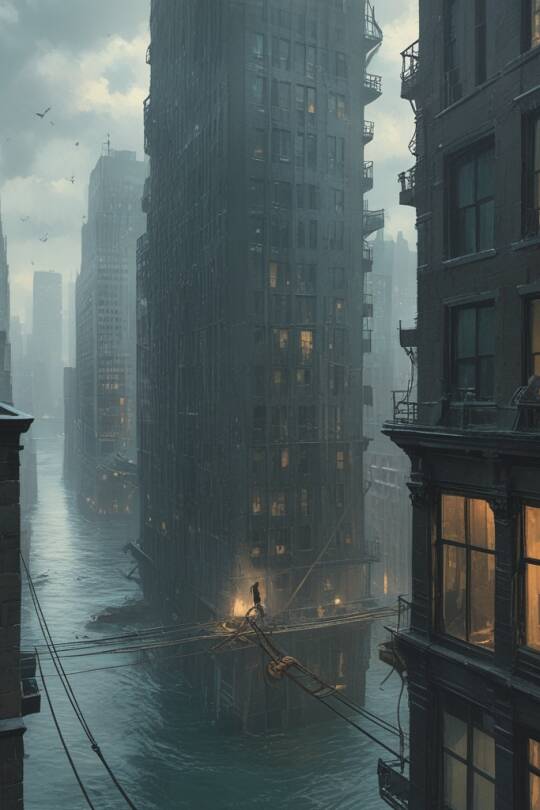
Fogged river air, frying dough, and the clink of harness metal set a morning where a seasoned high-rise window cleaner crosses a gulf between buildings to save a volunteer during his estranged daughter's rooftop installation. Sam's tools — knots, anchors and patient hands — become the means of rescue and unexpected reconnection.
Chapters
Story Insight
Where Glass Meets Sky follows Sam Archer, a veteran high-rise window cleaner whose days are measured in knots, harness clicks, and the exact pressure of a squeegee against glass. Up on the façades he knows how buildings speak: where mortar hides fragile seams, which cornices will take a load, how to translate a gust into a safe movement. Down in the courtyard his estranged daughter, Maya, stages rooftop installations that reconfigure the city’s ordinary gaps into improvised stages. A routine morning—steam from vendor carts, the scent of saffron buns, a parrot that inexplicably recites safety-manual lines, and inflatable ducks bobbing like absurd sentinels—fractures when a rehearsal goes wrong. A volunteer is left clinging to a ledge, the building’s temporary rigging begins to fray, and Sam faces a sharp moral choice: follow the hard lines of protocol and preserve his certification, or rely on the trade he knows by muscle memory and risk everything to intervene. The inciting crisis forces a practical calculus rather than a philosophical epiphany, and the tension is stitched together by the tangible specifics of a craft that is both livelihood and language. The story treats profession as metaphor and as the means of repair. It explores how skill can be an ethic: a way to care for strangers and for family that is enacted with hands, not speeches. Alongside the core moral dilemma the narrative examines generational friction, the slow accounting of missed obligations, and the awkward work of rebuilding a presence that was once absence. Atmosphere matters: the city’s weather—river fog, trams, late-morning stalls—forms a backdrop that is never merely cosmetic; it shapes decisions and heightens risk. The text pays close attention to technical detail (anchors, friction hitches, belays) in order to make the tension credible and to treat Sam’s labor with respect. Light absurdity—the parrot Comma reciting “double anchor,” a volunteer’s comic plea to “save the duck,” the quotidian smell of frying dough—breaks and humanizes the anxiety without undercutting stakes. Consequences are acknowledged honestly: institutional responses and the cost of rule-bending are part of the aftermath, as are small, stubborn shifts in relationship. Crafted as a compact three-act drama, the prose privileges tactile description and steady pacing: the first act establishes ritual and distance, the second tightens into an unavoidable decision, and the third resolves tension through deliberate, skillful action. The emotional arc moves from solitude toward a brittle but real reconnection, with humor and practical detail keeping the work grounded. This is not a high-octane thriller; it is a close, physically grounded portrait of a man who understands rescue as a series of engineered moves and imperfect offers of presence. The story will appeal to readers who appreciate dramas rooted in trade knowledge, understated parent-child reckonings, and urban scenes rendered through sensory specificity. It invites attention to small professional acts that also function as moral choices—an intimate, precise look at how a life of steady craftsmanship can become the tool for repairing what ordinary distance has worn thin.
Related Stories
The Resonance Beneath the City
A young luthier and subway violinist fights a city ban and a predatory organizer to fund her brother’s cochlear implant. With a retired acoustics engineer’s resonator and a band of buskers, she rallies a crowd, suffers a public setback, sparks a viral surge, and returns to the platform for a hard-won, tender victory.
Hold the Line
A veteran stage manager wrestles with failing rigging on the eve of a big preview. In a theatre of absurd props and nightly rituals, she must convert skill into salvation when automations fail and a set tilts—her hands, wits, and an improbable rabbit become the tools of rescue.
Beneath the Listening Light
When Asha Rami takes over the lighthouse at Nemir Point, a scraping at the seabed and a missing fishing sloop reveal an industrial threat. With an old engineer's drone and a town's stubborn courage she fights a corporation's teeth, repairs what was broken, and learns how grief becomes responsibility.
The Glass Bell of Gullsbridge
A dramatic tale of a young sound restorer who fights a corporate erasure of his town’s voices after his sister vanishes into an archival vault. Music, memory, and community bind neighbors together to reclaim the city’s past and assert the right to be heard.
The Hollow Room
A family secret kept to protect a community unravels when a daughter returns for her mother’s funeral and discovers a written confession that could free a man convicted decades earlier. The story examines truth versus protection, the cost of silence, and how responsibility divides and sometimes reunites family.
Frequencies of Home
In a tenement threaded with murals, a former stage sound technician rigs a communal ‘listening’ system meant to soften daily friction. When smoothing tech misroutes private voices, she must rewire the building’s audio and its rules, turning her craft into a ritualized practice of attention.
Other Stories by Julien Maret
Frequently Asked Questions about Where Glass Meets Sky
What practical ropework and rescue techniques are depicted in Where Glass Meets Sky ?
The story shows real rigging basics: anchor assessment, slings, locking carabiners, friction hitches (Prusik), belaying and load transfer. These actions drive the climax and are described with tactile, procedural detail.
What central themes does the novel explore beyond the rooftop rescue ?
It examines craft as care, the ethics of skill versus protocol, generational tension between Sam and his daughter, and the slow process of rebuilding presence after long absence, all within an urban sensory world.
How realistic is the portrayal of high-rise work and safety procedures in the book ?
Technical details are grounded in practical knowledge: knot choices, anchor checks, and belay technique are presented credibly. The story prioritizes plausible actions over dramatic contrivance for the rescue.
Is Where Glass Meets Sky purely serious, or are there lighter moments to balance the tension ?
The drama mixes gravity with human levity: a parrot that recites safety lines, oversized inflatable ducks and offhand jokes provide ironic relief without deflating the stakes of the rescue.
How is the narrative structured and where does the rescue occur in the story arc ?
It’s a tight three-chapter drama: setup of ritual and distance, escalation and moral calculus, and a climactic, profession-led rescue in chapter three that reshapes the personal relationship afterward.
Who will likely enjoy Where Glass Meets Sky and what reading experience does it offer ?
Readers who favor intimate, craft-focused dramas will appreciate it: tactile descriptions, workplace ethics, family reconciliation, urban atmosphere, and a paced rescue resolved through skill and action.
Ratings
There are lovely moments here — Sam’s methodical checking of knots, the clink of metal, the neon CLIMB ON sticker that tells you a lot about workplace camaraderie — but the story doesn’t quite sustain its emotional promise. The rescue sequence is the high point and is vividly imagined; you can feel the altitude and the friction. Yet the lead-up feels a touch underexplained. The daughter’s rooftop installation is mentioned as the catalyst but we never get enough context to care fully about her or the volunteer’s role; the estrangement between Sam and his daughter is hinted at rather than excavated. The ending leans toward reconciliation with minimal complication, which will satisfy readers who like tidy closures but frustrate those wanting deeper psychological beats. Still, the prose is evocative and the urban world-building (vendors, frying dough, dawn steam) is done with a real eye for texture. With a bit more interiority for the daughter and the volunteer, this could have been a standout.
Cute premise, beautifully written bits, but come on — the old hand swoops in, clips a carabiner, and suddenly family trauma is solved? I get the symbolism (tools = mending), but the reconciliation happens with suspicious speed. Also, the harness has feelings now — 'the harness sings' — which is poetic, sure, but a little on-the-nose. The saffron-roll vendor and the parrot are nice touches, though I’m not sure they needed as much spotlight. Enjoyable for a single sitting; not convinced it breaks new ground. 🤷
I wanted to love this more than I did. The imagery is often excellent — the morning steam, saffron rolls, even the parrot — but the plot leans on familiar beats: the seasoned saver, the estranged child who needs reconciling, the volunteer in peril. The rescue is well-described in mechanical terms (knots, anchors, the clink of metal), yet the emotional payoff felt a little tidy. Why exactly was the volunteer on that rooftop with the daughter’s installation? It’s hinted at but not convincingly fleshed out. Nico’s sticker and the parrot add charm, but occasionally these small details feel like ornamentation rather than character revelation. A competent, pleasant read, but I kept waiting for something less predictable.
Where Glass Meets Sky is the kind of story I needed on a gray Tuesday morning. It opens with practical ritual — shirt, harness, rope bag — and that repetition becomes an emotional anchor. The author stitches together sensory details (the saffron rolls, the tram’s brass band, a parrot up in a vent) that make the skyline alive, then drops you into a two-building gulf where every rope, knot and carabiner matters. I spent the rescue scene holding my breath: Sam’s patient hands, the way he checks friction, the very human humor with Nico’s neon sticker — it all rings true. What I most admired was the restraint. The story doesn’t shout at you about themes; it lets the profession-as-metaphor do the work. Sam’s tools are literal lifesavers and, quietly, the instruments that re-thread his relationship with his daughter. The reunion doesn’t explode into high drama; it gathers like steam at dawn — inevitable and soft. If I have any tiny complaint, it’s that I wanted a little more of Sam’s interior life before the rescue (a memory, a regret), but maybe the silence was intentional. Either way, read this for the craft, the atmosphere, and for the small, exact moments — the harness’s clink, the parrot’s ridiculous phrase — that make the city feel like a character. Lovely.
So tender. I loved how the city’s morning — steam, vendor carts, frying dough — reads like a soft backdrop to Sam’s focused competency. The rescue is nerve-tingling but restrained; the moment he clips in and the harness sings is so tactile I could feel it. The reunification at the rooftop felt quiet and real instead of TV melodrama. Short, sharp, and full of heart.
This is a very well-crafted little urban drama. The story uses profession-as-metaphor in a way that feels organic rather than forced: Sam’s knot-checking rituals mirror the slow work of repairing strained family ties. I appreciated how the author seeds texture — vendor carts, frying dough, the tram’s brass band — then focuses tightly on the rescue itself. Specific beats stand out: Nico’s CLIMB ON sticker (a neat character touch), the parrot echoing a safety line (subtle humor), and the harness’s metallic clink that serves as a recurring motif. Pacing is mostly effective; the ascent and the crossing between buildings felt physically immediate. My only small quibble is that the daughter’s rooftop installation could use one clearer detail to raise the stakes emotionally, but that’s minor. Strong writing, believable characters, and a rescue that doubles as reconciliation.
I loved this. The opening — Sam waking before the city remembers itself, dressing with the same deliberate ritual as he checks knots — hooked me immediately. The small details (the harness’s honest clink, the saffron-roll vendor, the neon CLIMB ON sticker) make the city feel lived-in and intimate. The rescue scene where Sam crosses the gulf between buildings to reach the volunteer is tense and beautifully handled; his patient hands and tools are both practical and symbolic. The reunion with the estranged daughter felt earned, quiet rather than melodramatic. The parrot squawking a phrase from a safety manual was a perfect bit of dark, gentle humor. Overall, atmospheric, human, and quietly heroic. :)