
Poppy and the Missing Colors
Join the conversation! Readers are sharing their thoughts:
About the Story
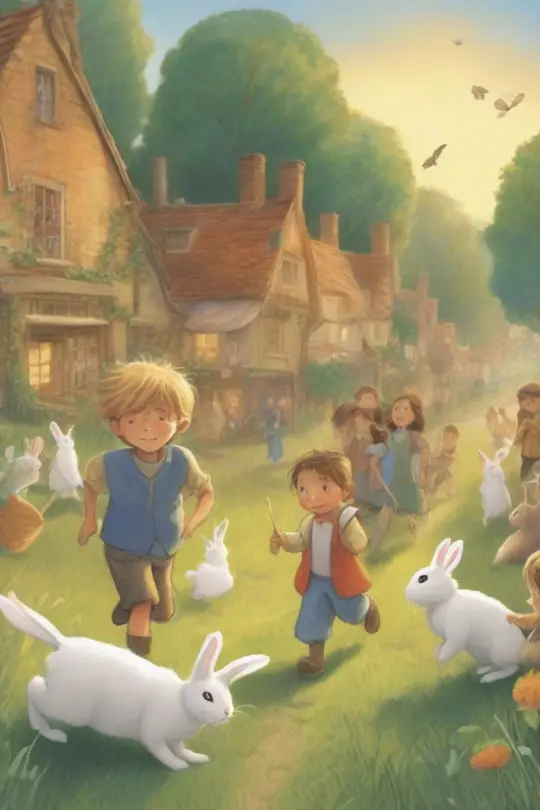
Sunfield wakes to a brighter morning after a shy rabbit leads a gentle hunt for a missing chorus. The village hums with cautious hope as they gather ribbons, songs, and a hesitant moth who keeps treasures. Quiet bravery and small gatherings shape a dawn that might stay.
Chapters
Related Stories
Tess and the Brightling Grove
A shy new neighbor discovers a tiny, fading creature in a willow hollow and learns that the small everyday stories people tell keep the little Brightlings bright. As Tess gathers ordinary objects and honest memories, a pale mist that steals forgotten moments grows. Tess must find her voice and recruit friends and neighbors to share their small truths so the hidden world beneath the tree can be saved.
Juniper Finch and the Tidemaker's Bell
When the tide-keeper's bell that keeps Brimble Bay's rhythms is stolen, nine-year-old Juniper Finch sets off with tin wings, small tools, and a stubborn heart. She must learn to listen, bargain with a lonely collector, and bring the bell home—quietly, kindly, and cleverly.
Pip and the Color-Bell
In a seaside town where a magical bell keeps colors bright, young Pip sets off to find the bell when the town begins to lose its hues. With a lantern-bird and a finding-brush, he discovers an island of forgotten things, meets a lonely Greyweaver, and learns the power of sharing and mending.
Sky-Thread and the Bottled Wind
In a seaside town where the wind suddenly vanishes, nine-year-old Mira discovers jars of captured breezes and sets out to free them. With a wind compass, sky-thread, and a tiny weather vane helper, she faces the bottle-keeper, finds a kinder way to be safe, and brings the kites — and the town — back to life.
Penny Stitches and the Button Bridge
Penny, an apprentice tailor, faces a choice when the town’s old footbridge collapses days before the Button Parade. She must decide whether to use her precious golden buttons for a prize outfit or to anchor the bridge so everyone can cross together. A warm tale about craft, community, and belonging, with a pinch of absurd humor.
Pip and the Silver Thread
A tiny stitcher robot named Pip must find a missing silver spool that keeps the sea singing. Along the way he meets a toymaker, an apprentice, a lighthouse keeper, and a gull. Together they learn to mend mistakes, share songs, and weave courage into everyday things.
Other Stories by Dorian Kell
Frequently Asked Questions about Poppy and the Missing Colors
What is the central conflict in Poppy and the Missing Colors ?
The story centers on Poppy, a shy rabbit who must recover the missing Color Song to restore Sunfield’s faded hues. The conflict blends an external search for scattered song pieces with Poppy’s inner struggle to find courage and lead gently.
What age range is Poppy and the Missing Colors intended for ?
This seven-chapter Children’s tale suits readers aged roughly 5–9. Language, pacing, and themes of friendship, empathy, and small acts of bravery make it ideal for early readers, read-aloud sessions, and classroom discussions.
How are characters like Dusky and Mayor Hazel used to explore themes ?
Dusky the moth represents loneliness and fear; Mayor Hazel models steady community leadership. Their interactions with Poppy highlight empathy, listening, and gradual trust-building rather than quick fixes or punishment.
How does the Color Song mechanic drive the plot and emotional arc ?
The missing Color Song functions as both plot engine and symbol: finding its scattered parts creates the adventure, while reassembling the chorus mirrors Poppy’s growth from shy listener to a gentle leader who helps the village heal.
Can Poppy and the Missing Colors be adapted for classroom activities or read-aloud programs ?
Yes. Teachers can use the book for lessons on cooperation, emotional literacy, and music. Activities include group singing, color scavenger hunts, empathy role-play, and art projects inspired by the village of Sunfield.
How does the story balance gentle conflict with a satisfying resolution ?
Conflict remains nonviolent and emotionally driven: discovery, misunderstanding, and fear. The resolution comes through dialogue, shared rituals, and small courageous acts, giving readers a clear, comforting ending in chapter seven.
Are there illustration or pacing recommendations for publishers adapting this seven-chapter concept ?
Illustrations should emphasize warm, muted palettes that brighten as the plot progresses. Pace each chapter with 10–12 short scenes, focusing visuals on character expressions, community gatherings, and the gradual return of color to Sunfield.
Ratings
The writing is pretty and the idea is sweet, but I ended up frustrated by how tidy everything is. The story uses a lot of familiar tropes — shy protagonist, mysterious gloom, community banding together — without adding a fresh angle. Poppy’s ritual with ribbons is cute, but the narrative doesn’t dig deeper into why colors disappear or what the moth’s hoarding really means beyond a metaphor. Some pacing problems too: the opening description is long and gorgeous, then things speed up and resolve almost before I felt invested in the mystery. It’ll be fine for very young readers who want soothing tales, but older kids might find it a bit clichéd.
I wanted to love this more than I did. The concept — a village losing its color and a shy rabbit leading a hunt to bring it back — is sweet, but the execution felt too safe and predictable. You can see every beat coming: the faded ribbon, the concerned neighbors, the moth who “keeps treasures” ultimately giving one up. There’s a lack of tension; nothing really threatens the village beyond a mild melancholy. For a children’s book that leans heavily on atmosphere, I’d have liked a bit more adventure or a twist that surprised both kids and adults. Still, the imagery is pleasant and it’s certainly comforting, but I can’t shake the feeling it plays too many cards it’s already showed.
Charming, with just the right amount of whimsy. I admired how the plot doesn’t rely on big explosions or scary villains — the conflict is a missing chorus and the solution is community: ribbons, songs, a hesitant moth deciding to share. The strawberry-stitched ribbon moment is such a visual that kids will remember it, and Mr. Rook’s dull apples give a concrete sense of what’s at stake. I grinned at the way Poppy’s ribbon choices map to her curiosities (cloud-watching, seed leaves, apples) — neat little lesson in paying attention. Recommended for storytime and quiet afternoons.
There’s so much warmth in this story. The author trusts small moments — a drawer of ribbons, a moth’s hesitation, a bell’s sleepy swing — to carry emotional weight, and it works beautifully. I especially loved the episode where Poppy chooses a ribbon for the day; it’s such a simple ritual but it tells you everything about her. The village’s collective effort to restore the chorus, gathering ribbons and songs, felt like a hymn to community. It’s gentle, reassuring, and ideal for young children learning about empathy and cooperation. The prose is calm and lyrical; I read it aloud and my voice softened on the last page. Lovely.
Short, sweet, and very visual. The strawberry ribbon detail is adorable and gives Poppy real personality. The scenes with Madam Wren’s faded roses and the sleepy bakery bell set the mood perfectly. I’ll be recommending this to parents who want stories about kindness and community that don’t feel sermon-y.
Poppy and the Missing Colors reads like a lullaby wrapped in watercolor. The author paints Sunfield with deliberate strokes — the patchwork gardens “sewn by careful hands,” the bell of the bakery swinging “a little sleepy” — and uses those images to make the loss of color feel personal and intimate rather than world-ending. I appreciated the community choreography: how strangers become collaborators, how ribbons and songs are offered like pieces of themselves. The motif of small, quiet bravery — Poppy deciding to notice color again, a moth reluctantly giving up a treasure — is handled with impressive restraint. It’s a calming, hopeful read for kids that subtly teaches that courage isn’t always loud; sometimes it’s choosing to look closely.
This is the kind of quiet story that sneaks into your heart. Loved Poppy’s little hop of surprise when the ribbon looked faded — tiny, believable emotion. The hesitant moth who hoards treasures? Genius. I laughed out loud at the image of children chasing one another between rows of bright houses and then felt a lump in my throat during the scene where everyone gathers ribbons and sings. The language is simple but never childish; it respects young readers. My only wish: more of the moth! 🦋
Smart, gentle children’s fiction. The story’s strength is its sensory detail — Mr. Rook’s apples described as “polished coins” then later reduced to “dull as pebbles” gives a clear before/after contrast that anchors the mystery. Poppy’s ritual of choosing a ribbon is an excellent character device; it externalizes her curiosity and gives young readers something concrete to latch onto. Pacing is mostly well handled: the hush at dawn, the drawer moment, the village gathering — each beats builds logically. If I have a minor critique it’s that the stakes are modest (intentionally), so adults might wish for a slightly sharper payoff. Still, as a children’s piece about community, courage, and music it’s practically flawless.
I read this to my little niece and we both fell in love with Poppy immediately. The opening image — Sunfield painted by the morning, the bakery door like a slice of sun — is so warm and visual that you can almost smell the cinnamon. I adored the tiny details: Poppy’s ribbon drawer, how she chooses a ribbon for the day, and that little strawberry-stitched ribbon fading in the pale morning. The gathering scene where the village comes together with ribbons and songs felt genuinely tender, and the hesitant moth who keeps treasures is such a lovely, shy bit of magic. It’s quiet bravery done right: small actions building hope. Perfect for bedtime and for teaching kids about community and courage without being preachy.