
Tetherline
Join the conversation! Readers are sharing their thoughts:
About the Story
Rope-access rigger Rhea Calder returns to her rooftop neighborhood to open a community-run Skycare Cooperative. Amid sea-breeze markets, pastry stalls, and a raccoon mascot, she trains neighbors, negotiates politics, and performs a last, skillful tensioning under public gaze to prove the co-op's worth.
Chapters
Story Insight
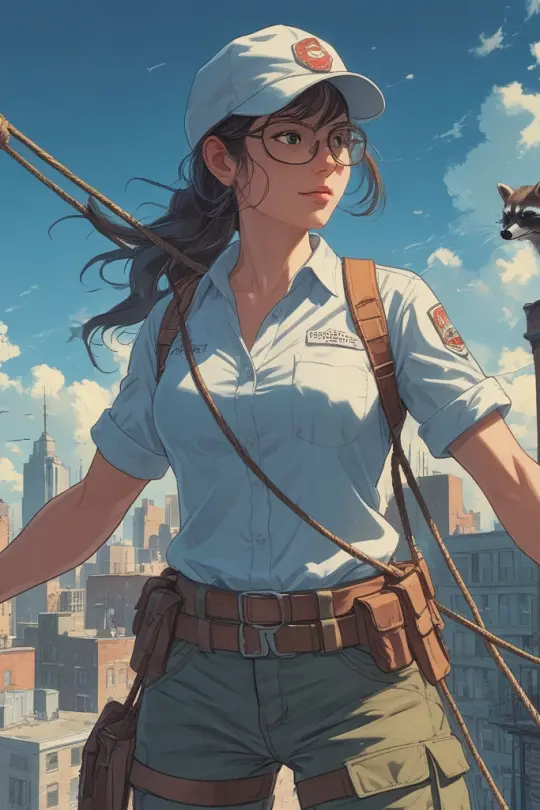
Tetherline centers on Rhea Calder, a rope-access technician who measures the world by knots and tension charts. The neighborhood where she works is built out of makeshift joy: suspended planters, a festival that strings stages between rooftops, a giant inflatable narwhal bobbing above the plaza, and a raccoon mascot named Button that steals anything shiny. When an inspection reveals brittle polymer flakes on load-bearing lines and someone files a bolt’s threads, a routine certification spirals into a mid-air emergency. Rhea’s expertise becomes the story’s engine—she reads micro-fractures, rigs temporary haul systems, and improvises load transfers under pressure—while the immediate crisis forces decisions about responsibility, belonging, and what a life built on skill is worth. The novel treats professional craft as metaphor: the same dexterity that let Rhea live a deliberately solitary life also lets her stitch people together. The supporting cast—June, the festival organizer; Arlo, the eager teenager; Ollie, the grizzled mentor; and Dex, a polished rival—populate a realistic urban tapestry of vendors, bands, and domestic rituals (tea flavored with star anise and orange peel, candied ginger, a rooftop herb swap). Action sequences foreground credible ropework and mechanical detail—snatch blocks, rolling-block transfers, prusik hitches, splice lore—rendered with technical clarity that will satisfy enthusiasts without alienating casual readers. Tension is both physical and moral: municipal inspectors, procedural fallout, and the offer of a stable, official post press Rhea to choose between a tidy career and messy local ties. Absurdity and warmth—Button’s petty thefts, dogs in tutus, and a pastry-shaped anchor—relieve the strain and humanize the stakes. The narrative unfolds across six focused chapters that balance kinetic rescues, procedural consequence, and community rebuilding. The book delivers precise action scenes that resolve through skill and improvisation rather than revelation, an emotional arc that moves from isolation toward connection, and frequent sensory detail that grounds the urban setting. It suits readers who appreciate grounded technical action, ethically complex choices, and small-town texture folded into an urban environment. If you enjoy a story where craft matters as much as courage—where the tools are actors in their own right and humor lightens peril—Tetherline offers a compact, practical, and humane take on how expertise binds people together.
Related Stories
Skyline Thrust
In a vertical city where air is sold by corporations, courier Ari Calder steals herself into a dangerous game: cells that power the Aerostat rings vanish, and neighborhoods suffocate. With a patched crew—an ex-engineer, a salvage captain, a loyal little drone—Ari risks everything to expose the ledger of breath and force the city to breathe on its own terms.
Gale Engine
In a storm-slashed floating city, courier Kade Maren steals back a missing rotor—the Helix's pulse—stolen by corporate hands. Racing across rooftops, barges and maintenance galleries with a ragtag crew and a battered drone, he fights to return the city's heart before it costs his sister her life.
Tetherfall
In a flooded neon city tethered to an ancient orbital Spine, salvage-runner Cass Calder finds a stolen shard of the Spire. Hunted by corporate enforcer Marla Voss, Cass must gather a ragged crew, learn to wield a strange device, and protect a secret that could remake the city. An action-driven tale of risk, loyalty, and hard choices.
Tide of Keys
In a near-future harbor where corporate grids control life and neighborhoods run on fragile micro-cores, courier Juno Reyes races against corporate security to reclaim a lost flux key. With a salvaged ally and a band of misfits, she must outwit machines, face an uncompromising corporate agent, and restore power to her community.
Scarlet Protocol
A fast, tense cyber-action set in a near-future city. Mara Cade, a scarred former operative, is pulled back into a net of corporate power after a mysterious module links her past to a sweeping infrastructure takeover. As evidence is exposed and streets erupt, she must choose between personal ruin and stopping a silent seizure of the city's systems.
Nodefall
On a rooftop above a restless city, a former extraction specialist risks everything to free the living anchor of a corporate neural broadcast. With time counting down, a small, fractured team breaks into a fortified tower, forces a destabilizing misalignment into the network, and exposes damning evidence—buying a narrow rescue at steep cost.
Other Stories by Edgar Mallin
Frequently Asked Questions about Tetherline
What is Tetherline about ?
Tetherline follows rope-access rigger Rhea Calder as she uncovers tampered rigging at a rooftop festival, improvises life-saving rescues, and helps launch a community-run Skycare Cooperative.
Who is Rhea Calder and why are her skills central to the plot ?
Rhea is a seasoned rope-access technician whose command of knots, haul systems and improvised anchors drives action. Her hands-on decisions resolve the climax and shape the moral choices she faces.
Is the ropework and rescue action in Tetherline realistic ?
Yes. Action scenes emphasize credible gear, hitches, rolling-block transfers and staged load transfers. Technical details are clear and practical, aimed at authenticity without heavy jargon.
How do community and municipal politics influence the story ?
Local organizers, municipal inspectors and procurement failures create moral and procedural conflicts. Rhea must balance safety, paperwork, and neighborhood ties while facing official scrutiny.
Does the book include humor or absurd elements ?
Absolutely. Light absurdity—Button the raccoon, dogs in tutus, and a giant inflatable narwhal—breaks tension, humanizes characters, and provides comic relief amid high-stakes rescues.
Who will enjoy Tetherline and what makes it distinctive ?
Readers who like grounded action, technical problem-solving and urban community drama will appreciate it. The novel blends practical rigging craft with moral choices and warm neighborhood detail.
Ratings
Beautiful prose in places — the opening lines, the sensory details of sea fog and candied ginger, and the oddball humor of a raccoon mascot are all wins. The author clearly knows ropework and uses that knowledge to create believable procedural beats: the checks, the load histories, the minute attention to welds. Those scenes are tactile and engrossing. However, structurally the story felt undernourished. The political negotiations around starting a Skycare Cooperative are repeatedly referenced but never fully dramatized; we hear mention of “negotiates politics” but seldom see real conflict beyond some implied skepticism. The climax — a public tensioning meant to prove the co-op’s worth — ends up feeling more like a demonstration than a narrative resolution. The humming guideline is an evocative detail early on, but it isn’t used as a turning point; small threads like the thermos and June’s greeting set mood but don’t always pay off. I enjoyed the atmosphere and the craft-focused scenes, but wanted sharper stakes and a more rigorous payoff for the community’s struggle.
I wanted to like Tetherline more than I did. The setup is cute — rooftops, markets, an inflatable narwhal — but too much of the story leans on quaint details instead of real conflict. Rhea’s competence is continuously asserted (she checks datums, taps carabiner tags, sniffs out fatigue), and while it’s nice to see craft celebrated, the final ‘public tensioning proves everything’ moment felt staged. The crowd is there to applaud competence, not to present any real danger. There are also narrative gaps: how does the co-op actually sustain itself? Who’s opposing it, besides vague “politics”? A humming guideline and a chalk mark are neat images, but they don’t carry the weight of justified stakes. If you want a cozy slice-of-life with rope jargon and a community mascot, fine — but if you came for high-stakes action, this won’t satisfy.
This story charmed me in a low-key way. The festival setting is delicious — espresso, fried dough, a floating narwhal? Love it 😂 Rhea’s hands-on competence is the star: the tiny rituals (chalk marks, listening for a hum) are described so well you can almost feel the rope under your palm. The raccoon mascot moment made me laugh out loud; it’s absurd and perfect. The climax is a great payoff — public tensioning as a kind of civic performance. The writing balances humor and seriousness nicely, and the community vibe is earned. Short, playful, and smart — recommend if you like action rooted in skills and people.
There’s a comforting restraint to this story. It doesn’t have to shout to be tense — a humming guideline, a chalk mark on an anchor plate, a thermos steam in the sea fog are enough. Rhea’s return home and her patient work training neighbors feels authentic; you can see how the co-op is both practical and symbolic. I liked June’s casual greeting — it grounds the relationship dynamics without long exposition — and the little community flourishes (narwhal, raccoon mascot) add charm. The last scene, where Rhea proves the co-op’s worth with a public tensioning, is satisfying because it’s about competence and trust rather than spectacle. Nicely done and quietly moving.
As someone who enjoys technical accuracy in fiction, Tetherline hit a lot of the right notes. The ropework is described with tangible specificity — datum checks, rated capacity, listening for hairline noises — and those details aren’t just window dressing; they inform character and plot. Rhea’s habit of tracing welds and tapping carabiner tags gives her competency weight; I believed someone would trust her to run a live tensioning under an audience. Narratively, I appreciated how the profession functions as metaphor: rigging equals civic trust, knots equal negotiated relationships. The public tensioning sequence is neatly constructed as a skills-driven climax — tension (pun intended) builds not through melodrama but through incremental verification and a final clean execution. The background textures — sea fog, pastry stalls, and the absurdity of community mascots — make the world feel lived-in without distracting from the core action. A minor quibble: politics and funding of the cooperative are sketched rather than fully explored, but that restraint also keeps the story tight. Overall, a refreshing action piece that privileges craft over spectacle.
Tetherline had me smiling from the first paragraph — that image of dawn arriving “like a slow, curious animal” is such a perfect, small mercy. Rhea is exactly the kind of practical, quietly brave protagonist I love: she checks a datum with the same reverence other stories save for spells. The rooftop festival is vivid (candied ginger, espresso, that ridiculous inflatable narwhal) and the town’s absurd little rituals — the raccoon mascot! — give the whole thing warmth without feeling twee. I especially loved the final tensioning scene. The way the crowd is mentioned in fragments and Rhea has to turn technique into theater was heartbreaking and exhilarating at once. There’s a real tenderness in how the author handles neighbors learning serious skills from one another; the cooperative feels earned. If you like action that’s rooted in craft and community instead of explosions, this one’s for you.