
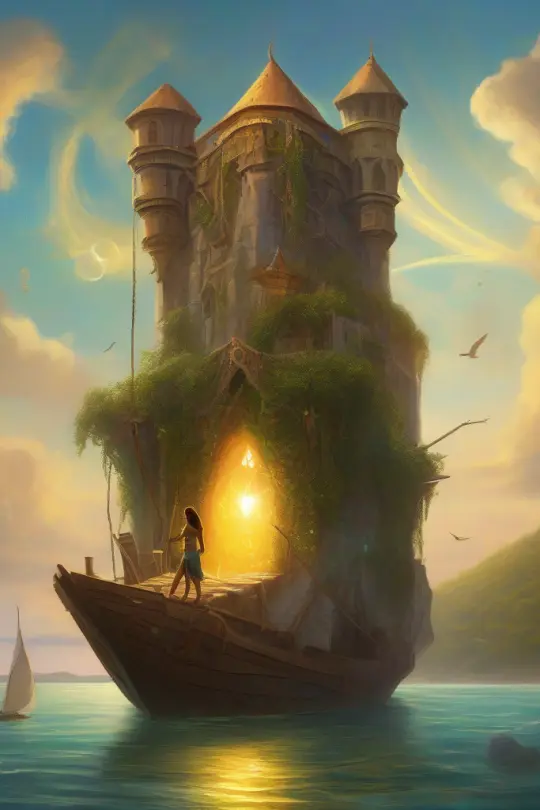
The Lightsmith's Tide
Join the conversation! Readers are sharing their thoughts:
About the Story
On floating isles held aloft by captured sunlight, a young glasssmith named Noor follows the theft of her island's keystone prism into the heart of a hoarding Tower. She must trade memories and craft a machine's song to return the light and remake stewardship across the archipelago.
Chapters
Related Stories
Borrowed Moments
June Navarro inherited her family’s curios shop and discovered that certain small objects kept other people’s lived moments—first-person memories that appear when touched. When one such object seems linked to her missing sister, June must decide whether to pry and risk exposing private lives, or to protect community privacy against a company that wants to commercialize these memories. Tension mounts as she and her friends trace clues to a mill, confront the firm’s offers, and learn a quiet truth that forces a new kind of stewardship.
The Sounding Line
When 19-year-old Isla Reyes hears her missing brother’s harmonica echo through an old lighthouse radio, it draws her into a hidden network beneath a Maine harbor. With a retired acoustician and a scrappy intern, she exposes a corporate scheme and finds a new way to listen—to the sea, to grief, and to herself.
The Third Pool’s Whisper
When his grandmother disappears at the forbidden third tidepool, nineteen-year-old Kai dives into a hidden glass city beneath the cove. Guided by a sea-glass whistle, a retired micro-sub, and his own hands, he faces a living current that trades on memory to bring Elena home—and decides what he’ll shape next.
Keepsong
A seventeen-year-old restorer uncovers a device that can extract and play memories. When she uses it to expose a factory cover-up linked to her missing mother, small-town loyalties fracture. The town wrestles with truth, loss, and the price of remembering as Mira and those around her rebuild what was taken.
The Memory Shop
After inheriting her aunt’s shop that stores private memories in tiny vials, a seventeen-year-old sparks a public reckoning when she returns suppressed recollections at a town commemoration. As records unravel and alliances fracture, she must rebuild the shop as a consensual archive while living with what she sacrificed.
Unwritten Lines
June Harlow finds a peculiar blank journal that makes written lines come true. As she uses it to mend fractures after her sister’s death, memories begin to fray for others. When the cost becomes clear, she confesses, faces the fallout, and tries to rebuild truth by human work rather than quick fixes.
Other Stories by Gregor Hains
Ratings
That opening—Noor literally knowing the kiln before her mind does—pulled me straight into a world I wanted to live in. The prose is deliciously tactile: the metallic tang of copper, the strip of skylight across the bench, the memory‑vials that hum like busy bees. I loved how the book treats craft as language and power; scenes where Noor reads a vial’s faint sound or fumbles a seam after “you pressed the coil too long this morning” feel intimate and earned. Characters are a real highlight. Noor is brave without being melodramatic; she’s someone whose competence and small vulnerabilities make her choices about trading memories feel devastating and credible. Lutie is the perfect frayed mentor—her shawl of glass chips and dry judgments land every time—and Pip, the welded coppercat, is charming in the exact weird way steampunk pets should be (that clinking purr is unforgettable). Plotwise, the keystone prism theft gives the story crisp momentum: it’s more than a MacGuffin because the stakes tie into who controls light and memory across the isles. The scene-setting—floating balconies, arc‑ropes, steam braided with spice smoke—creates an atmosphere that’s both cozy and precarious. I finished it smiling and a little bruised by Noor’s sacrifices. Highly recommend for teens who like adventure with heart and makers who like their magic grounded in real, gritty work ✨
I wanted to love this—there are gorgeous images here, like the skylight strip of sun and Pip's clinking purr—but I found the story a bit too predictable and undercooked in places. The theft of the keystone prism sets up a neat heist/adventure premise, but the motives behind the Tower's hoarding felt thin; I kept waiting for a more complicated antagonist than 'hoarder of light.' The memory‑trading mechanic is promising, but it reads like a plot device more than an explored ethical dilemma: Noor sacrifices memories so the machine can sing, but we don't always feel the emotional aftermath in depth. Some pacing issues too—the first act luxuriates in craft detail (which I liked), but the middle slows when the stakes should intensify, and the climax relies on a convenient solution that felt a bit too engineered. Not bad, but could use tighter plotting and richer antagonists.
This is an excellent YA fantasy that balances adventure with quieter emotional stakes. The world is inventive—the architecture of balconies clinging to iron ribs, the arc‑ropes humming—and the craft scenes are the highlight: Noor's dexterity with molten glass, reading the hum of filled vials, Lutie correcting a seam, and the sensory detail of ash and copper are all vivid. The plot's central moral dilemma—trading memories to make a machine's song—is thoughtfully handled, and it grounds the more epic elements (the keystone prism, the hoarding Tower) in personal cost. I also appreciated the theme of stewardship: it's not just about getting light back, it's about who gets to be responsible for it. Found family threads are sweet but never saccharine. A satisfying read for teens and adults alike.
I came for the floating isles and stayed for the coppercat. Seriously, Pip is the kind of companion character that eats a scene and leaves crumbs of charm everywhere. The author nails small mechanical detail without nerding out to the point of alienation—Noor's bead-seam mistakes and the hiss of steam feel authentic. The Tower-as-hoarder is a deliciously greedy antagonist and the moral cost of trading memories gives the plot actual teeth. A touch of sarcasm: I was half expecting a villain monologue about 'light belongs to those who can take it'—but the story avoids lazy speeches and keeps the focus on craft and care. Fast, clever, and oddly tender. Recommend if you like your YA with gears and heart.
Reading The Lightsmith's Tide felt like standing under that skylight strip of sun—warm, bright, and full of flecks that catch your eye if you look close. Noor is written with such tenderness: her scars map a life of small, careful violence against a beautiful craft, and the image of a bead 'filled with a child's story or a father's laugh' made me ache. The memory‑vials are a gorgeous metaphor for how communities keep one another afloat, and the theft of the keystone prism turns political stewardship into something intimate and fragile. I loved the juxtaposition of found family—Lutie with her shawl of glass chips, Pip's clinking purr—and the coldness of the hoarding Tower. The idea of crafting a machine's song to call back light is original and oddly lyrical; scenes where Noor experiments with tone and seam reminded me of listening to a fragile instrument being tuned. This is a book that shines in quiet places.
The prose is controlled and observant, especially in scenes centered on Noor's hands and the glassmaking process. I appreciated the restraint: there's enough sparkle in the steampunk elements to be fun, but the narrative doesn't get carried away by gizmos. The memory‑vials are handled with care—both literally on the bench and thematically in the plot—and you can feel the weight of each memory Noor contemplates trading. The theft of the keystone prism provides a clear motivating goal, and the Tower as antagonist is suitably ominous without being cartoonish. My one small quibble is that certain exposition beats (the rules of how light is captured, or why the Tower hoards prisms) could be tightened to keep the momentum, but overall it's an engaging YA fantasy with heart.
Short and sweet: I adored Noor. Her relationship with the glass—the way she can 'read' the hum of a vial—felt like a superpower rooted in craft, not just magic. The little domestic touches (Pip the coppercat, the market's spice smoke braided with steam) made the floating city feel warm and messy. The moral stakes of trading memories are heartbreaking though—I'm already worried about what Noor will lose. Also, that moment where she inspects the bead and Lutie calls out the seam? Perfect, small-worldbuilding detail. 10/10, will recommend to my book club 🙂
As a fan of steampunk-tinged YA, I appreciated how tightly the worldbuilding is handled. Floating isles held by captured sunlight is a strong central conceit, and small details—the arc‑ropes and clearpanes, the clear description of a skylight sending a strip of sun across Noor's bench—make the setting feel lived in rather than merely decorative. The memory‑vials are an excellent mechanic: they solve practical problems (tethering, stabilizing) while tying into the emotional core (holding a child's story, a father's laugh). The theft of the keystone prism is a classic inciting incident, but the twist—Needing to trade memories and compose a machine's song—raises the conflict from a simple recovery mission to an ethical dilemma about what we keep and what we give away. Character moments land: Lutie’s shawl of glass chips, Pip winding around Noor’s calves, Noor’s scarred palms reading the shaping rod like a pulse. A well-crafted read that balances adventure and introspection.
This book caught me from the very first sensory line—Noor's hands remembering heat before her mind did is such a vivid way to open a story. I loved how the author makes the craft tangible: the kiln smell, the metallic tang, the way Noor listens to the memory‑vials humming like bees. The scene where Lutie points out, "You pressed the coil too long," made me grin because it shows how small mistakes in craft have real consequences. Pip the coppercat is a delightful touch (welded drone + purring gears = perfect) and the found family aspect felt warm and earned. The theft of the keystone prism raises real stakes, and the idea that Noor must trade pieces of herself—memories—for the machine's song to work is heartbreaking and beautiful. Atmosphere, character work, and worldbuilding all sing together here. I can't wait to see how Noor's choices reshape stewardship across the isles.