
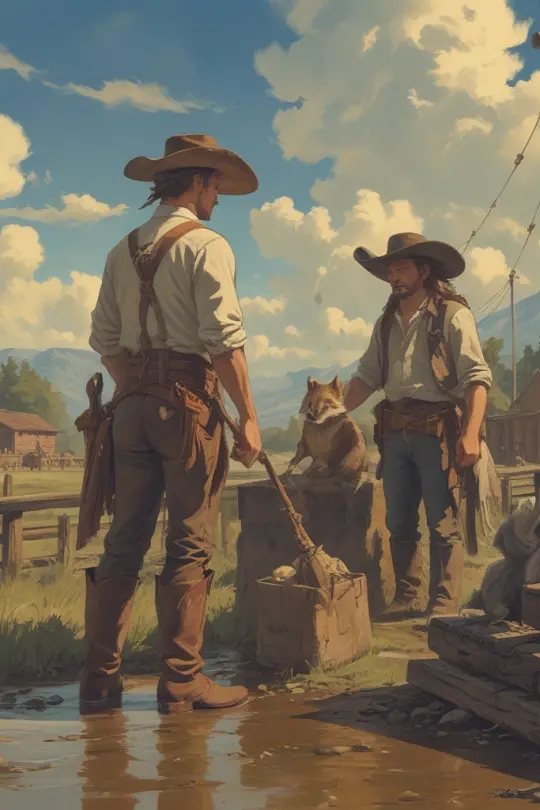
Forged Crossing
Join the conversation! Readers are sharing their thoughts:
About the Story
After a spring flood and a tense offer from a wealthy rancher, bridgewright Ephraim Lyle holds a town together with the metal of his craft and the patience of his hands. In the calm following the storm, he negotiates maintenance, trains apprentices, and stitches family ties back together. The closing days mix practical decisions — collars, rotas, seed money — with moments of absurdity and small festivals: a raccoon parade, molasses buns, Hobart’s ill-fated hat theatrics, and Buttons earning a ribbon. The final chapter follows the bridge’s formal opening, the founding of a communal trust, and a quiet hint of future work beyond the river.
Chapters
Story Insight
Forged Crossing opens in a river town where weather and work keep people honest and the smell of coal and molasses is as common as morning prayer. Ephraim Lyle, a solitary blacksmith who has made a life out of bridging gaps—literal and otherwise—finds himself at the center of a practical dilemma: a wealthy rancher offers payment to erect a private, tolled span, while neighbors plead for a communal crossing that will not shut out the most vulnerable. The novel renders small, tactile detail with authority; hammers, collars, turnbuckles and the heat of an anvil are described with the exactness of someone who understands how metal behaves under pressure. That craft knowledge is more than color: it supplies the engine of the plot, shaping choices and consequences through hands-on action rather than rhetorical argument. Interwoven with the technical work are human textures—Tess the ferrywoman’s plainspoken diplomacy, Hobart the tinkerer’s earnest absurdities, and Buttons the hat‑obsessed mule—so the atmosphere balances grit and warmth. The setting feels lived-in: stagecoach timetables, molasses buns from the baker, a town fair poster flapping on a telegraph pole, and the day-to-day commerce that gives the stakes a clear, communal weight. At its heart, the story stages a moral dilemma that plays out in wood and iron. Ephraim’s choice—whether to accept a tidy contract that would strengthen one man’s hold or to use his skills to keep the crossing open for everyone—becomes a study in vocation as ethics. The conflict mixes private pressure, generational friction with his son Caleb, and social urgency, all while the river itself tests the work in unpredictable ways. Tension escalates from council debates and tool‑room secrecy to practical emergencies that require rapid, skilled improvisation; crucial turning points are resolved by Ephraim’s forging, rigging and quick mechanical thinking rather than by revelation. Humor and absurdity punctuate the strain—Hobart’s half‑baked inventions, Buttons’s stageworthy interludes, and townsfolk rituals—so the drama never becomes merely grim. The narrative structure is deliberate, with a measured build toward confrontations that highlight workmanship, responsibility, and how community norms are negotiated through labor and compromise. Forged Crossing will appeal to readers who enjoy Western landscapes inhabited by plainly drawn people whose values are tested by everyday exigencies. The novel emphasizes sensory, technical fidelity and an unflashy moral seriousness: choices have immediate material consequences, and the hands that make things are also the hands that must repair them. Mood is a key draw—earthy, candid, occasionally wry—and the pacing rewards attention to detail rather than chase sequences. For anyone interested in stories where tradecraft functions as metaphor and action, where small-town politics and family tensions feel as specific as the grain of oak under a rasp, this book offers a grounded, humane reading experience built on knowing observation and careful construction.
Related Stories
Dustrow Springs
In the dust-choked town of Dustrow, Rhiannon "Rye" Calloway fights to save her family's spring from a railroad magnate. With a stubborn mare, a bellows-heart pump, and a ragtag community, she faces threats, wins hard-fought justice, and learns what it takes to protect home.
The Brass Echo of Dry Creek
In a parched frontier town, Etta Larkin, a former teacher turned stagecoach driver, uncovers a plot to seize the creek that sustains her community. With a tinker's listening device, a deputy's steadiness, and a town's stubborn courage, she confronts hired men and legal might to reclaim their water.
The Spark Key of Sundown Ridge
In the dusty town of Sundown Ridge, Mara Quinn keeps the telegraph and the depot running. When the town's rails are cut and a land baron moves to seize the water and the deeds, Mara gathers unlikely allies, a spark key, and a stubborn heart to save her home.
Harrow's Run
In a drought-struck frontier town, mechanic and telegraph operator June Harrow races east to reclaim a stolen pocket engine that can power a life-saving pump. With an itinerant engineer, a mechanical pony, and a ragged company, she must outwit a greedy mill owner and bind the town together.
Red Hollow Oath
In a sunburned frontier town, farrier Marigold Reyes defends her claim to Red Hollow’s water when a ranch baron’s men kidnap her brother to force a surrender. Guided by a traveling smith and her own grit, she sets a stampede, confronts the foreman, exposes corruption, and returns to stand as steward of the creek.
Signal at Red Mesa
When Red Mesa's water rights are threatened by a hungry company and the telegraph line goes silent, Maeve Calder—young keeper of the line—rides through dust and law to retrieve a missing ledger, face hired guns, and stitch a town back together using wire, wit, and stubborn courage.
Other Stories by Oliver Merad
Frequently Asked Questions about Forged Crossing
What is Forged Crossing about and who is the central character ?
Forged Crossing follows Ephraim Lyle, a bridgewright and blacksmith, as he must decide whether to build a tolled private span or use his craft to restore a shared crossing for his river town.
How does Ephraim's profession shape the story's conflict and resolution ?
Ephraim's hands-on skills drive the plot: his forging, rigging, and improvised engineering create practical solutions and moral choices that resolve crises through action.
Is the climax solved by skillful action rather than by revelation ?
Yes. The story's climax hinges on Ephraim's technical expertise—hot-forging clamps, setting anchors and tensioning lines—to save the crossing and stranded townsfolk.
What tone and balance of humor should readers expect in this Western ?
Expect a grounded, warm tone with dry humor and small absurdities: a hat-obsessed mule, Hobart's eccentric gadgets, and town rituals that lighten tense moments.
Does Forged Crossing explore community, moral choice, and generational conflict ?
It does. The plot examines private gain vs. communal needs, father-son tension between Ephraim and Caleb, and how workmanship becomes a vehicle for social repair.
Are the technical details of blacksmithing and bridgework authentic or dramatized for the story ?
Technical details are rooted in practical craft knowledge for realism, though some elements are dramatised to serve pacing and plot needs without being instructional.
Ratings
There’s a dignity to this book that kept me reading late into the night. The opening — Ephraim at the fire, the bellows like a patient beast — is one of those rare paragraphs that sets a tone for the whole novel: elemental, slow, and honest. The author writes craft as if it matters, which it does here. The act of forging becomes a metaphor for rebuilding — of bridges, families, and trust. I loved the small rituals: Tess’s coffee pan placed by the anvil with that grin that does three things at once; Ephraim measuring the span with the gravity of a surgeon; Buttons standing in the shadow with a hat someone left on a post. These details give the book its heartbeat. The communal life — apprentices learning to file and temper, townspeople arguing about collars and rotas, the funny chaos of a raccoon parade — is portrayed with affection and exactness. Moments like Hobart’s ill-fated hat theatrics or Buttons earning a ribbon aren't just comic relief; they’re acts of communal repair. The negotiation with the wealthy rancher and the founding of the trust feel rooted in real choices. There’s no melodramatic showdown, just the slow, often boring work of making a community resilient. The final chapter’s bridge opening is quietly moving — not a triumphal fanfare but a thing that people do because it must be done. The closing hint of future work beyond the river left me content but curious: will Ephraim take his patience elsewhere? I hope so. If you like westerns that focus on hands, habits, and small moral reckonings rather than endless shootouts, this is a gem. It’s comforting but never complacent — a story about people who put a lot of care into what they make and how they belong to one another.
The craftsmanship on display is vivid — I could almost feel the hot metal — but the narrative relies too much on familiar western beats. The wealthy rancher’s offer is textbook: outsider threatens community cohesion, righteous local fights back. The communal trust feels like a predictable outcome rather than a risk taken. Even Hobart’s hat bits and the raccoon parade, while amusing, read like scene-fillers to soften a straightforward arc. Pacing wobbles in the middle: several chapters linger over rotas and seed money discussions that slow momentum without adding new character insight. Buttons the mule and the molasses buns provide welcome lightness, but they also highlight missed opportunities to deepen relationships — why not let the father-son thread complicate the bridge’s opening more, instead of kissing off tensions with an ‘earnest talk’? Not bad — the voice is competent, and the setting is credible — but I wanted a bit more grit and less neatness. The ending’s hint at future work feels more like a setup for a sequel than a satisfying wrap.
I wanted to love this more than I did. The prose is pleasant and the forge scenes are well-written, but the plot felt too tidy. The wealthy rancher subplot sets up a good moral dilemma, but it’s resolved in ways that felt convenient rather than hard-earned; for a story that emphasizes patience and craft, important decisions sometimes happen off-page or too quickly. Characters are likable but often stay at the surface. Ephraim’s inner life — especially the memory of cutting the old line down — is hinted at but not fully explored. The father-son dynamics and training of apprentices are mentioned, yet I wanted deeper emotional stakes, more friction. The raccoon parade and molasses buns are charming, but at times the novel leans on quaint festival moments to prop up the pacing. If you want a cozy, community-focused western, this will satisfy. If you’re after sharper moral conflict and less tidy endings, it might disappoint.
I didn't expect to be chuckling in a western, but Hobart’s hat theatrics and that raccoon parade were pure comic gold. The book knows how to be funny without becoming a farce — the molasses buns and Buttons winning a ribbon are small human beats that make the community feel real. You care because the characters are tactile: Ephraim’s hands, Tess’s pragmatic affection, the apprentices learning the trade. That said, the novel is smarter than it looks. It hides its moral questions beneath the clang of metal. The wealthy rancher’s offer and the decision to form a communal trust are treated with the kind of practical ethics that suits the setting — there’s negotiation, compromise, and a sense of consequence that doesn't dissolve into melodrama. The final hint of further work beyond the river left me grinning; it’s a gentle promise that this world will keep moving. If you like your westerns low-spark and high-heart, this one’s for you. Also: Buttons deserves a sequel. Seriously. 🐴
Short, sweet, and solid. The story’s strength is its details: the forge smells, the broom of townsfolk fixing things, and the raccoon parade that breaks up the tension beautifully. I loved Buttons’ hat and the way Tess uses coffee to anchor Ephraim. The opening of the bridge and the communal trust felt believable and satisfying. Not flashy, but warm and honest — perfect Sunday reading. 😊
Nicely done. Forged Crossing earns its title in both literal and metaphorical ways: Ephraim’s metalwork is the plot engine, while his patience welds the community. The excerpt’s opening is a masterclass in show-not-tell — the bellows, the soap, the mule with the hat — and the town scenes that follow strike an appealing balance between the mundane and the absurd. I appreciated how the author threaded moral choice through practicalities: negotiations with the wealthy rancher are grounded in real concessions, and the founding of the communal trust doesn’t feel like a glued-on happy ending. Training apprentices and talking collars and rotas give the story a lived-in texture; it’s plausible, not romanticized. Small touches — Tess’s bluntness, Hobart’s hat theatrics, Buttons getting a ribbon — provide comic relief and deepen the cast. If I have one critique, it’s that the wealthy rancher subplot could use sharper stakes — the offer feels consequential but its long-term implications are hinted at rather than fully explored. Overall, a thoughtful western with strong atmosphere and dependable pacing. Recommended for readers who like character-driven rural tales and honest depictions of craftsmanship.
I fell in love with Ephraim Lyle in the first paragraph — the bellows, the rhythm of hammering, the smell of coal and lemon soap. The story has that tactile, hands-on quality that's rare: you can almost feel the heat and hear sparks against the forge hood. The quieter moments are the ones that stick — Tess bringing coffee and the way she steers him back into the town; Buttons chewing oats with the dignity of a mule wearing a scrunched hat; the scene where Ephraim measures the span like a doctor checking a pulse. Those small human details are gold. And then the community scenes! The raccoon parade and molasses buns provide levity without undercutting the seriousness of rebuilding the bridge. Hobart’s ill-fated hat theatrics made me laugh out loud, and Buttons earning a ribbon was the tiniest delight that landed perfectly. The founding of the communal trust felt earned — practical talk of collars, rotas, and seed money balanced with the sense of people stitching their lives back together. This is storytelling that trusts its characters and its readers. Warm, steady, and quietly hopeful — like a well-forged link in a chain. I wanted more of Ephraim’s internal reckonings, but the ending’s hint of future work beyond the river was a lovely promise. A wonderful western about craftsmanship, community, and second chances.