
Forged Across the Canyon
Join the conversation! Readers are sharing their thoughts:
About the Story
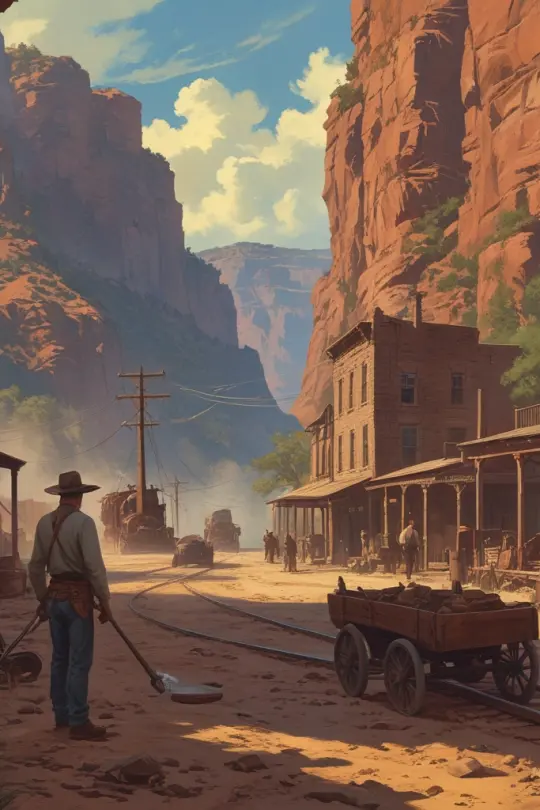
In a sun-scorched canyon, stoic blacksmith Cal McCready is pulled into a risky plan to span the gorge with a freight cable. When sabotage and a sudden wind turn the inaugural run into a runaway disaster, Cal must use his craft and quick judgment to stop the car and hold his town together.
Chapters
Story Insight
Forged Across the Canyon is a compact, tactile Western centered on Cal McCready, a solitary blacksmith whose work shapes more than horseshoes. When Ada Lyle arrives in the canyon with a makeshift cable freight idea, she lights a spark beneath a town that has lived by the river and its slow rhythms. The plot begins in the forge and keeps returning there: the sound of a hammer, the smell of coal, the precise confidence of hands that know how metal yields to heat and insistence. That sensory focus gives the story its distinct voice—small, concrete details of tempering, peening, and bolting are used not only to dramatize the craft but to explore responsibility. Humor and local color—Mae’s biscuits, a mule with a ribbon, a town parade of frying-pan helmets—keep the tone human and warm even when tensions rise. The initial chapters establish a moral question rather than a sensational mystery: should Cal lend his expertise to an invention that could change livelihoods and put people at risk, or should he protect the town from a promise he cannot trust? The narrative moves cleanly through setup, complications, and a high-stakes climax. Early scenes introduce characters whose motives are recognizably pragmatic: Ada’s urgency, Deputy Roscoe’s insistence on standards, and neighbors who fear change. Cal’s inspection uncovers design flaws and deliberate sabotage, and the middle portion of the story is an engineering drama—redesigning anchors, testing collars, training helpers—rendered in hands-on detail. That attention to craft becomes integral to the plot’s resolution: the climax is resolved by skilled, physical action rather than an abstract revelation. The tension is immediate and bodily; it’s about belays, ratchets, friction, and the timing of a hammer blow. The story also treats the saboteur’s motives with nuance, showing how fear of economic loss can harden into desperate acts, and then examines how a small community negotiates accountability and restitution. What makes this Western worth reading is its balance of quiet intimacy and mechanical problem-solving. The prose lingers on textures—metal biting leather, the river’s indifferent movement, the sound of biscuits being distributed—while dialogue reveals relationships in short, telling exchanges rather than expository speeches. The arc moves from guarded solitude toward a cautious, earned belonging: Cal’s craft becomes a bridge between individuals and the collective life of the town. The book suits readers who appreciate grounded period detail, practical ingenuity, and moral dilemmas that are solved by skill and courage rather than melodrama. It offers emotional payoff without turning sentimental, and a realistic portrait of how communities mend after near-disaster, all delivered with a steady, experienced hand that knows both storytelling and the lived particulars of working iron.
Related Stories
The Spring of Sagebrush Hollow
In a sunbaked frontier town, a young wagonwright named Marta Reyes fights to save her community's spring from a railroad baron's claim. With a photograph, a ledger, and unexpected allies, she turns evidence into resistance and learns what it means to protect what matters.
The Spark Key of Sundown Ridge
In the dusty town of Sundown Ridge, Mara Quinn keeps the telegraph and the depot running. When the town's rails are cut and a land baron moves to seize the water and the deeds, Mara gathers unlikely allies, a spark key, and a stubborn heart to save her home.
The Telegraph Key
In an Arizona Territory town, telegraph operator Eliza Hart hears a crooked message about the only spring for miles. With a roan mare, a portable key, and help from a blacksmith and a surveyor, she rides for proof against a ruthless cattle baron, outwits his hired gun, and brings law and water home.
Dust and Vow
After a failed night ambush turns violent, Elias rescues Isabel and forces a confrontation that exposes Jeremiah Cross's crimes. With the sheriff pressed into action and evidence gathered, the town drags Cross into a public reckoning. The verdict is messy but freeing; Dry Hollow begins to reclaim itself as Elias follows the road again, the brass token of his promise left in Rosa’s care.
Sundown at Silver Hollow
In a sun-bleached frontier town, Maeve Calhoun fights to reclaim her community when a railroad company's men seize land and people using forged deeds. A stolen ledger, a borrowed compass, and a ragged band of neighbors become the tools of resistance in this gritty Western about courage, craft, and what it takes to hold a home.
Sundown Verdict
A young photographer rides into a thirsty New Mexico town and finds a land baron trying to own water itself. When her telegraphist brother vanishes, she follows a trail through quarries and ranch gates, using flash powder and nerve to expose forged deeds, free her kin, and help the townsfolk claim their spring.
Other Stories by Agatha Vorin
Frequently Asked Questions about Forged Across the Canyon
What is Forged Across the Canyon about and what inciting event sets the plot in motion ?
A stoic blacksmith is asked to inspect and reinforce a makeshift cable freight across a canyon. Ada Lyle’s plan to speed trade sparks the central dilemma when the town must decide whether to trust the device and its safety.
Who is Cal McCready and how does his profession as a blacksmith drive the central conflict and moral choices in the story ?
Cal is a solitary, skilled blacksmith whose technical knowledge and ethical standards become pivotal. His trade frames the conflict: he must choose whether to lend his craft to a risky innovation or protect the town by refusing.
How does Ada Lyle’s cable freight project affect the small canyon town’s economy and social dynamics ?
Ada’s project promises faster freight and new income, stirring hope and anxiety. It divides neighbors between those craving change and those fearing disruption, exposing hidden grudges and forcing collective responsibility.
What are the nature and motives behind the sabotage that complicates the cable project, and how does that escalate the stakes ?
Sabotage is subtle: notched bolts and loosened anchors designed to cause quiet failure. Motives stem from fear of lost livelihoods and resistance to change, which raises the moral and physical urgency of securing the system.
How is the climax resolved — through a character revelation or through Cal’s skilled, hands‑on action as a craftsman ?
The climax is solved through Cal’s blacksmithing skill: improvising a heated band brake, rigging a capstan, and physically stopping the runaway tub. It’s a technical, high-stakes rescue, not a mere revelation.
Does the story include humor, local color, or everyday details like food, weather, and festivals to balance the tension ?
Yes. The narrative mixes tense engineering moments with warm, absurd touches—Mae’s biscuits, Gus the mule’s hijinks, local parades and weathered river routines—grounding the drama in community life.
Ratings
I found this promising but ultimately a bit too tidy. The prose is lovely — the passage about listening for the ring that means the grain took the shape is a standout — and Cal is sympathetic. But the plot relies on the 'stoic tradesman saves the day' trope without complicating it enough. The sabotage is revealed right when we need stakes, which made the danger feel convenient rather than organic. The pacing feels compressed: the setup lovingly lingers in the forge, then the action hurtles by with little time to breathe between beats. I also raised an eyebrow at a few technical aspects of the rescue; it reads like a good scene in a movie but some explanations would have made the resolution more convincing. Still, the atmosphere is strong and there are moments of real charm — the Mae Barnes detail especially — so it’s worth a read if you like classic Western moods.
Good vibes and great imagery, but the story didn’t quite hold together for me. The scene-setting — bellows, anvil, Mae’s biscuits drifting — is gorgeous and immersive. Sparks is amusing, and I liked the human-scale stakes. However, the sabotage felt contrived: who sabotaged the cable and why? The story hints at tensions but doesn’t dig into motive, which left the conflict feeling thin. The runaway car sequence is tense but leans on convenient timing and a last-minute improvisation from Cal that edges into implausible. I admire the attempt to root the climax in practical tradecraft, but I wanted clearer mechanics so I could fully buy the rescue. Also, the moral dilemma at the end is touched on but not fully explored — the town’s fallout deserves more than a brief coda. Good writing; patchy execution.
I wanted to love this, but it fell into a few familiar traps. The opening is lovely — the breathing forge line is arresting — and Cal is a good, solid character. But after that promising start, the plot leans too heavily on cliché: the taciturn blacksmith who saves the town, the jaunty sparks character, the neat sabotage that conveniently reveals itself at just the right moment. The sabotage and runaway car should have been more surprising; instead it felt like a checklist of Western beats. Pacing is another issue — the middle rushes through motivations for the cable project and the sabotage without giving us enough reason to care about the political stakes. And a technical nitpick: the description of how Cal stops the car skirts specifics in a way that made me wonder whether the solution was mechanically plausible or just narrative hand-waving. In short, nice atmosphere but predictable plot and some gaps in logic.
Beautifully written vignette with a strong sense of place. The canyon itself becomes a character — dusty winds, river smell, Mae’s baking — and Cal is the perfect stoic center. The set pieces are vivid: Sparks dropping coil wire on the bench, the inaugural run going sideways, the scramble to stop the car. I liked how the resolution relied on practical skills rather than cinematic gimmicks. The narrative economy is impressive; nothing feels wasted. Overall, very satisfying and atmospheric — a short story that stays with you.
What a lovely, atmospheric short — I read it in one sitting and came away smiling. The author trusts small details to reveal character: Cal’s blunt-fingered hands, the ring of the nailed shoe, the smoke that sighs warm iron into the yard. Sparks is a fun foil, and the interplay between the town’s ordinary rhythms and the extraordinary danger of a sabotaged freight cable is handled deftly. I especially admired the moral thread: Cal isn’t just fixing metal; he’s repairing community trust. That ending — where he uses his blacksmithing and quick thinking to stop a runaway car — felt quietly heroic rather than flamboyant. The pacing is brisk but not rushed, and the prose never oversells the emotion. Highly recommend for anyone who likes a character-first Western with heart.
This is an old-school, slow-burning Western done well. The writing is spare but tactile — you can feel Cal’s calluses and the heat of the forge. I appreciated the attention to craft: the horseshoe nailed in three blows, the bellows rhythm, even the small domestic detail of Mae’s baking signaling community. The sabotage and the runaway car sequence are thrilling because they’re grounded in real tradecraft: Cal’s solutions come from his occupation, not sudden superhero reflexes. That made the climax satisfying. The dialogue has an easy, lived-in cadence — Sparks teasing Cal felt authentic, and the town’s dynamic is convincingly sketched. If you like character-driven action and the smell-of-rust-and-biscuits vibe, this one delivers. A solid read for fans of traditional Westerns.
I loved the texture of this story — the opening line about the forge breathing like a patient animal hooked me immediately. Cal is the kind of quiet, reliable protagonist Westerns need: scarred hands, steady wrists, a moral center that doesn’t feel forced. The way Mae Barnes’s biscuits drift through the air and even the metal “tasted of biscuits and coffee” is such a small detail that makes the town feel lived-in. Sparks’s entrance with the coil wire and the bright ribbon gave the scene levity without undercutting the stakes, and the sabotage sequence on the inaugural run had my heart in my throat. When Cal improvises with his blacksmithing knowledge to slow the runaway car, it felt earned — not deus ex machina — because the text had already established his skill and calm judgment. The moral dilemma afterward, holding the town together while choosing accountability, added emotional weight beyond the action. The prose is lean but evocative, and the atmosphere — sun-scorched canyon, dusty wind — is pitch-perfect. My only tiny gripe is that I wanted a little more backstory about why someone would risk sabotaging the cable; a couple of hints would have amplified the tension. Still, a beautifully crafted Western with a real sense of place and character.