
Shifts and Lifts
Join the conversation! Readers are sharing their thoughts:
About the Story
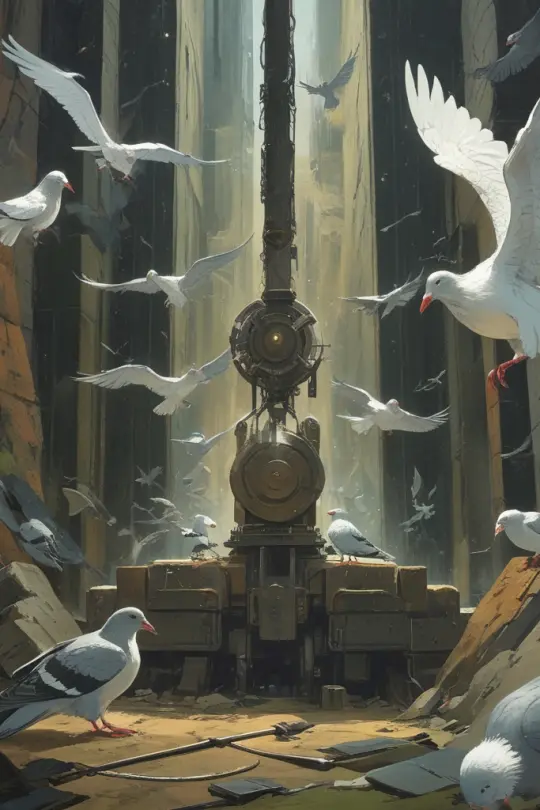
Sam Calder, an elevator mechanic who treats mechanisms like companions, is pulled into an emergency when a hurried patch binds a lift mid-shaft. Racing against bureaucracy and a mischievous vertical wind, Sam must risk sanction to lower a car by hand, using muscle, ingenuity, and a flock of tool-bearing pigeons.
Chapters
Story Insight
Shifts and Lifts centers on Sam Calder, a seasoned elevator mechanic who measures his days by the taste of grease and the rhythm of ratchets. In a city built in tiers, where rooftop bakeries trade warmth for the convenience of a well-timed car and municipal inspectors love margins as much as forms, a small, unauthorized hardware tweak creates an immediate and physical problem: an elevator stalls between floors at the worst possible moment. Sam is pulled into a dilemma that is less about ideology and more about practical consequence—obey the letter of the code, or use the tacit knowledge of his trade to intervene. Around him stand a cast of vivid, human neighbors: Asha, the rooftop baker whose livelihood depends on timely runs; Dex, an eager apprentice with a ridiculous but oddly effective pigeon tool-relay; and Inspector Finch, whose devotion to procedure collides with the messy needs of community life. The city itself feels alive in small, uncanny ways—sylph-like threads that nestle in hinges, markets strung under sky-bridges, stray cats that treat pulley platforms like courts—adding an urban-magic texture to a story grounded in workmanship. The narrative trades in tactile specificity and short, decisive scenes. Instead of grand revelations, the plot runs on hands-on expertise: spanners, tensioners, and the muscle-memory of a trade passed down in garages and kitchen corners. The central emotional arc is precise and credible: Sam moves from a wary, almost cynical posture toward a cautious, practical hope, not through platitudes but through doing. Humor and absurdity puncture the tension—pigeons in tiny harnesses delivering tools, a cat bribery routine involving stale croissant crumbs—so the book never becomes solemn for its own sake. The prose leans into sensory detail: the squeal of idler bearings, the smell of saffron and butter from nearby ovens, the taste of metal on the tongue when a live splice demands attention. Dialogue is compact and revealing; exchanges show working relationships, mutual teasing, and the kind of loyalty that forms when people rely on each other’s hands. This is a tight, two-chapter urban fantasy that privileges craft, community, and the ethical weight of small actions. The stakes remain local and immediate—people, livelihoods, and the machinery that links them—while the fantasy elements add color rather than abstraction. The climax is resolved through skilled intervention rather than an abstract discovery: competence, improvisation, and shared improvisational labor are what move the plot to its practical resolution. The story will appeal to readers who appreciate vivid, work-focused storytelling, brisk pacing, and a balance of humor with genuine tension. It delivers a compact, satisfying experience built on authoritative details about a trade rarely treated as a moral language, an intimate sense of place, and an honest portrayal of what it takes to keep a city’s small systems running.
Related Stories
Opening Hours of a Wandering City
A locksmith named Rafe contends with wandering doorways that rearrange a neighborhood’s private maps. In a city of late-night vendors and peculiar civic rituals, he must use his craft to steady thresholds and teach neighbors a physical protocol for consent—before thresholds choose themselves.
Between the Bricks
Night crews and artisans weave living memory into mortar. Cass Arlen, a seamwright who can sense and shape the city's manifest fragments, hides a luminous shard that hints at her mother's erasure. As she joins a network of clandestine menders to confront the Department that flattens scraps of life into civic neutrality, she must choose whether to anchor a public mosaic with her own last private memory. The city's mortar listens; the ritual asks for a price.
Inkbound
A sign-painter who can coax surfaces back into memory sacrifices a single private recollection to anchor the city against a tech-driven campaign to sterilize public history. As civic machines and human hands collide, the streets resurface with recovered names, legal fights, and changed lives.
Beneath the Soundwell
In a metropolis where sound is currency, a courier whose brother loses his voice exposes a municipal reservoir that hoards human expression. Forced into a reckoning with an emergent chorus that feeds on voices, she makes a costly choice: to become the city's living register — a human anchor bound to the Chorus — in exchange for a negotiated system of voluntary restitution.
The Last Facade
The city’s facades have always held people’s promises; when a firm begins harvesting those marks, a restorer discovers a private fragment of her own turned into a keystone for mass reconfiguration. She must choose how to stop the reworking—by breaking the machine, by letting the firm dictate the future, or by sacrificing a piece of herself to flood the city with its own scattered memories.
Elseforms
In a city where unrealized choices become small, sentient Elseforms, a maintenance worker named Zara uncovers a corporation compressing those possibilities into consumable experiences. Drawn into an escalating confrontation, she must risk merging with her own Elseform to reroute a machine built to take.
Other Stories by Greta Holvin
Frequently Asked Questions about Shifts and Lifts
What is Shifts and Lifts about ?
A compact two-chapter urban fantasy following Sam Calder, an elevator mechanic who must physically free a stuck lift after a hurried aftermarket patch binds its controls, racing time, wind, and bureaucracy.
Who is Sam Calder and what motivates him ?
Sam is a skilled, pragmatic lift technician who values craft and community. He’s motivated by a sense of duty to keep people moving and pragmatic ethics rooted in hands-on problem solving.
Is the story more fantasy or grounded realism ?
It blends both: detailed procedural realism—tools, ratchets, tensioners—and small urban-magic touches (sylph threads, pigeons in tool vests) that color the setting without overwhelming the technical rescue.
How does the story use humor and absurdity ?
Light, situational humor appears through eccentric city details—pigeons delivering wrenches, cats bribed with croissant crumbs—and friendly banter, easing tension while deepening neighborhood character.
Does the climax depend on revelation or skill ?
The climax is resolved by skill. Sam performs a risky live splice, manual tuning, and mechanical improvisation. Success hinges on his trade expertise, timing, and physical action.
Are there consequences for Sam’s choice to act ?
Yes. The narrative acknowledges formal consequences—reports and review—while emphasizing immediate practical outcomes and community response that complicate simple punishment.
Ratings
I wanted to love this more than I did. The premise is fun — an elevator mechanic, tool-bearing pigeons, and a hand-lowering rescue — but parts of the story felt a little too neat. The bureaucracy is presented as an obstacle, yet we never see real consequences for flouting it; Sam risks 'sanction' but the fallout is vague. That undercuts some of the urgency the setup promises. Also, the pigeons border on gimmickry. They’re charming in small doses (Dex’s harness, stale croissants), but they don’t quite earn the narrative weight the author gives them. Asha is introduced vividly, but her role could have been expanded beyond the symbolic — the envelope of privilege, for example, is intriguing but underexplored. On the plus side, the prose has nice sensory touches (the saffron roll, the hum of the sheave) and the mechanical detail is convincing. It’s an enjoyable read, but it leaned a bit toward tidy resolution and missed chances to complicate the moral stakes.
Quirky, charming, and surprisingly moving. I wasn’t sure how pigeons with tiny wrench bits would play out, but they become a clever emblem of community improvisation. Sam’s hands-as-language thing stuck with me — the scene in the service hatch where he listens to the hum was perfect. Short, sweet, and satisfying.
Lovely prose and atmosphere. The opening scents (grease + saffron roll) are so specific they anchor the whole story, and the van-as-metal-beetle image is delightful. Sam’s tactile relationship with machinery — fingers that 'remember the angles' — is the novel's real gift. The emergency is handled with both humor and seriousness: pigeon harnesses, a mischievous vertical wind, and a very human decision to lower the car by hand. Felt authentic and slyly poetic.
This story does a lot with a tight premise. At its center is Sam Calder, a mechanic whose relationship with machines reads like a tender devotion. The author elevates shopcraft into language: the way Sam 'runs the wrench along the guide rail' and 'listens' to a hum made me remember the rhythm of manual work — the patience, the muscle memory. The incident (a hurried patch binding a lift mid-shaft) immediately sets up the conflict between improvisational expertise and institutional inertia. I particularly enjoyed how the narrative balances stakes and satire. The vertical wind is treated almost as a capricious sprite, complicating the physical task and giving the rescue a mythic quality — you're not just undoing a bolt, you're arguing with the city itself. Dex and his pigeons are more than comic relief; they symbolize neighborly problem-solving. The image of pigeons in tiny leather vests carrying thread and wrench bits is absurd but affectionate, and it shows how the community repurposes the mundane into a cooperative toolkit. The ethical dimension—Sam risking sanction to lower the car by hand—lands because the characters are fully realized. Asha Rivera's concise introduction (flour on her apron, wrist like an anchor) gives her agency without an expository dump. The pacing during the rescue is taut; the bureaucratic delays feel real and infuriating. If there's a small flaw, it's that the denouement could have used one extra beat to show consequences or the city’s reaction. Still, this is a superbly crafted urban fantasy: it marries practical detail with whimsical worldbuilding and makes you care about the work people do to keep a city moving.
Heartwarming little gem. The community threads — Asha the rooftop baker, Dex’s pigeons, Sam’s quiet competence — make the rescue feel like a neighborhood event instead of a lone hero stunt. I loved that Asha shows up with pastry dust like confetti. The scene where they actually lower the car by hand is tense but intimate; you can almost smell the frying dough and oil. Felt like a warm pastry in book form.
Okay, I did not expect to root so hard for an elevator and a flock of croissant-nibbling pigeons. 😂 The story's tone walks a tightrope between absurd and earnest and somehow nails it. Dex with a pigeon harness like an 'ill-chosen scarf' is a line I'll quote forever. The whole 'van hissed along the filigreed ramps' bit reads like a city that's part machine, part pastry shop — delightful. When the lift binds mid-shaft and Sam decides to lower the car by hand, I was cheering, groaning, and biting my nails all at once. The bureaucratic red tape is handled with a wink (but real consequences), and the vertical wind is a great antagonist — unseen but mean. A few beats lean on whimsy a touch too much for me, but the affection for labor and community keeps everything grounded. Good, funny, and oddly touching.
Short and sweet: this is a love letter to handiwork. Sam handling the sheave like a companion, the pigeons with tiny wrench bits, and that image of lowering the car by hand — all of it lands. The voice is calm and confident, and Asha Rivera is a standout scene partner (flour on her apron, grin that clips through a late fee — chef's kiss). I wanted more world-building, but the emotional heart is strong. Cozy, clever, and oddly moving.
As someone who writes about labor and urban systems, I appreciated how 'Shifts and Lifts' uses the elevator mechanic as a living metaphor. The prose is precise in the same way Sam's hands are — economical, reliable, and full of small observations (the idler tuned with a knock, the bench that had seen too many birthdays). That specificity makes the city feel lived-in. The plot's core—an emergency caused by a hurried patch—works well because it foregrounds institutional friction. The bureaucracy that Sam races against is almost a character in itself, and the vertical wind adds an unpredictable force that keeps the rescue tactile and dangerous. The pigeons are a bold touch; they could've become a gimmick, but the author uses them to underline community improvisation and humor. If I had one critique, it's that a couple of side threads (Asha's request, Dex's backstory) are sketched rather than fully developed. But given the story's tight focus on the rescue and what it reveals about Sam's ethics and craft, that restraint mostly serves the narrative. A smart, warm urban fantasy that honors small, essential work.
I fell for Sam Calder on the first line — that opening about grease and a saffron roll is such a small, perfect detail that it sets the whole mood. The story treats the mechanics’ work like a language and a religion, and Sam's tenderness toward machines feels both literal and deeply human. I loved the way the pigeons were described: ridiculous little leather vests, tool loops, Dex grinning as he untangled them. The scene where Sam pops the service hatch and listens to the car hum is one of those lovely bits of craft writing — you feel him measuring the world by touch. When the lift gets stuck mid-shaft, the stakes were immediate and intimate. The race against bureaucracy, the vertical wind mocking them, and Sam deciding to lower the car by hand — risking sanction for a real rescue — made the moral choice feel earned. Asha Rivera is a brilliant addition: grounded, warm, and quietly fierce. The blend of absurd humor (tool-bearing pigeons!) with genuine tension and community warmth is rare and delightful. I smiled, I teared up a little at the ending, and I want more of this city.