
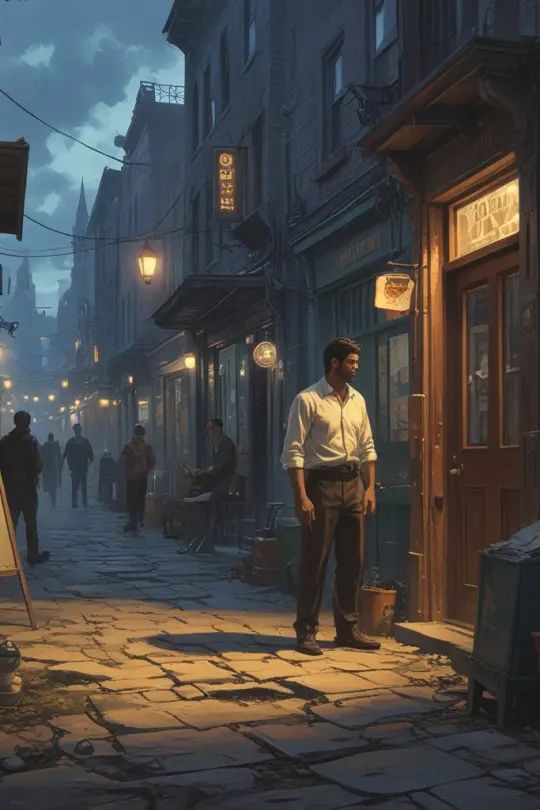
Opening Hours of a Wandering City
Join the conversation! Readers are sharing their thoughts:
About the Story
A locksmith named Rafe contends with wandering doorways that rearrange a neighborhood’s private maps. In a city of late-night vendors and peculiar civic rituals, he must use his craft to steady thresholds and teach neighbors a physical protocol for consent—before thresholds choose themselves.
Chapters
Story Insight
In a city where thresholds have minds of their own, a locksmith named Rafe Quinn becomes the unlikely fulcrum between private habit and communal life. Doors start to wander—apartment entries open into pizzerias, shop fronts appear inside living rooms, and the everyday geography of neighbors shifts in ways that are at once comic and dangerous. Rafe’s trade—the precise, tactile business of pins, cylinders, and torque—anchors the narrative. The story inhabits a vivid urban landscape: a municipal market that smells of citrus and coal, late-night vendors who score the city’s hours by taste, and tiny domestic rituals like shortbread and shared thermoses. Humor and gentle absurdity thread through these details, most notably in an opinionated, semi-sentient doorknob who offers ironic commentary on civic life. The tone balances immediacy and wry observation, giving the fantasy elements a grounded, lived-in logic rather than theatrical spectacle. At its heart the plot frames a moral and practical choice: patch the city’s faults with quick, profitable fixes that preserve distance, or invest labor and trust in a technical solution that asks neighbors to work together. The stakes are intimate—privacy, safety, and the small dignities of daily life—so the drama grows from the tangible consequences of misaligned thresholds. Themes of boundary and consent are explored through locksmithing as metaphor: keys and latches become ways to encode voluntary connection and to resist unwelcome intrusion. Rather than resolving the crisis by revealing a grand conspiracy, the story insists on craft and coordination. The climax is deliberately hands-on: the protagonist’s skills and improvisations—filing pins, machining a master cylinder, synchronizing turns across multiple frames—are the means by which the neighborhood stabilizes itself. That emphasis on labor as moral action gives the tale a practical, credible core that will feel familiar to anyone who appreciates well-observed technical work in fiction. This three-chapter novella delivers a compact but richly textured reading experience. The prose pays particular attention to sensory detail—the tug of a stubborn strap, the smell of lemon oil on metal, the muttered gossip of brass—so the city comes alive through craft as much as through magic. The story treats community as an engineered practice: routines, classes, and rosters matter as much as ceremonies or revelations. If a preference exists, it leans toward quiet, character-focused scenes full of hands-on problem solving, warm humor, and a comforting respect for ordinary civic rituals. The narrative will appeal to readers who like urban fantasy grounded in material reality, those drawn to stories where skill and cooperation change the world, and anyone curious about a gentle, humane take on how neighbors learn to live with the small strange things a city sometimes asks of them.
Related Stories
When the City Forgets
In Bellmont, sign-restorer Mara Vance fixes more than metal—she mends belonging. When anonymous plaques begin erasing people’s memories, Mara joins a ragged coalition of archivists, a detective, and a graffiti artist to unmask a developer and confront a force rewriting the city’s names.
Inkbound
A sign-painter who can coax surfaces back into memory sacrifices a single private recollection to anchor the city against a tech-driven campaign to sterilize public history. As civic machines and human hands collide, the streets resurface with recovered names, legal fights, and changed lives.
A Tear in the Morning
Afterlight concludes Seams of Cinderwell with the city learning to live alongside its repaired and altered memories. Mara navigates her new role as a living anchor while institutions, legal systems, and neighbors adapt to uncertain reforms and fragile restitutions. The tone is quiet and watchful, centered on a heroine whose search for a lost sibling ignites public upheaval and private change; the inciting event is the discovery of systematic extractions of personal impressions tied to urban “consolidation” projects.
The City of Small Oaths
At dusk the streets are held together by tiny promises: taped receipts, whispered pledges, favors traded without records. When a glossy startup begins erasing those traces, a courier who delivers fragile vows must break her distance and confront what it means to reclaim what was taken. The city tightens as she moves from courier to public keeper, carrying a single, visible pledge back into the world.
Neon Oath
Beneath the city's neon, a municipal technician confronts a corporate market that extracts people’s memories as commodities. When friends are seized and neighborhoods thin into quiet shells, Kara must breach a Solace facility and become the human conduit the system demands. The atmosphere is taut and mechanical; the hero moves through law, ritual, and sacrifice to force memory back into the streets.
Blueprints of Forgetting
In a city where memories are mapped into visible seams along streets and walls, a mender of those seams uncovers a corporate program erasing neighborhoods. With evidence, community ritual, and a risky technical countermeasure, a small group fights to anchor collective memory—forcing a personal sacrifice to secure a shared past.
Other Stories by Astrid Hallen
Frequently Asked Questions about Opening Hours of a Wandering City
What is Opening Hours of a Wandering City about ?
A locksmith named Rafe faces a neighborhood where doors literally wander, opening to unexpected places. He must use his trade to steady thresholds, coordinate neighbors, and install opt-in latches to restore daily order.
Who is Rafe Quinn and what role does his locksmith trade play in the story ?
Rafe is a practical, solitary locksmith whose hands-on skills—filing pins, cutting cylinders, improvising clamps—become the decisive force. His craft serves as both metaphor and method for repairing social boundaries.
How does the story balance urban fantasy elements with everyday city life ?
Magical occurrences (talking doorknobs, migrating thresholds) are woven into sensory urban detail: markets, food smells, late-night rhythms. The fantasy complements tangible craft work and neighborhood routines, not replaces them.
Is the central conflict resolved through revelations or through craft and action ?
Resolution arrives through applied skill and coordinated labor: machining a master cylinder, synchronizing turns across frames, and installing consent latches. The climax is technical and action-based, not purely revelatory.
Are there humorous or absurd elements in the novella ?
Yes. The story uses light absurdity—an opinionated doorknob, doors that demand compliments, vendors offering machine-aphrodisiac pastries—to humanize characters and relieve tension while advancing community bonds.
Will the story explore community and consent in practical ways ?
Definitely. Consent is treated materially: opt-in mechanical latches let residents deliberately share door pairings, and the plot includes workshops, rosters, and neighborhood clinics to teach and maintain those practices.
Ratings
I started with high hopes — a locksmith as a hero, magical doors, a neighborhood that shifts — but ended feeling mildly disappointed. The writing is pleasant and the small details (the kettle’s habit, the vendor’s bulbs) are evocative, yet the plot never quite builds to a meaningful climax. The Mrs. Hyun scene is fun, but similar incidents keep repeating without deeper exploration, which makes the pacing drag. Also, the premise of teaching a physical consent protocol is intriguing but underdeveloped. There are hints of civic conflict and rituals, but we barely see neighbors confront each other or the bureaucracy involved. And the bit about thresholds ‘choosing themselves’? Left too vague. Nice worldbuilding snippets, but the story needed sharper stakes and a clearer internal logic to the magic to fully land.
Cute concept, inconsistent execution. The imagery is strong in places — I loved the keys like a constellation and Geraldine’s cranky voice — but the story often reads like a sequence of charming vignettes that don’t add up to a satisfying narrative push. Rafe is competent to the point of being unthreatened, so the tension is minimal. What bothered me more were plot holes: thresholds ‘choosing themselves’ is stated as if it needs no explanation, and the rules around the magic are nebulous. If you’re going to center a story on consent and public rituals, you also need to show complications when those rituals fail; here, the solutions are almost bureaucratically tidy. Worth reading for the atmosphere, but don’t expect a fully realized world or payoff.
I wanted to love this more than I did. The premise — wandering doorways and a locksmith trying to teach consent rituals — is fresh, and the opening paragraph with the three apologetic knocks is lovely. But as the story progresses it leans on the same charming details without escalating the central conflict enough. After Mrs. Hyun’s pizzeria mishap, the episodes start to feel repetitious rather than cumulative. There are also a few unexplained mechanisms that grated on me: why do thresholds choose themselves? Is there any logic beyond whimsy? The civic protocol is an interesting idea, but it’s presented a bit too neatly; the social friction and resistance from neighbors are barely shown. I wanted more moral complexity and stakes. Good writing and atmosphere, but pacing and depth hold it back from being truly memorable.
This story made me think a lot about how communities manage boundaries. Rafe isn’t just fixing hardware; he’s scaffolding trust. The best scenes are the small domestic ones — the doorknob Geraldine speaking, the thermos of kimchi pancakes, Rafe’s keys arranged like stars — which create intimacy and make the city feel cohesive. I particularly liked the civic angle: teaching neighbors a physical protocol for consent elevates the plot from quirky supernatural occurrence to a social problem with workable solutions. The author clearly understands that city life is negotiated every day, and they translate that into a believable, moving arc. Would love to see more about how different cultures or vendors in the city influence these rituals, but as it stands, this is a thoughtful, warmly-rendered slice of urban fantasy that honors skill, labor, and neighborliness.
There’s a lullaby quality to the prose: quiet, precise, and with a low-key magic that creeps under your skin. The first knock — three tentative raps — felt musical, an invitation into a city that rearranges its own meaning. I appreciated how the neighborhood feels like a living mosaic of late-night vendors and rituals; those worldbuilding touches (the clock that ticks by sympathy, the kettle that hisses from habit) lingered long after I closed the story. Rafe’s locksmith craft is both literal and symbolic; his attempts to ‘steady thresholds’ read as a meditation on consent, care, and neighborhood responsibility. The Mrs. Hyun sequence on Magnolia, where a door redirected her into a pizzeria, is funny but also quietly unnerving — a reminder that home can be uncertain. A poetic, humane urban fantasy that trusts small moments to carry large meaning.
Totally charmed by this one. Rafe is the kind of reluctant hero I’m here for — slightly cranky, deeply skilled, and with a soft spot for odd neighbors. The scene where Geraldine clears her throat and almost apologizes had me grinning; it’s such a quirky, human moment for an inanimate thing. The city at night (fried dough scent + mismatched bulbs = chef’s kiss) is vivid, and the locksmith details make the fantasy feel lived-in. 🗝️ My favorite bit: the practical, almost bureaucratic solution of teaching people a consent protocol. It’s clever and grounded — you get folklore and municipal weirdness without losing the human stakes. Also, Mrs. Hyun’s basil/pizzeria mishap is comedic gold. Short, sweet, and full of heart. I wanted more pages, but that’s a compliment — I’ll take another walk through this wandering city any day.
Warm, tactile, and unexpectedly tender. The vignette of Rafe waking to three soft raps is such a lovely opening image — it immediately sets the tone of a city that is alive in small, careful ways. I loved the sensory writing: the fried dough and citrus, the barely-keeping-time clock, the doorknob Geraldine speaking like a slightly tipsy friend. Rafe’s work as a locksmith becomes a beautiful metaphor for consent and community care; teaching people a protocol for thresholds felt original and humane. The Mrs. Hyun episode on Magnolia — being redirected to a pizzeria and having to pay for basil — is funny and poignant, showing how the magical rearrangements affect daily life. The story never forgets the craft: there’s joy in the details of locks, tools, and routines. If you enjoy character-driven urban fantasy that emphasizes community and small rituals, this one’s a gem.
Clever premise executed with a craftsman’s care. The author nails the specificities of locksmithing enough that Rafe’s work feels both believable and metaphorically rich: keys as constellations, Geraldine as an object with voice. The prose balances wry humor with melancholy — that clock that has no second hand and the kettle that hisses out of habit are such smart humanizing touches. Structurally, the episodic jobs (Mrs. Hyun’s door, the late-night vendor scenes) serve to map the neighborhood’s disruption while also gradually revealing Rafe’s methodical approach to consent and thresholds. I appreciated the civic-side solutions — teaching neighbors a physical protocol — which grounds the magic in communal ethics rather than leaving it as purely supernatural chaos. If I have a quibble it’s minor: a couple of scenes could use more friction to raise stakes (Rafe is a bit competent too early), but that’s nitpicking. Overall a thoughtful, well-paced urban fantasy with a fresh lens on boundaries and belonging.
I finished this in one sitting and felt a small ache afterward — the kind that comes from leaving a place you wish you could stay in a little longer. Rafe is a quietly brilliant protagonist: practical, a little battered, and oddly tender with metal and people. The opening — those three soft raps that sound like an apology — is one of the best scene-setters I’ve read in urban fantasy. The details sing: keys like constellations, Geraldine the doorknob clearing her throat, the vendor’s cart with mismatched bulbs. I loved how the city itself feels alive and opinionated; thresholds aren’t just obstacles, they have personalities and moods. The Mrs. Hyun pizzeria incident on Magnolia is such a great blend of the mundane (kimchi pancakes!) and the fantastical (doors that refuse to be literal). The way Rafe has to teach neighbors a physical protocol for consent is a touching, inventive angle — it turns a supernatural problem into a community ritual. Atmosphere, character, and craft are all strong here. If you like stories where small jobs reveal big truths, this is for you.