
Echoes in the Fourth Rail
Join the conversation! Readers are sharing their thoughts:
About the Story
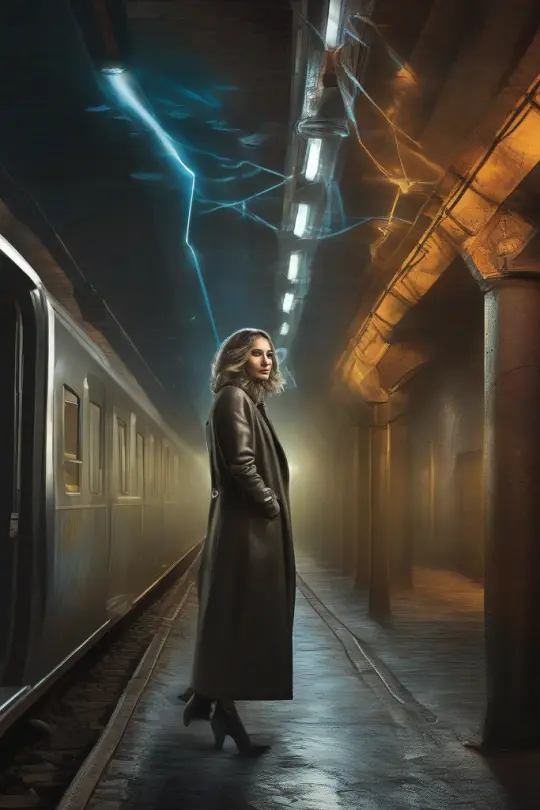
Acoustic engineer Maya descends into Lidov City's subway after her graffiti-artist brother vanishes, following blue arrows and a hum only she can read. With a retired stationmaster's tuning fork and her own wits, she crosses maintenance mazes, exposes a smuggling ring, and brings its cold leader to light.
Chapters
Related Stories
Seventh Directive
An investigative journalist discovers an encrypted municipal file that names her missing brother and sets off a collision with a private contractor running a covert program. As she traces shipments, recovers footage, and risks betrayal and violence, a live expose detonates public outrage and reveals a system that punishes lives with coded decisions.
The Vanishing Code
A forensic audio specialist, Nora Voss, unearths a hidden sonic signature embedded in municipal broadcasts—an engineered pattern capable of disrupting memory. As she, a journalist ally, and a municipal technician race to stop a scheduled public deployment, they infiltrate broadcast infrastructure, confront corporate operatives, and force the evidence into daylight. The atmosphere is tight and clinical, with technical precision and personal stakes: Nora's discovery ties back to a long-buried loss and makes her a target, setting in motion a public revelation that halts the immediate threat but uncovers deeper institutional complicity.
Protocol Nine
Former analyst Maya Cole risks everything to expose a covert program that converts predictive models into instruments of removal. After a dramatic, signed confession and a coordinated legal push, she and her allies force Helios’ operations inward, rescue detainees, and ignite public inquiries — but the system’s quiet pipelines persist.
Signal Fade
A transit signal engineer races to stop a coordinated sabotage that nudges passengers and clears corridors for covert convoys. As micro-timing pulses threaten a cascading rail failure, Noor must use wrenches, wetware, and grit to force the system into safe fallback while keeping a loved one out of harm’s way.
Silent Signal
A former audio forensics expert uncovers a hidden low‑frequency carrier embedded in everyday broadcasts that manipulates and silences inconvenient voices. Racing against a corporate machine, she and a small team attempt to hijack a national feed to expose the truth before a scheduled testimony is muted.
The Hush Frequency
On sleepless nights, forensic audio analyst Mara Voss threads her tinnitus through police tapes and hears something no one else does: a sub-bass hush that erases microphones and stills crowds. When a source dies and her home is breached, the signal pulls her toward a staged ‘calm.’
Other Stories by Orlan Petrovic
Ratings
I wanted to love this more than I did. The premise — an acoustic engineer following blue arrows into a subway to find her graffiti-artist brother — is undeniably cinematic, and the opening sensory writing (the platform breathing, neon spectrograms) is lovely. But as the plot unfolds, a few structural issues started to pile up. First: predictability. The clues (blue arrows, fox mural, a tuning fork from an old stationmaster) line up a bit too neatly, and the maintenance mazes feel like convenient obstacles engineered solely to showcase Maya's skills rather than organic parts of the world. The Hydra app verges on a deus ex machina at times: it's a neat tool, but it occasionally does the heavy lifting of plot exposition instead of letting Maya's intuition drive the discovery. Pacing is another problem. The middle section lurches — some scenes drag on acoustic minutiae that work best in small doses, while the climax rushes past the dismantling of the smuggling ring and the unmasking of the "cold" leader. That reveal felt thin; we get method but very little motive or emotional payoff, which lessens the tension of the final confrontation. Lastly, while the sibling bond is touching in places, Petya's disappearance itself could have been explored more deeply — his character remains more a plot device than a person I grieved for. There's a good thriller here under the surface, but it needed tighter plotting and a stronger emotional center to reach its potential.
Loved it. Proper urban thriller with enough grime and brain to keep you chewing pages. The setup — younger brother Petya with his fox mural and blue arrows, Maya the acoustic nerd who literally hears things others can't — is such a cool pairing. A few moments made me grin: the conductor's line about "the line will adopt you," Maya's deadpan reply about shaving two tenths, and of course that tuning-fork handoff from a retired stationmaster (classic: old guy gives young specialist a single tool and the plot clicks). The blue arrows leading her in felt like a scavenger hunt for grown-ups, and the maintenance mazes? Properly claustrophobic. I liked the smuggling ring being run by a "cold" leader rather than some cartoon villain — methodical, understated menace. If I had to nitpick, maybe the graffiti scenes could've had an extra splash of color (literally). But honestly, this one kept me invested, and the sibling bond kept it from being just another procedural. Bravo. 🙂
Short and to the point: this story hooked me from the line about the platform breathing. I loved the way small details (the conductor's "adopt you" quip, the sunflower scarf, the coins in a pocket) give the subway real life. Maya's relationship with Petya feels authentic — that text exchange with the rabbit emoji made me smile and then worry. The tuning fork scene with the old stationmaster is quietly brilliant; it's not flashy but it matters. The smuggling ring revelation didn't feel contrived — the clues lined up and the maintenance passages had actual grit. It moved briskly and kept me guessing until the end. Clean, atmospheric, solid character work.
As someone who geeks out over sound design, I appreciated how the author wove acoustics into the plot without turning it into a lecture. Hydra, the spectrogram app, isn't just window dressing — it drives the investigation (calibrating mics, measuring reverb tails, shaving two tenths off delay). The technical bits read believable: the low A of a train that "shivered through her bone," and the tuning-fork scene with the retired stationmaster is used cleverly to ground Maya's ear for anomalies. Structure-wise the story is tight: the initial hook — Petya's blue arrows and half-finished fox mural — sets a graffiti-ish urban thread that's nicely contrasted with the municipal and mechanical world of the subway. The maintenance mazes feel like an actual engineered space rather than a generic labyrinth, which raises the stakes when Maya's acoustics skills reveal hidden doors and smuggling caches. The antagonist's "cold" leadership is shown more in method than melodrama, which fits the world-building. If I have a critique, it's minor: a couple of transitions into the underground could be smoothed, but overall this is a smart, atmospheric thriller that uses its central conceit — sound — to full effect.
Echoes in the Fourth Rail landed on me like a low note that won't leave — in the best way. Maya is one of those rare protagonists who feels lived-in: her little jokes about shaving two tenths off an announcement delay, the way she reads a platform's mood through a spectrogram, and the small, fierce worry she carries about Petya (that rabbit emoji stuck in my head). The subway comes alive — the platform "breathing," the mosaic chips catching fluorescent shivers, and especially that scene where the retired stationmaster hands her the tuning fork. I loved how that old object anchored the whole acoustic sleuthing. The blue arrows and the fox mural under Serafim felt like breadcrumbs that made sense in a city that hides things on purpose. The pacing was taut without being breathless. The descent into the maintenance mazes had real texture: damp stone, echoing clanks, and the app Hydra tracing reverb tails felt authentic and cinematic. The reveal of the smuggling ring's cold leader was satisfying — not just a big-name villain but someone whose methods were chillingly mundane. Mostly, the sibling bond kept everything human. I read it in one evening and immediately wanted to talk about it. Highly recommend for anyone who likes urban thrillers with heart and a seriously cool take on sound.