
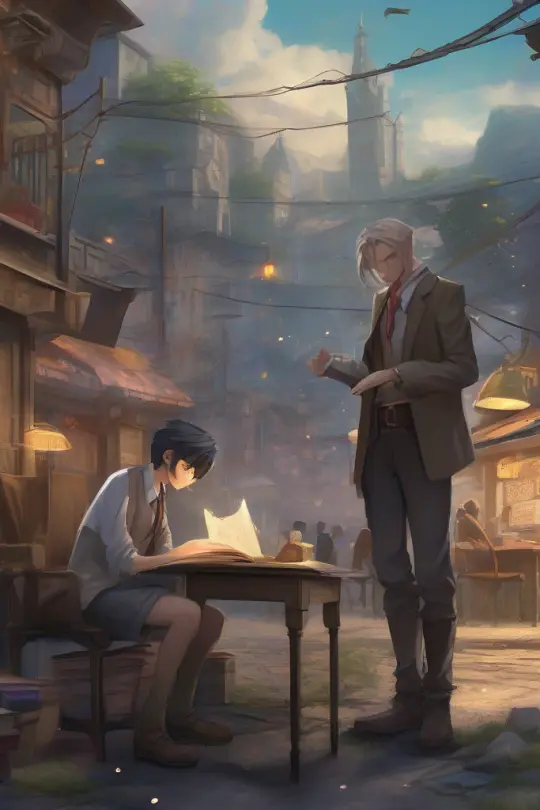
Left on Doorsteps
Join the conversation! Readers are sharing their thoughts:
About the Story
A small-town stationery owner’s anonymous notes upend the quiet of daily life when a returning journalist’s reporting leads to an unintended revelation. Tension follows as exposure fractures trust, and repair becomes a cautious negotiation between privacy and public curiosity.
Chapters
Story Insight
Left on Doorsteps begins in the small, tactile world of Nora Whitaker’s stationery shop, where the ritual of folding a single sentence into a folded slip of paper feels as necessary as breathing. Nora has kept a private promise to leave anonymous notes of encouragement across town — tucked into bookshop bags, slipped under bench slats, sealed with a tiny hand-drawn sprig. When Jonah Hale, a returning freelance journalist with a soft eye for human detail, finds one of those notes and follows the trail to Nora’s shop, a gentle attraction blooms alongside a quieter moral question: how far should curiosity go when it risks exposing someone who chose anonymity as protection? That tension—between a private act of kindness and the public appetite for a story—propels the plot without theatrics, grounding the romance in real ethical friction. The narrative treats everyday textures as storytelling tools: the clink of the shop bell, the smell of brewed tea, the feel of card stock between fingers. These specifics are not ornamentation but the means by which trust and intimacy are rendered believable. The three-part structure moves deliberately: an opening that introduces the ritual and the meeting; a middle that deepens intimacy while compressing journalistic pressure; and a final section where an unintended revelation forces accountability and community negotiation. Conflicts are moral as much as romantic—consent, ownership of another person’s gestures, and the consequences of turning private kindness into public currency. Side characters give the town weight and perspective: Nora’s pragmatic friend Bea, who pressures her toward openness in small, human ways; Jonah’s editor Marco, whose career-minded impulses complicate the reporter’s choices. The book’s moral debates sit close to real-world questions about storytelling and privacy, handled with nuance rather than didacticism. Left on Doorsteps will appeal to readers who enjoy quiet, thoughtful romances that take time to breathe and reckon. The tone is warm without being saccharine, and the novel focuses on repair and responsibility rather than tidy rescues. It offers intimate domestic moments and community gatherings that feel lived-in, alongside a pressing contemporary dilemma about when, if ever, a story should be told at the expense of someone’s agency. Emotional payoff comes from watching flawed people make difficult, sometimes imperfect amends, and from the careful exploration of how small acts ripple through a neighborhood. If the appeal lies in texture, ethical subtlety, and a romance built on consent and accountability, Left on Doorsteps is written with a steady hand and plenty of heart.
Related Stories
Tides of the Clockmaker
A coastal romance about Ada, a clockmaker haunted by her father's disappearance, and Elias, a marine acoustic scientist whose work entwines science and heart. Together they uncover a lost journal, protect a fragile cove from development, and learn that small, steady actions keep a town—and love—alive.
Salt and Ivory
A coastal romance about Mara, a piano restorer, and Evan, a marine biologist. When a storm steals a small sea-glass vital to restoring a family piano, the two hunt the harbor, confront a salvage crew, and mend things both musical and human. A story of found objects and second chances.
Letters in the Salt
In a coastal town, an apprentice paper conservator and a sailmaker unite to save a chest of letters that tie the community to its vanished ship. Through restorations, small revelations, and shared labor, they discover roots, resist commodification, and bind love to the town’s memory.
Cinnamon and Glass
In the sunlit coastal city of Porto Azul, pastry chef Mara fights to save her grandmother’s bakery from redevelopment. When architect Rafael proposes a gentler plan—and falls for her warmth—they rally a community, protect a hidden mosaic, and build a future that balances love, craft, and place.
A Season to Stay
Nora Vale returns to the small town where her family’s bakery stands threatened by an investor’s redevelopment plans and a hidden debt. As she confronts the practical demands of repairs and addresses the years long silence between her and Julian Archer, the local craftsman she once loved, an urgent inspection forces the town into action. Secrets surface, alliances form, and negotiations between pragmatic survival and preserving community character push Nora and Julian toward difficult choices about trust, responsibility, and whether to stay and rebuild together.
Second Bloom
In a town that cradles a small conservatory, Nora guards a living legacy threatened by repairs and uncertain funding. When Asher, a returning landscape consultant, offers practical aid, a partnership forms—practical labor entwined with rising attraction—as they race to save the place.
Other Stories by Felix Norwin
Frequently Asked Questions about Left on Doorsteps
Who is the anonymous note writer in Left on Doorsteps ?
The anonymous note writer is Nora Whitaker, a small-town stationery shop owner. She leaves unsigned encouragements as a private promise, which becomes central when a returning journalist notices the sprig sticker and pursues the story.
What is the central conflict driving the romance in Left on Doorsteps ?
The romance is driven by Nora’s need for anonymity and Jonah’s journalistic curiosity. Their bond deepens while professional pressure and the temptation to reveal authorship threaten trust, forcing accountability and repair.
How is the story structured across its three chapters ?
The novel spans three focused chapters: introduction of the anonymous notes and meeting, deepening intimacy and ethical pressure, then exposure, fallout, and a resolution centered on apology, community repair, and renewed boundaries.
Is Left on Doorsteps a gentle romance or heavy drama ?
It’s primarily a gentle romance with emotional stakes. The tone emphasizes small-town warmth and quiet intimacy, but it also explores ethical tension and betrayal, leading to sincere emotional reckonings rather than melodrama.
Does the story explore consent and journalistic ethics ?
Yes. Jonah faces an ethical dilemma about exposing someone’s private kindness. The plot addresses consent, publication consequences, retraction efforts, and community agreements to protect anonymity and agency.
What emotional arcs do the main characters follow in Left on Doorsteps ?
Nora moves from guarded solitude to cautious openness, protecting her ritual of anonymous giving. Jonah evolves from curiosity-driven reporter to remorseful ally who chooses accountability and the protection of Nora’s boundaries.
Ratings
I found the story emotionally distant. The author excels at small details — I could see the glass jars of buttons and the leather blotter — but the characters beyond Nora never quite breathed. The reveal sparked by the returning journalist comes across as contrived: I didn’t buy why the press would blow so hot over anonymous kindnesses, and the community’s reaction sometimes reads like a checklist of predictable tensions (privacy vs. curiosity, performative kindness, etc.). The supposed ‘repair’ between Nora and the journalist happens through tidy scenes — an apology in the shop, a returned note — that didn’t feel earned to me. I wanted messier, more complicated fallout, and deeper looks into the journalist’s reasoning. Nicely written in parts, but overall too tidy and cautious for my taste.
I wanted to like this more than I did. The premise is cute — anonymous notes as small acts of kindness — and the descriptions of Nora’s shop are lovely, but the middle sagged for me. Once the journalist’s reporting breaks the anonymity, the consequences feel familiar and a little predictable: town gossip, a contrite apology, and then an inevitable reconciliation. A few moments stood out (the folded notes under the bench, the sprig sticker), but many scenes felt like scaffolding to get to the next neat moral beat. Also, the journalist’s motivation was thinly sketched; it would have helped to see more about their inner conflict rather than having them act as a plot device. If you’re into gentle, tidy romances, this will probably work for you. For readers wanting sharper stakes or surprises, this may feel a bit tame.
Such a sweet, bittersweet book. The imagery is precise — pastel morning light on notecards, a chipped mug — and those details make Nora’s world feel comforting and real. I loved how the author uses the little sprig sticker as a symbol that threads through the story. The reporting subplot introduces real stakes; when the anonymous notes are exposed, people’s reactions are messy and true-to-life. The romance is understated but satisfying: the way trust is rebuilt through small, repeatable acts echoes the book’s central motif. I laughed out loud at the awkward community meeting and cried during the scene where someone reads a note aloud at the river bench. Highly recommend for readers who enjoy slow-building emotional payoff and ethical nuance.
I’m normally wary of small-town romances, but this one won me over with its specificity. Nora’s rituals — the little brass tray with stamps, the way she folds the notes — make her feel real and tactile. The ethical tangle around anonymity and public interest is the strongest part: the scene where the journalist publishes and the town’s reaction pivots from curiosity to accusation is tense and believable. I particularly liked the negotiation scenes where Nora and the journalist discuss what it means to ‘do good’ in public; they don’t resolve everything, but they make progress through honest, awkward conversation. The ending doesn’t tie everything up in a bow, which felt right. Warm, earnest, and surprisingly thoughtful about privacy in a connected age.
This story is a lovely study in restraint. The writing is calm and observant — you can almost hear the scissors and feel the paper — and it trusts the reader to sit with moral ambiguity. I admired the choice not to demonize the journalist; instead, the reporting is shown as an ethical dilemma with consequences. My favorite scene is when Nora chooses the single sentence for someone who’s on the verge of giving up — the humility of that gesture is the whole book’s heart. If I had one criticism, it’s that a few supporting characters felt a bit thin; I wanted more perspective from the town’s teenagers or the bookstore owner. Still, the main relationship’s repair felt honest and deserved. A quiet, thoughtful romance worth reading.
I loved this. Nora’s tiny acts of kindness — folded notes that force a moment of intimacy — are such a sweet, original premise. The author captures the hum of small-town life so well: the independent bookshop three doors down, the river bus stop, neighbors who know too much and not enough. The reveal driven by the returning journalist felt heartbreaking; the scene where Nora overhears someone speculate about the notes at the general store made me physically ache. The book interrogates the difference between doing good for recognition and doing good because you believe in it, and it refuses to simplify that into easy answers. The second-chance romance is handled with real care; the reconciliation isn’t instant, it’s negotiated through small acts that echo Nora’s original project. Sweet, thoughtful, and quietly moving. 🙂
A gently compelling read. I enjoyed how the story used small objects — a round sticker with a hand-drawn sprig, a paper bag in a bookshop, the leftmost plank at a bus stop — to map out relationships and trust. The ethical questions around anonymity versus transparency are nicely explored; the journalist’s reporting is not cartoonishly villainous, which made the tension feel real. The climax where the town finds out felt messy and plausible, with people reacting in predictable but sympathetic ways. Romance here is slow and a little awkward — in the best way — as both parties have to learn how to apologize and rebuild. The prose is quiet and attentive to textures. If you like quiet, thoughtful romances with moral complexity, this is for you.
This book made me fall in love with a town. The descriptions of Nora’s mornings — pastel sunlight pooling on glass jars of buttons, the hush of scissors cutting ribbon — are gorgeous and transporting. I especially loved the delicate ritual of choosing exactly one sentence each week; that small rule is the engine of the whole plot and it’s such a lovely idea. When the returning journalist arrives and the notes are exposed, the author dramatizes the fallout with real heart: the fracture of trust, the awkward town meetings, the way people reinterpret kindness as performance. The repair arc between Nora and the journalist is beautifully done — tentative apologies, awkward coffees, and the scene where the journalist leaves an unsigned note back on Nora’s counter had me smiling like an idiot. This is romance that grows out of community and ethical complexity rather than melodrama. Cozy, thoughtful, and emotionally satisfying.
I appreciated the moral complexity at the heart of this story. The setup is deceptively simple: a stationery shop, anonymous notes, a small emblematic sticker of a sprig. But when the returning journalist’s reporting sparks an unintended revelation, what follows is a convincing negotiation between privacy and public curiosity. The author resists easy answers — I liked that — and the scene where the community meetings devolve into whispered speculation felt terribly plausible. Stylistically it's restrained in a good way: the prose around Nora’s practices (the single sentence per week, folded so the act of unfolding matters) is spare and effective. My only small quibble is pacing in the middle chapters: the reporting subplot accelerates a little faster than Nora’s interior life, making the reconciliation feel slightly hurried. Still, as a meditation on kindness, anonymity, and second chances, it succeeds. The final exchange on the shop doorstep felt earned and quietly hopeful.
This was exactly the kind of quiet, warm story I needed. Nora’s rituals — tea in a chipped mug, the brass tray with stamps, and that leather blotter — felt lovingly observed; you can tell the author really knows how to render small, domestic details so that they carry weight. I loved the way the notes were placed — under the leftmost plank of the bus-stop bench, tucked into a paper bag at the bookshop three doors down — those little, precise gestures made the town feel lived-in. The moral tension when the returning journalist’s reporting leads to the revelation is handled gently but honestly. The book asks difficult questions about privacy and the ethics of exposure without turning preachy, and the slow repair between Nora and the journalist is tender and believable. I teared up at the scene where Nora watches someone unfold a note on the river bench and realizes the impact of her anonymity. Overall, warm, thoughtful, and quietly romantic — highly recommend to anyone who likes slow-burn, character-driven stories.