
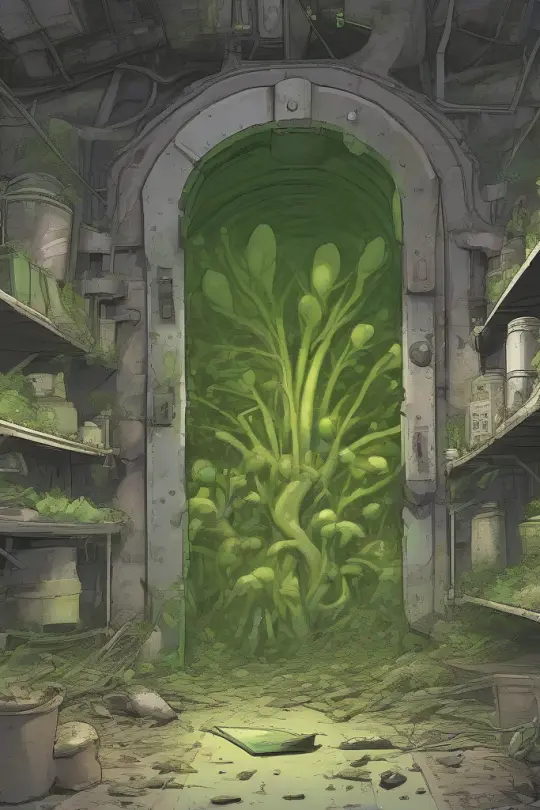
Seedfall
Join the conversation! Readers are sharing their thoughts:
About the Story
A hardened botanist, a child changed by a strange sprout, and a quiet band breach an old vault to unearth engineered seeds—sow them, hide them, or watch them become tools of power. Tensions ripple from vault logs to market deals and siege lines as fragile green starts to rewrite scarcity across ash-strewn tradeways.
Chapters
Related Stories
The Ferryman's Signal
In a fractured coastal world, a young radio mechanic, Etta, embarks from her barge to coax light back into her settlement. She bargains, fights, and learns to stitch communities together with fragile technology and harder choices. A post-apocalyptic tale of barter, courage, and shared light.
Greenwell
In a scorched future settlement, a water-runner discovers a pre-collapse ecological engine called Greenwell. Her search to save her fevered brother becomes a political and moral struggle as the engine demands a living interface; choices will redefine personhood and communal stewardship.
When the Wells Remember
Decades after the climate infrastructure fell, Hollowfall survives on dwindling cisterns. Ex-hydrologist Mara Jansen must reach Station Seven — a derelict precipitation-control complex — where old protocols, rival syndicates and a brittle machine force a choice over who controls water.
Static Communion
A signal mechanic clings to a mast while rewiring a community’s scheduler by hand. Against wind and arcs she improvises soldered bypasses, a mica shard, and a bicycle-spoke coil to widen the mesh’s tolerance for messy, human broadcasts. Her hands change the network and, quietly, her place among people.
Shards of Dawn
In ash‑dark ruins, archivist Maya guards a metal canister that could coax the land green. When the Council demands it she flees with a ragged band to the Ena Vault and discovers revival requires living consent. Their race to disperse knowledge and a single, costly act will reshape who holds the future.
Vault of Roots
In a fractured coastal city after the Fall, twenty-two-year-old seedkeeper Mara Voss must cross ruined plains, bargain with guarded strongholds, and learn to listen to the memory in a seed. A prism and a tiny soil-moth become the tools that let her trade knowledge for life and bind communities back together.
Other Stories by Jon Verdin
Frequently Asked Questions about Seedfall
What is Seedfall about and how does its post‑apocalyptic setting shape the plot ?
Seedfall follows Mara, a hardened botanist, and her small band who uncover Project Greenline — engineered seeds buried in a vault. The ruined, resource‑scarce world forces stark choices about control, survival and whether to disperse life or hand it to power.
Who are the central characters in Seedfall and what roles do they play in the conflict ?
Mara leads as the pragmatic botanist; Julek is the loyal engineer whose sacrifice shifts strategy; Kah is the former researcher who knows vault access; Lio, a child touched by a sprout, becomes a living activation key. Varo embodies coercive power.
What is Project Greenline and why are its engineered seeds both valuable and dangerous ?
Project Greenline is an old ecological program producing microbiome‑dependent seed strains. Valuable because they can restore degraded soils; dangerous because built‑in bio‑locks and suppression modules can be weaponized or centralize control over who can grow.
How does Seedfall handle the ethical dilemma of sharing life‑restoring technology versus guarding it to prevent abuse ?
The story frames the dilemma through community debate, betrayals, and tactical choices: trade for immediate relief, keep strains secret, or disperse them widely. It explores stewardship, risk, and the cost of choosing collective renewal over concentrated control.
How plausible is the concept of microbiome‑locked seeds in Seedfall and is it anchored in real science ?
The fiction builds on real ideas: plant‑microbiome interactions and targeted microbial consortia. While microbiome‑locked activation is speculative and dramatized, it rests on plausible biological principles adapted for narrative tension, not direct real‑world deployment.
Why does Mara ultimately opt to disperse the inoculant rather than hand it to Varo or hide it away ?
Mara sees handing seeds to Varo as consolidating power and perpetuating scarcity; hiding risks loss or weaponization. Dispersal spreads agency, reducing monopoly risk and enabling many communities to experiment, despite new uncertainties and moral costs.
What broader themes does Seedfall explore for readers interested in environmental recovery, governance, and survival ethics ?
Seedfall probes stewardship vs control, scarcity ethics, tech’s double‑edged nature, and community resilience. It raises questions about who should decide ecological futures, how to balance short‑term needs with systemic change, and the human cost of those choices.
Ratings
I wanted to love this more than I did. Seedfall has a strong premise — engineered seeds in a ruined economy — and some compelling images (Mara's 'lab memory,' Lio on the barrel), but the execution felt predictable at times. The arc from cylinder discovery to vault breach plays out like a checklist of familiar tropes: outsider arrives with mysterious tech, community debates morality, seeds magically become a battleground. Pacing is uneven; the middle stretches where market deals and siege lines should complicate things more deeply instead skim the surface. There are also a few plot conveniences that pulled me out of the story — information seems to leak at just the right moments for tension, and some factions behave too uniformly (the warlords decide to seize; the market instantly commodifies) rather than showing messy internal politics. The ethical questions are introduced but not always interrogated fully; I wanted more wrestling and less telling. Still, the atmosphere is strong and Mara is a memorable protagonist, so there's a lot of potential here if the author tightens the plotting and lets the moral conflicts breathe.
This hit me in the chest. The quiet faith people place in Mara — like trust having 'shape and weight' — is the kind of image that sticks. That cylinder scene where Rahn unwraps the brass and the green pulse shows through? So creepy and perfect. Lio's curiosity is a bright, risky thread against the ruined landscape. I cared who lived and who didn't. Really moving, and unsettling in the best way.
What impressed me most about Seedfall is how it treats regeneration as both technical craft and political flashpoint. Mara's past as a botanist is shown through details — her hands' 'lab memory,' the ritual care for plots — and that specificity makes the later decisions devastatingly plausible. The vault breach and the discovery of engineered seeds (and accompanying vault logs that hint at containment protocols and dependency clauses) raise realistic dilemmas: should these seeds be distributed to rebuild fairer systems, or will market actors and warlords simply turn them into tools of control? I loved passages where the narrative shifts scale — intimate moments like Lio climbing a barrel or Mara tasting iron juxtaposed with market deals and siege lines — because they reveal how personal choices ripple outward. The prose is economical, atmospheric, and occasionally lyrical; I especially enjoyed the sensory grounding (salt pits, orange dawn). A few secondary characters could be fleshed out more, but that may be intentional to keep focus on Mara's moral compass. Top-notch thematic richness and worldbuilding.
Okay, I have to confess: I wasn't expecting to be so emotionally invested in a seed. 😂 But Seedfall makes the mundane sacred — dirt, roots, the way Mara wraps a root 'tight' like a prayer. The cylinder reveal is executed perfectly: Rahn's smoke-stained entrance, the brass plating, the faint green pulse — that beat in the prose hooked me. The story also gets gritty when trade and siege lines get involved; it isn't all wistful rebirth. There are moments of dark humor, too (the offers flying 'like stones' made me snort), and the ethical tug-of-war over whether to sow, hide, or weaponize the seeds is handled without spoon-feeding. If you like slow-burning moral messes, this one's for you.
Short and sharp: this story stuck with me. The council under the tarp scene is textured — you can smell smoke and spice — and the debates about opening the cylinder felt like real community politics, not just plot convenience. Project Greenline raises excellent ethical questions. I wanted more of Mara's backstory as a botanist, but the restraint works; the narrative trusts the reader. Solid, thoughtful post-apocalyptic fiction.
Seedfall nails the intersection of hard science and messy human decisions. The opening establishes Mara as both expert and guardian, and the cylinder marked Project Greenline neatly foreshadows the central dilemma: seeds as salvation or weapon. I appreciated how the text connects quiet micro-scenes (Mara walking the plots; Lio peering over the barrel) to larger structures — vault logs, market deals, siege lines — without feeling didactic. The vault-breach sequences are taut and grim, and the market/siege fallout underscores the ethical ambiguity of introducing engineered scarcity into survival economies. A minor quibble: a few of the logistical details (how information leaks through the market, who enforces containment) could be tightened, but overall the pacing and moral complexity kept me engaged. Strong worldbuilding and a protagonist you actually care about.
I loved Mara from the first paragraph — the way her hands have 'lab memory' and she treats the plots like 'careful accounting' is heartbreaking and beautiful. The scene where she holds the cylinder and tastes iron in the back of her throat gave me chills; you can feel the weight of the choice in her palms. Lio climbing the barrel felt real and awful and hopeful all at once. The writing balances small human gestures with big ethical questions (Project Greenline? yikes). This is a quietly brutal world that still allows tenderness, and the seeds-as-power metaphor lands hard. I stayed up thinking about the market deals and siege lines — what people will trade for life. Gorgeous, humane post-apocalypse.