
The Bridgebuilder of Mercersford
Join the conversation! Readers are sharing their thoughts:
About the Story
Isobel Harrow leads Mercersford to build a hybrid timber-and-iron bridge, negotiating guild oversight and town needs while turning crises into practical tasks. The final chapter follows the bridge’s completion, a tense crossing solved by Isobel’s skill, and a modest opening where craft, apprenticeships, and community everyday life converge.
Chapters
Story Insight
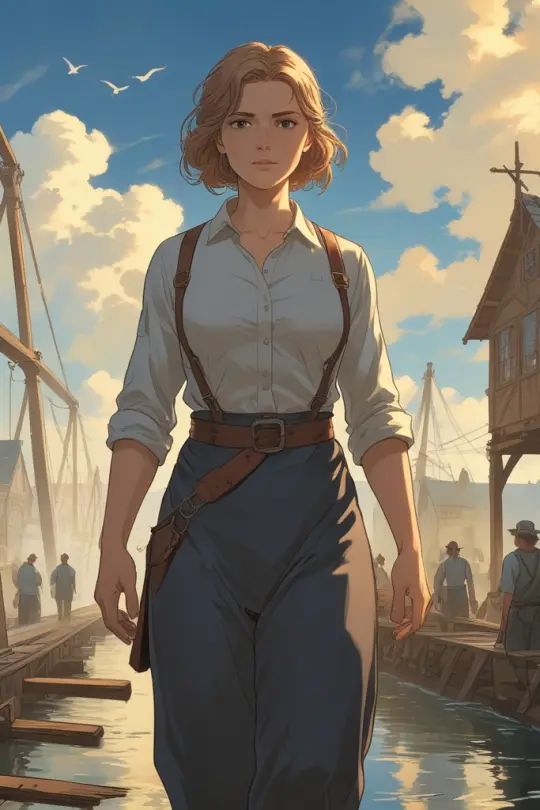
The Bridgebuilder of Mercersford follows Isobel Harrow, a solitary master of timber joinery whose workshop sits at the elbow of a stubborn river. Set in a town balancing old stonework and the lure of iron, the novel turns a profession into its organizing lens: carpentry, falsework and the patient mathematics of joints become both practical tasks and moral language. A proposal to replace the town’s aging crossing with a modern iron span launches a series of debates, petty sabotages and civic theatrics—the mayor’s ceremonial goose and an absurd teapot adjudication among them—until an urgent collapse and a sudden spring flood force the community to face the limits of spectacle versus craft. Isobel refuses easy patronage, negotiates with guilds and rivals, and is repeatedly tested not through revelation but through the work she knows how to do: designing shoring, driving piles at angles, rigging block-and-tackle, and managing men and materials under strain. Along the way the story builds apprenticeship, neighborly bargains and a hybrid plan that asks the town to keep its crossing free while adapting to new technologies. What sets this story apart is its tactile specificity and a steady, humane perspective. The prose lingers on the smells and small rituals of rural life—hearth broth, woad-dyed cloth, bakery steam—and it treats craft as an ethical practice rather than quaint detail. The book sketches the politics of small-town finance and guild oversight with a practical eye: offers of outside capital come with conditions, and those choices carry consequences for who maintains access to everyday goods and who learns the trades. The emotional arc moves from solitude toward belonging; Isobel’s guarded independence softens as she teaches apprentices, bargains with laundresses and wagoners, and accepts the messy, sometimes comic solidarity of neighbors. Humor is threaded through civic absurdities and eccentric local characters, so scenes of technical urgency are balanced by wry relief rather than melodrama. Readers drawn to historically grounded fiction that privileges detail and procedure will find a steady, satisfying rhythm here. The novel’s strength is the way high stakes are translated into hands-on responses: crisis scenes are resolved by skillful action—timbering, bracing, and coordinated labor—rather than by contrived secrets or last-minute epiphanies. Dialogue sketches relationships and local life as much as it moves plot: council rooms smell of tallow and cabbage, market lanes are alive with barter and lemon-peel sweets, and workbenches become sites of apprenticeship and trust. The narrative balances technical descriptions with accessible language, so the mechanics of construction enhance rather than obscure the story. This is a historical novel for readers who appreciate craftsmanship, small-scale civic drama, and quiet moral pressure: a story about how a community chooses what to preserve and what to change, told through the honest work of building and repair.
Related Stories
The Paper of Names
A meticulous customs clerk in a 19th‑century port uncovers a hidden manifest linking local elites to illicit night shipments. Her copying and witness‑gathering unsettle civic comforts, ignite press scrutiny, and push private records into public view—forcing hard choices for family and community.
The Harbor's Charter
In a mid‑19th‑century coastal town, widow Miriam Calder turns communal memory into evidence to resist a plan that would enclose the eastern slip. A discovered family folio, legal hearings and a frayed community lead to a tense negotiation before a pragmatic court order pauses construction and forces a conditional settlement.
The Cartographer of Saint-Malo
In mid‑18th century Saint‑Malo, Eloise Fournier, an apprentice mapmaker, must outwit smugglers who harvest wrecks by snuffing coastal lights. With a makeshift binnacle, an old surveyor, and a retired lieutenant, she turns instruments and ledger into proof, saving her town and earning recognition.
The Beacon of Valparaíso
Fog, salt and the steady turn of a lighthouse define the atmosphere. Catalina, a practical lighthouse keeper, faces a harsh choice when a wounded childhood friend arrives with a coded plea. Between mechanics and politics, her decision will shape a single night and a town’s fate.
Between Hem and Horizon
In a coastal 19th‑century harbor, Beatrice Voss, a master sailmaker, must act when a brig founders on a reef and lives hang on her craft. Hands, ropes, and a stubborn stitch set the pace; a small sewn patch hints at someone she once lost. Salt, lantern light, and a goose keep the night human.
The Binder of Saint Aveline
In seventeenth-century Venice, binder Livia Levrini must recover a stolen ledger that condemns her father. Through canals, hidden cellars, and court chambers she pieces together a web of secrets, trains in craft and cunning, and binds truth to witness to restore honor and teach others.
Other Stories by Rafael Donnier
Frequently Asked Questions about The Bridgebuilder of Mercersford
What is The Bridgebuilder of Mercersford about and what central conflict does it explore ?
A historical novel centered on Isobel Harrow, a master timber bridgewright. It follows a town torn between timber craft and iron-backed modern proposals, exploring social prejudice, civic choices, and the practical stakes of infrastructure.
Who is Isobel Harrow in The Bridgebuilder of Mercersford and what craft defines her role in the story ?
Isobel Harrow is a solitary master of timber joinery. Her expertise in carpentry, falsework and bridgecraft drives the plot: her hands-on skill becomes the town’s solution to collapse, flood and contested modernization.
In what kind of historical setting and era is The Bridgebuilder of Mercersford placed, and how does it reflect industrial change ?
Set in a riverside market town during an early industrial transition, the story stages local guild politics and outside investors. It shows how ironworking and capital pressure traditional timber craft and community control of common roads.
What major themes—such as community, craft, and modernization—are examined in The Bridgebuilder of Mercersford ?
Key themes include profession as moral language, tradition versus novelty, community responsibility, apprenticeship, and practical heroism. It also weaves light humor through civic rituals and everyday rural detail.
How is the climax of The Bridgebuilder of Mercersford resolved — does practical skill or revelation drive the outcome ?
The climax is resolved by Isobel’s practical skills: timber engineering, emergency falsework, pile-driving and coordinated rescue. Action rooted in craft—not a withheld secret—saves lives and proves her approach.
Who should read The Bridgebuilder of Mercersford, and what kind of reader will most appreciate its blend of craft, history, and humor ?
Readers who enjoy historically grounded fiction, detailed craftwork, community-scale drama and quiet moral stakes will like it—especially those drawn to tactile description, apprenticeship arcs and modest, human humor.
Ratings
I wanted to love this more than I did. The prose is lovely in places—the workshop descriptions, the mallet worn hollow by a hundred blows—but too much of the story relies on charm and atmosphere to cover thin plotting. The guild oversight subplot, for example, hints at real conflict but never becomes consequential; it exists to remind us there’s pressure without ever delivering a satisfying showdown. The final crossing is tense, yes, but it’s resolved a little too neatly by Isobel’s skill alone. I kept waiting for a complication that would test the community or the bridge’s hybrid design in a way that mattered beyond the immediate scene. Pacing is another issue: the middle lingers in delightful detail but slows momentum, so when the story needs to escalate it instead slips into quiet domesticity. That’s not bad per se, but it makes the ending feel unsurprising and safe rather than earned drama. If you’re here for mood and craftsmanship, there’s much to admire; if you want stakes and sharper conflict, this may leave you wanting.
Okay, so I went into this expecting quaint village vibes and got full-on craftsmanship porn (in the most wholesome way). Isobel Harrow is the best kind of boss—no cape, just a mallet and nerves of oak. The line about the last plank giving a ‘thin, satisfied groan’ is gorgeous and maybe the single best description of adult joy I’ve read all month. The book doesn’t try to be bigger than it is: guild politics are a pressure, not a melodrama; the market bell rings, people bicker, and Isobel gets on with the work. The crossing scene? Chef’s kiss—tenon snug, peg home, problem averted with a cool head. Also, apprentices getting real responsibilities felt modern and wholesome. If you like stories where competence is the plot twist, this one’s for you. 10/10 would recommend to anyone who secretly likes watching people do things properly. 😄
I loved how tactile everything felt—the shaving curls like confetti, the mallet’s handle hollowed by use. Isobel is an honest, unshowy heroine: you believe the way she sizes a joint and the way she sizes up people. The scene at Old Harker’s farm and the final crossing were especially satisfying; when the cart teetered I was actually nervous. The ending isn’t loud, and that’s exactly right—the modest opening, apprentices bustling, the community folding back around the bridge, felt true to life. Short, steady, and full of craft. A lovely read.
This is a quietly rigorous piece of historical fiction that does a lot with a seemingly small canvas. The central conceit—the hybrid timber-and-iron bridge—is handled smartly: it’s not just a plot device but a nexus for debates about guild oversight, tradition versus innovation, and practical risk management. I appreciated the specificity in the carpentry language (mortise, tenon, scarf joints, the peg driven home) because it roots the story in craft knowledge rather than abstract heroics. Isobel Harrow is well-drawn: she’s neither saint nor wunderkind but a competent professional who negotiates politics as deftly as she does joinery. The river’s elbow and the weir are more than scenery; they shape the town’s economy and mood. The final crossing is taut and credible—her decision-making under stress reads like someone with hands-on expertise rather than a melodramatic deus ex machina. The modest opening, with apprentices and everyday life converging, is thematically satisfying: the bridge literally and figuratively connects people and skills. If there’s a quibble, it’s that the larger political stakes (the guild’s motives, the town’s long-term plans) could be expanded a touch, but that restraint also contributes to the story’s charm. Overall, thoughtful, well-crafted, and a pleasure for anyone interested in craft history or quietly heroic protagonists.
I’ll admit I cried a little when the last plank went into place. That thin, satisfied groan—“wood meeting wood”—is one of those tiny, perfect moments the story keeps handing you, and Isobel’s quiet pleasure in it is infectious. The workshop scenes are so tactile: the smell of lime soap, the shaving curls laid out like confetti, the mallet handle worn smooth by a hundred blows. You can almost feel the grit and hear the market bell beyond the window. What I loved most was how the book makes practical work feel like heroism. The tense crossing in the final chapter had me holding my breath; Isobel’s steady eye for a snug tenon and her improvisation when the cart wobbled were thrilling without ever getting melodramatic. The modest opening afterwards—apprentices learning, neighbors chatting—felt earned. A lovely, grounded read that honors craft and community without romanticizing either.