
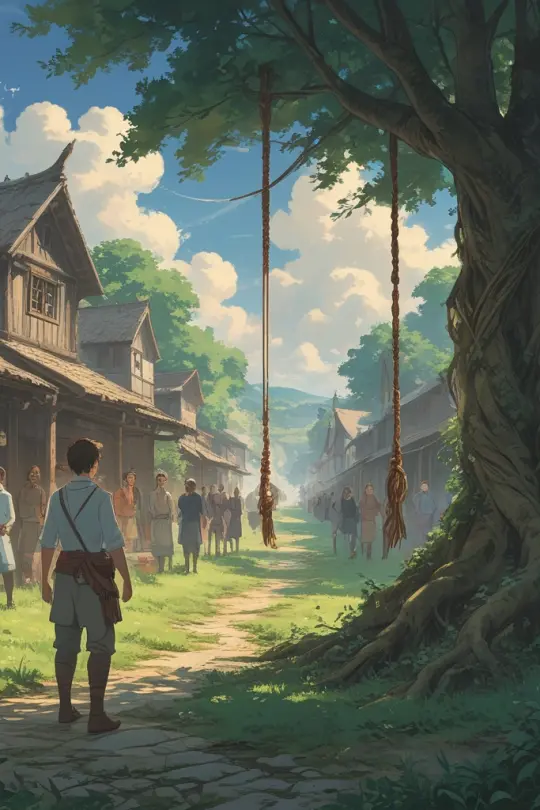
Measure of a Span
Join the conversation! Readers are sharing their thoughts:
About the Story
In a town of humming lanes and absurd rituals, a solitary spansmith confronts the Pairing Festival’s demand for a living anchor from a protected grove. When a sudden wind-shift tests an experimental hybrid splice, Rosan must climb, braid, and sing the craft’s hardest measure to hold a crowd and a living root together.
Chapters
Story Insight
Measure of a Span follows Rosan Vale, a meticulous spansmith whose trade is equal parts engineering, ritual, and care, in a small town where bridges hum and municipal eccentricities take the form of a toad-in-a-waistcoat stamping forms. When the Pairing Festival demands a living anchor, the only viable source is the last choralroot growing in Ardensgrove — a communal, sentient root guarded by a mischievous root-spirit named Nib and protected by local law. Rosan faces a practical, moral dilemma: take a living sprig and coax it into service, honoring the grove with careful tending, or accept Marlo Ives’ secure bolted alternative that would spare the grove but leave the lane without its warm, humming voice. The narrative centers on professional practice as a form of relationship-making — measurements, breath-lash cadences that are half lullaby and half technique, the use of a battered tensimeter called Gad, and the tactile choreography of splice and ferrule. Supporting figures — Pip the eager apprentice, Old Gavren the crotchety mentor, and a civic cast that includes engineers and volunteers — make the conflict communal and practical rather than abstract. Themes of stewardship, craft ethics, and communal labor run through the book. Rather than framing the choice as pure ideology, the plot examines how a skilled craftsperson reads material limits, trains others, and improvises under pressure. The emotional arc moves from solitude toward connection: Rosan’s work brings neighbors into shared responsibility, teaching them to cradle living chord, to share slack without snapping pride, and to tend a hybrid anchorage when weather and fickle markets conspire. Humor and small absurdities punctuate the stakes — Nib’s demand for “three jokes, a hat, and a dance,” the Bridge Bureau’s forms asking whether a span prefers tea or stew — giving the town texture and easing tension without trivializing peril. Technical scenes are rendered with concrete specificity and clarity; grafting practice, dynamic load tests, and a staged opening simulate real engineering constraints. The story’s climax is an action-based test of craft: in a sudden wind-shift that threatens the opening, the resolution requires Rosan’s hands, timing, and a novel hybrid splice rather than an epiphany, underscoring workmanship as ethical practice. Readings are grounded and sensory: the prose lingers on sap-scented dust, the rasp of files, and the precise feel of a ferrule cinched to a living fiber. Pacing moves through four purposeful stages — setup, debate, rehearsal, and crisis — so technical detail accumulates meaningful weight and community bonds form through everyday labor. The tone balances earnestness with light, warm comedy; civic rituals, market oddities, and the town’s small domestic flourishes root the fantasy in lived experience. The result will appeal to readers who value imaginative worlds built on craft, practical problem solving, and moral nuance, and to anyone who enjoys scenes where knowledge, apprenticeship, and steady hands are the decisive forces in a crisis. The book offers close, trustworthy attention to how work reshapes relationships and how inventive techniques can reconcile competing claims on a living world, all while keeping the story accessible and human-scaled.
Related Stories
The Weaver of Echoes
When the Chordstone that binds the sky-city of Aerlance begins to fray, apprentice sound-weaver Eloin must follow a vanished low note into factories and ledgers. With a borrowed violin and a clever companion she uncovers a trade in silenced songs and learns to mend a city by teaching people how to listen.
The Ropewright Who Mended a Town
Tamsin Hallow, a solitary ropewright who mistrusts crowds as thoroughly as she trusts her hands, returns to mend a town’s broken crossing. When a storm and a jealous saboteur threaten the fragile repairs, Tamsin must braid a living span in one continuous, dangerous operation. The final night is a raw, physical trial in wind and rain—spikes, wax, and fingers moving like tools—to weave roots and rope into a steadier way across the gorge. The atmosphere is bracing and tactile: rain-slick market stalls, odd local pastries that hum when bitten, officious ferrets, and a cart that refuses to move without a pun. Tamsin’s skill and stubbornness drive the climax, and the town’s practical, awkward responses shape the aftermath.
The Loom of Lost Places
A young glassworker from a floating city must retrieve stolen fragments of place to mend her home. She gains strange allies, faces a collector who curates memories, and pays a costly sacrifice to return what was lost. A tale of craft, courage, and the price of remembering.
The Weave of Days
In a city where a living tapestry holds and hides the past, an apprentice discovers a removed panel tied to her own lost childhood. As suppressed truths spill back into streets and institutions strain to contain them, she must decide whether to offer the memory that will anchor the Weave—and cost her who she is.
The Orchard at Duskwell
In a town where a glass-barked orchard once set the rhythm of life, the living heart is stolen and reworked into instruments of frozen mercy. A young steward, a wary mentor, and a streetwise child steal back the pieces, forcing a confrontation with a faith that binds grief into exhibits. The orchard responds as lives rearrange and seasons begin to move unpredictably.
The Bridgewright and the Hollow
At the rim of a widening chasm, ostracized bridgewright Sorrel Halben must build a sequence of living-anchored ribs to stabilize the land. The tone mixes practical craft, lemon-wicked rituals, and a sentient plank's sarcasm as neighbors learn to pull together for a risky rescue.
Other Stories by Amira Solan
Frequently Asked Questions about Measure of a Span
What is Measure of a Span about ?
A spansmith named Rosan is asked to provide a living anchor from a protected choralroot for the Pairing Festival. The story follows craft, community training, moral choices, and a tense, action‑driven rescue centered on a hybrid splice.
Who are the main characters and their roles in the plot ?
Rosan Vale is the spansmith and protagonist; Pip is the eager apprentice; Marlo Ives is the practical municipal engineer; Old Gavren is Rosan’s mentor; Nib is the mischievous root‑spirit tied to the choralroot.
What is the hybrid splice and why is it central to the climax ?
The hybrid splice blends living root tissue with metal reinforcement to share load. It’s central because the crisis is resolved by Rosan’s professional skill in quickly re‑routing tensions and coaxing the living chord under stress.
How detailed are the craft and technical descriptions in the book ?
Technical scenes focus on tangible, tactile craft: measurements, breath‑lash patterns, lashings, tensimeter readings, and hands‑on splicing. Details serve plot and stakes, not heavy technical exposition or jargon overload.
Is there humor in Measure of a Span, and what kind of tone does it use ?
Yes. Humor is warm and absurd—bureaucratic toads, a root‑spirit demanding jokes and a hat, and local customs. The tone mixes gentle comedy with earnest, practical tension rather than slapstick or cynicism.
What themes does the story explore ?
The book examines stewardship, ethics of making, craft as relationship, communal labor, tradition versus adaptation, and how practical skills and shared responsibility repair social bonds without simplistic moralizing.
Who should read this story and what will they find rewarding ?
Readers who enjoy grounded fantasy, hands‑on problem solving, apprenticeship arcs, and community‑focused plots will find the tactile craftwork, ethical stakes, and a satisfying action climax driven by skill especially rewarding.
Ratings
Cute idea, mediocre execution. I appreciate a good artisan protagonist, but Rosan felt a touch too archetypal — the stoic, patient spansmith who 'breathes' into wood, destined to save the day. The whole "living root from the protected grove" dilemma is suspiciously convenient: the festival needs a living anchor, licensing is ominous thanks to a toad stamp, and surprise wind-shift! — suddenly Rosan must sing and braid and deliver emotional closure. It reads like plotting by checklist. The language can be lovely (the rasp singing is a nice line), but the emotional stakes are handled with a featherweight. Who cares about the grove's protection after the spectacle? The apprentices and town gossip are background props, never fully fleshed out. I wanted grit and moral fallout, not just a moving stunt. If you want pretty imagery and a tidy ending, you'll like it; if you want real risk and consequence, keep looking.
I found this one frustratingly uneven. The writing is vivid in patches — the rasp, the kettle, Hetsa's ladle are nice touches — but the plot leans on familiar beats without exploring them deeply. The Pairing Festival and the summons are presented as high stakes, yet the actual ethical conflict (a living anchor taken from a protected grove) never achieves the complexity it promises. We get hints — the indigo toad stamp, the apprentices — but the world feels sketched rather than lived-in. The wind-shift and the hybrid splice operate like set pieces more than consequences; when the story pushes Rosan to "climb, braid, and sing," it reads as a well-written stunt instead of an earned character moment. Also, certain conveniences (the kettle for visitors, the open door allowing gossip, Pip's precise timing) feel a bit too tidy. I wanted messy moral conversation, not just spectacle. Worth reading for the craft descriptions, but unsatisfying as a moral drama.
Short, lovely, and quietly powerful. Rosan's workshop — open door, kettle on, the rasp singing — is one of those settings that stays with you. The summons stamped with the toad seal felt delightfully specific and a little unnerving. The story's centerpiece — the climb and the braided singing to hold a living root — made my heart race. I appreciated how the ethical question (taking a living anchor from a protected grove) is implied rather than sermonized. A small gripe: I wanted a touch more follow-through after the festival night, but otherwise this is a beautifully crafted slice of fantasy. 🙂
Measure of a Span is an elegant little study in hands-on heroism and community ritual. The author does the hard work of worldbuilding through craft: the rule-board, harness-belt, and the indigo stamp of licensing convey bureaucracy and tradition without info-dumps. The experimental hybrid splice is a clever narrative hinge — technical specificity (the rasp, the braid, the living chords) gives the fantasy its plausibility. Narratively, Rosan functions as both artisan and ethical conscience. The Pairing Festival provides a neat external pressure, while the demand for a living anchor from a protected grove sets up a moral conflict that never feels tacked on. The wind-shift test — where Rosan must "climb, braid, and sing" — pays off physically and emotionally; the singing scene is well staged, balancing the crowd's need for spectacle with the intimate negotiation between maker and root-spirit. If I had one nitpick it’s that a few background threads (the role of apprentices, the grove’s protection) could be expanded into a longer piece. Still, as a compact fantasy vignette, this is satisfying and smart.
I loved how tactile this story feels — you can almost smell the sawdust and hear the rasping of Rosan's plane. The opening paragraph, where Rosan sharpens a measure until the wood "complained," set the tone perfectly: craftsmanship as a kind of conversation between hands and living things. The little domestic details (Hetsa's ladle, the kettle for damp tradesmen, Pip's dusty fingerprints) ground the fantastical Pairing Festival in a believable town life. What really stuck with me was the moral tug of the summons stamped with the toad-in-waistcoat seal. The way Rosan hesitates before clipping the harness-belt made the ethical stakes feel intimate rather than grandiose. And the climax — climbing the braided span, singing to a living root as wind tore at the splice — was both vivid and suspenseful. I wanted more of Rosan's inner life afterward, but as a short, concentrated slice of a world where craft and spirit collide, this is gorgeous. ❤️