
Between Glass and Sky
Join the conversation! Readers are sharing their thoughts:
About the Story
A façade technician living between rooftops and city rituals faces a wrenching split: a career-making demonstration for a glossy firm or his estranged daughter’s rooftop showcase. When the show fractures into crisis, his trade becomes the tool to save people—and to stitch a new life.
Chapters
Story Insight
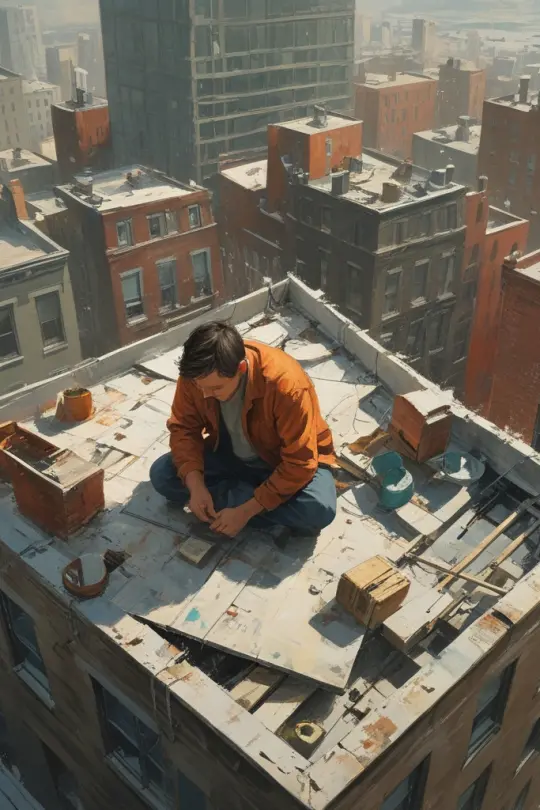
Between Glass and Sky follows Jonah Calder, a rope-access façade technician who spends his days literally hanging between floors and lives. His skills—keen judgment of anchor points, steady hands on pulleys, and an unshowy fluency with knots—are the vocabulary through which the plot speaks. Jonah’s life is held together by professional competence and small domestic rituals: a chipped mug plant on the sill, a harness neatly coiled by the door, and an uneasy truce with his ex-partner, Carmen, over their daughter Lena. A career-defining offer arrives from an elite demonstration firm that promises steady pay and public acclaim, but it collides with Lena’s school rooftop garden showcase—an invitation that demands Jonah’s presence in a quieter, more personal way. The conflict frames an ethical question that is neither abstract nor theatrical: when confronted with a choice between career advancement and being physically present for family, how does a person act when action is their language? The plot moves from this moral dilemma into a high-stakes evening where spectacle and community ritual intersect, and the protagonist must translate his trade into rescue rather than promotion. The novel treats a profession as both metaphor and method. The mechanics of rope work, anchor redundancy, and improvised load-spreading are rendered with specificity that reflects lived knowledge of high-rise maintenance, not romanticized hazard. That technical precision is the story’s backbone: the climax hinges on a practical, skills-based solution rather than a sudden revelation. Humor and absurdity are woven throughout to humanize the tension—Val’s collection of googly-eyed suction cups, a thieving raccoon nicknamed Sir Socks, ballooned “balcony ballet” costumes that get tangled in rigging, and Mrs. Kline’s terrace broth trade add texture and levity. These elements make the urban landscape feel inhabited and believable; they offer relief without undermining the drama. The city itself—its rooftop tea rituals, food carts, and neighborly quirks—acts as setting and counterpoint, a cultural detail that deepens the stakes and reminds the reader why presence, not spectacle, matters to the people on the ground. Told in three tightly focused chapters, the story balances tense, technical rescue sequences with quieter domestic moments that show how repair work extends beyond glass and steel into relationships. The voice favors clarity: descriptive passages linger on tactile details—rubber-smell of harnesses, the particular groan of a corroded bolt—while dialogue reveals the characters’ dynamics without exposition-heavy scenes. Emotional movement arcs from a hard-edged solitude toward a more complicated, fragile connection; reconciliation is practical and earned rather than instantaneous. Thematically, the novel explores craft as identity, the contrast between repair and performance, and how community safety can be sewn together through shared skills. For readers who appreciate realistic depictions of labor, small-town urban rituals, and dramas that resolve through action rather than epiphany, this story offers a grounded, humane portrait of a man who chooses to put down his work on show for work that keeps people safe and close. It’s a close, hands-on narrative that privileges skill, tact, and the messy business of keeping things—and people—upright.
Related Stories
The Listening Room
A young sound engineer loses his hearing and seeks an unorthodox cure from a reclusive acoustician. As corporate forces try to silence the work, he must rebuild his sense, confront power, and create a community that learns to listen — and to reclaim sound.
Beneath the Listening Light
When Asha Rami takes over the lighthouse at Nemir Point, a scraping at the seabed and a missing fishing sloop reveal an industrial threat. With an old engineer's drone and a town's stubborn courage she fights a corporation's teeth, repairs what was broken, and learns how grief becomes responsibility.
Paper Houses
Returning to care for her ailing mother, Nora discovers papers that suggest the town’s closure over a decades-old crime might be false. The discovery entangles her with a convicted man, a young woman who may be the hidden child, and a quiet list of protections Evelyn left behind. As Nora balances legal pressure and the need to shield a life from sudden exposure, the town’s small intimacies and resentments gather around each new revelation.
The Clockmaker's Lullaby
A young watchmaking apprentice in a river city faces a developer’s plan to erase the old clock tower. When the bell falls silent, Mira accepts the charge to restore it. Guided by an eccentric master, an archive intern, and a curious automaton dove, she confronts sabotage—and time—at Founders’ Day.
Frequencies of Home
In a tenement threaded with murals, a former stage sound technician rigs a communal ‘listening’ system meant to soften daily friction. When smoothing tech misroutes private voices, she must rewire the building’s audio and its rules, turning her craft into a ritualized practice of attention.
The Resonance Beneath the City
A young luthier and subway violinist fights a city ban and a predatory organizer to fund her brother’s cochlear implant. With a retired acoustics engineer’s resonator and a band of buskers, she rallies a crowd, suffers a public setback, sparks a viral surge, and returns to the platform for a hard-won, tender victory.
Other Stories by Ophelia Varn
Frequently Asked Questions about Between Glass and Sky
What is Between Glass and Sky about and what central conflict drives the plot ?
Jonah Calder, a high-rise façade technician, faces a choice between a career-defining demo and his daughter's rooftop showcase. The story centers on a personal moral dilemma that escalates into a tense, skills-based rescue.
Who is Jonah Calder and how does his façade technician profession shape the story's themes ?
Jonah’s trade is both metaphor and method: ropework, anchors and careful rigging reflect his emotional life. His technical expertise informs key plot beats and the climax, grounding drama in practical skill.
How does the story balance technical rescue action with family and community drama ?
Rescue sequences are rendered with realistic procedures—anchors, redirects, controlled lowers—while quieter scenes show strained family dynamics, neighborhood rituals and the slow work of rebuilding trust.
Is the climax resolved through Jonah's professional skills rather than a sudden revelation or twist ?
Yes. The climax depends on Jonah’s fieldcraft: improvised anchors, load distribution and controlled lowering. The emergency is solved by measured action and teamwork, not by a last-minute exposé.
What roles do supporting characters like Val, Carmen, and Mrs. Kline play in Jonah's journey ?
Val provides camaraderie and comic relief; Carmen embodies accountability and the complexities of co-parenting; Mrs. Kline and neighbors supply local color and human stakes that motivate Jonah’s choices.
Does Between Glass and Sky include moments of humor or absurdity alongside its dramatic rescue scenes ?
Absolutely. Googly-eyed suction cups, a mischievous raccoon, ballooned ballet mishaps and terrace broth moments inject levity and texture, keeping the urban setting lived-in without undermining tension.
Ratings
I wanted to love this, and parts of it are beautifully observed — the small rituals, the tactile details about tools and glass, even Sir Socks the raccoon are delightful. But overall I found the story's arc disappointingly familiar and a little too tidy. The central choice (big demo for the firm vs daughter's rooftop show) telegraphs the emotional beat from a mile away, and the 'show fractures into crisis' rescue feels like a device to force reconciliation rather than a natural escalation. There are moments when the prose wanders into purple patches about the city 'stacking' itself, which slows down momentum instead of deepening character. Also, a few plot conveniences stand out: how the glossy firm’s stakes are never fully explained, and how quickly estrangement melts away after a single dramatic night. If you enjoy lyrical descriptions of urban craft and don't mind an arc that's a bit predictable, you'll find charm here. If you're after sharper plotting and less sentimentality, this might frustrate you.
Between Glass and Sky is one of those quiet dramas that accumulates feeling in the margins. Jonah isn't defined by a single gesture; he's built out of ritual and repetition — naming his ropes, the precise moment a pane of glass 'settles,' the harness that bites under his thighs. These are the things that make him believable and sympathetic before the plot even tilts. I particularly liked how the city itself reads like a character: tram bells and street food scent drifting upward, an overgrown planter hosting Sir Socks the raccoon, the skyline stacking like carefully fitted scales. That sensory work makes the later crisis feel visceral rather than contrived. The moral dilemma — career-defining demo for a glossy firm versus his estranged daughter's rooftop showcase — is familiar, yes, but the way it's handled avoids cliché. The storytelling trusts the reader with small moments: Jonah tugging a line, the names whispered to his ropes, a glide of a suction pad that tells you everything about his experience. When the show fractures and people are in real danger, Jonah's trade ceases to be only livelihood and becomes a language of rescue; the rescue sequences read like choreography, technical and humane. The reconciliation with his daughter is the most moving part because it arrives as a consequence of his work rather than a tidy moral lesson. My only quibble is that a few secondary characters could be a touch sharper — the property manager and the glossy firm feel a bit flattened — but that's minor. This is a book for anyone who loves craft, cities, and stories about how practical skill can repair more than physical things.
Loved it. Jonah talking to his ropes like they're houseplants cracked me up and then made me cry five pages later 😅. The raccoon, Sir Socks, is a whole mood — that bottle-cap moment is cinematic. The rooftop scenes are so vivid: the hiss of the tram bells, the scent of seaweed pancakes, the way glass 'starts doing the honest thing' — the prose is smart and slightly melancholic. When the daughter's showcase collapses and Jonah becomes the guy who literally holds things together, the emotional pay-off lands hard. Short, sharp, and oddly comforting. Would read the whole thing.
Concise, tactile, and smart. The excerpt nails a blue-collar intimacy — Jonah naming lines out loud, the smell of engine grease, the raccoon turning a bottle cap — details that make the rooftop world tangible. I appreciated the structural contrast between the glossy firm demonstration and the daughter's grassroots rooftop showcase; it sets up the moral stakes cleanly. The pacing in the opening is deliberate but never boring, and the rescue turning his trade into salvation feels earned because of the careful craft descriptions earlier. A well-constructed drama about work-life balance and community.
This story quietly stole my heart. Jonah's rituals — naming his ropes “Maggie” and “Phillip,” the small absurdities like talking to Sir Socks the raccoon — make him feel lived-in and real. The scene where he feels the glass “settle” under his palm is gorgeous; you can almost hear the city exhale with him. I loved how the author balances technical detail (harness seat biting, suction pads, ceramic carabiners) with domestic touches like the tram bells and seaweed pancakes drifting up from the street. The climax — the rooftop showcase fracturing and Jonah turning his craft into a tool for rescue — was tense and satisfying: it's rare to see a profession treated as both poetic and practical in service of family repair. The reunion with his daughter isn't melodrama; it's earned, messy, and hopeful. Atmosphere, voice, and the tactile sense of working on glass make this one of the more humane urban dramas I've read lately.