
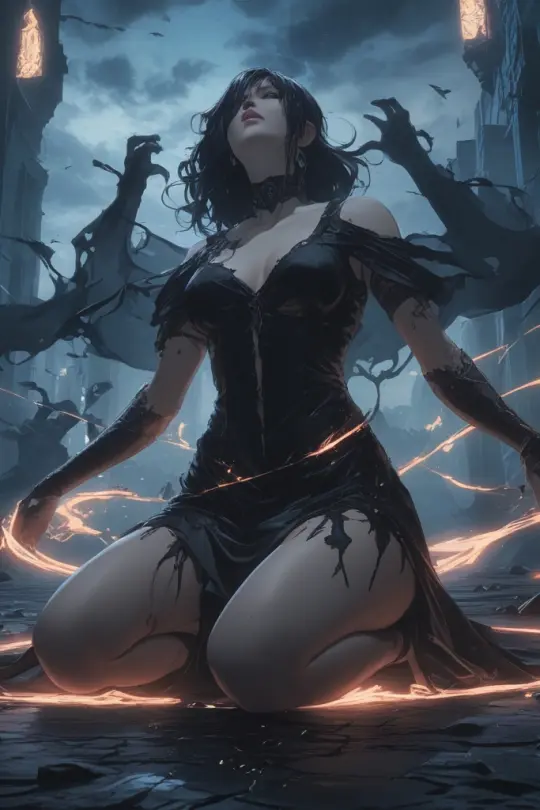
The Hem of Night
Join the conversation! Readers are sharing their thoughts:
About the Story
At the dusk-hem of a city, a mender trades pieces of herself to repair what is lost. When her brother begins to unmake, she seeks forbidden knowledge and bargains with remnants beyond the seam. Choices lead her to the guild’s heart, a root stitched with vows, and a final cut that alters who is remembered.
Chapters
Story Insight
The Hem of Night opens on a city whose boundary is literally hemmed by dusk: a living seam that quietly consumes the things people lose—voices, names, little habits that make a life whole. At the seam’s edge, Rheya Kest practices a dangerous craft. She mends the frayed parts of others, taking in what has gone missing and paying the cost with pieces of her own memory and sense of self. The story begins in a small workshop scented of lemon and warmed metal, with domestic details that make the uncanny feel tactile and immediate. When Rheya’s younger brother begins to “unsettle,” losing threads of his identity in ways that ordinary mending cannot staunch, she faces a choice that scales beyond the household: cooperate with the guild that stabilizes the city by converting living people into anchors, or pursue forbidden knowledge that could unravel the seam at its source. The narrative moves from intimate, quietly wrenching scenes into a larger confrontation between private sacrifice and institutional order. The guild—represented by the polished, persuasive Magistrate Valeth—turns the practicality of repair into civic policy, while the Fringe holds the story’s older, stranger lore: remnants of last words, toys, and vanished rituals that barter memory for leverage. Those elements are not mere mechanics; they function as moral instruments. The prose balances lyrical description with methodical worldbuilding, making the seam feel like a character in its own right. Emotional stakes drive the plot: fear, responsibility, and the diminishing returns of repeated giving. Themes of memory and naming intersect with questions about who controls care and at what price, and the story keeps its tension rooted in personal costs rather than schematic debates. This is a dense, atmosphere-first dark fantasy that rewards attention to small things—textures of thread, the way a pocket-watch hesitates when time withers—and to the messy consequences of apparent solutions. The Hem of Night pairs ritualistic, almost mythic moments with the everyday mechanics of a city that has learned to live with a dangerous convenience. The tone tends toward quiet intensity rather than spectacle: scenes are claustrophobic and tactile, then widen to reveal civic consequences. Readers attuned to morally ambiguous dilemmas, haunting imagery, and stories that explore identity through loss and repair will find the book compelling. It offers a richly imagined setting and a tightly contained dramatic arc that examines what is given up to keep a community whole, while preserving surprises about how those sacrifices are negotiated and challenged.
Related Stories
The Bone Orchard
In a decaying city of bell-trees and collected silence, a young bellwright named Eiran risks himself to reclaim his sister from a devouring seam that hoards voices. Dark bargains, hidden markets, and a moral choice between memory and mercy push him to sacrifice and reshape his craft, forging a fragile reckoning between loss and the stubborn persistence of sound.
Reckoning of the Nameless
A somber city binds its hunger to a single guardian when a devouring fissure begins to take more than what is offered. Mara Vell, former custodian of memory, becomes both seal and sacrifice as communities struggle to reclaim names, recover missing registers and rewrite ritual in the wake of political gambits and personal loss.
The Last Pledge
Final chapter completing the ritual, the public reading, and Aveline's sacrificial choice, showing the aftermath and the city's fragile reforms.
The Nameless Accord
In a rain-dark city bound by an ancient bargain, a mechanic's sister is unmoored when names begin to vanish. She descends into vaults of stolen memory and uncovers a ledger of fragments. To rescue her brother she must stand at the seam between living and forgotten and offer herself as the city's anchor.
Crown of Veils
In the salt-bitten port of Gharum, young mycologist Neris defies a ban to descend into catacombs and seek a lost luminous fungus that keeps the city breathing. She bonds with an ancient mycelial mind, confronts a ruthless matriarch bent on waking the leviathan under the harbor, and must sacrifice her own breath to bind bones and save her home.
Stitches Beneath the Hollow Sky
Aveline, a solitary master seamstress, works beneath a patched sky that begins to fray with a hunger for loose edges. When ragged tears threaten the market, she must teach and lead others to hold the seam and perform a dangerous, precise binding. The city’s ordinary rhythms—bread, wind chimes, rooftop gardens—settle the scene even as a new, stitched border forms overhead.
Other Stories by Wendy Sarrel
Frequently Asked Questions about The Hem of Night
What is the central premise of The Hem of Night and who is the protagonist ?
The Hem of Night follows Rheya Kest, a seam-mender who repairs lost names and memories at great personal cost. When her brother begins to unmake, she must choose between binding him or cutting the seam’s root.
How does Rheya's mending ability affect her and what is the cost of each repair ?
Rheya absorbs fragments—phrases, textures, small memories—when she mends. Each repair erodes a slice of her recall or identity, accumulating toward deeper forgetting and eventual personal erasure.
What role does the guild and Magistrate Valeth play in the conflict ?
The guild, led by Magistrate Valeth, institutionalizes mending into regulated permanent bindings. They pressure Rheya to perform sanctioned stabilizations, turning people into anchors to serve the seam.
What is the Hem or seam, and why is unmaking its root significant to the city ?
The Hem is a quasi-sentient seam born from an ancestral stitch that feeds on mended lives. Unmaking its root severs that appetite, freeing citizens but destabilizing the ordered structures that depend on anchors.
How does the Fringe and remnants function in Rheya's plan to undo the seam ?
The Fringe harbors remnants—forgotten toys, last words, altered habits—that barter memories for aid. Rheya gathers three such remnants as counterweights to pry and unravel the original buried stitch.
What are the emotional stakes and final consequence of Rheya's decision in the ending ?
Rheya chooses to unmake the original stitch, sacrificing her name and recorded presence. The guild’s power collapses and the city gains messy freedom, while Rheya fades from collective memory.
Ratings
Mixed feelings. The Hem of Night is gorgeously atmospheric — the seam imagery, Rheya's shop half in shadow, and that small insistence on ordinary smells in an extraordinary place are all vivid. The moral questions are interesting: what should one sacrifice to restore someone else, and who has authority to decide who is remembered? However, the execution wobbles. Pacing in the middle drags with repetitive mending scenes that reiterate the same emotional cost without adding new insight. The brother's unmaking, which should be the emotional fulcrum, felt underdeveloped; his decline motivates Rheya but we never get enough threaded scenes to feel the full weight. There are also moments where the rules of the magic are inconsistent — some mends cost a phrase, others a texture, but the stakes shift for convenience. The final cut is thematically satisfying but narratively abrupt. In short: lovely language and provocative ideas, but the plot mechanics and pacing needed tighter control.
Beautiful writing, slightly hollow core. The imagery — seam like a raw hem, the scent of lemon peel — is lovely and the idea of bartering away pieces of yourself to restore others is affecting. But the narrative sometimes feels like polished wallpaper: pretty, but not supportive. The "root stitched with vows" feels like a tropey plot-object, and the forbidden bargains are melodramatic where they should be wrenching. I also think the book leans on certain clichés of urban fantasy (secret guilds, ritual roots, final cuts that decide fate) instead of subverting them. If you love lyrical prose and don't need big surprises, you'll enjoy it. If you want innovation beyond mood, this might frustrate you.
I wanted to love this, but it fell into some familiar traps. The premise — a mender who trades pieces of herself to restore memory — is compelling, and the early scenes (the seam, the shop, the jars) are beautifully rendered. But the plot becomes somewhat predictable: the "forbidden knowledge" and bargaining with remnants outside the seam hits beats we've seen before, and the escalation to the guild's heart and the final cut follows an expected arc without surprising twists. Pacing is uneven; long, lyrical passages slow momentum just when the brother's unmaking or the guild politics needed urgency. There are also a few underexplained mechanics — why certain memories cost more, or how Rheya's internal ledger really tallies — that left holes I couldn't reconcile. It's atmospheric and well-written, but for me the story's emotional payoffs didn't always land because the structure felt too familiar.
Okay, I wasn't ready to cry over a spool of thread, but here we are. 😂 The Hem of Night sneaks up on you — gorgeous sentences, creeptastic seam-at-the-edge imagery, and a heroine whose work feels like a small, terrible kindness. The laugh-that-left-the-shop and the woman's forever-practiced smile haunted me for days. Rheya's trade (losing a phrase here, a color there) is such a clever way to dramatize the cost of care. Also, the guild's heart and that root stitched with vows? Super creepy in the best possible way. I loved the moral wrench of the final cut. If you like melancholy, inventive urban fantasy with depth, this is a treat. 🌒
I tore through this because I needed to know how the bargains would land. The idea of mending memory by trading bits of yourself is both fresh and mythic — it reads like an urban folk tale filtered through a moralist's lens. The bargains with remnants beyond the seam are eerie; I loved the scenes where Rheya reaches out into that trembling line and comes back changed. The guild's heart and the root stitched with vows add ritual weight that transforms a lonely shopkeeper's grief into something systemic and dangerous. The final cut — when choices at last decide who is remembered — is morally ambiguous and haunting. Only gripe: the brother's "unmaking" felt slightly rushed; I wanted a longer, messier arc there. Still, this is a rare dark fantasy that balances atmosphere, intimacy, and ethical consequence. Read it when you can afford to feel a bit hollow afterward.
Small, measured praise: I loved the prose on a sentence level. Lines like "the seam lay along the city's edge like a raw hem left unfinished" do heavy lifting — they set mood, place, and tone all at once. Rheya's tactile shop, the jars and warm metal, the smell of lemon peel, make the magic feel domestic and intimate. The moral dilemma (what do you sacrifice to repair someone else?) is quietly devastating. The scene where Rheya realizes she's taken the texture of spontaneous laughter and can't find it again was beautifully, painfully done. I wanted more time with the brother subplot, but that's a minor wish in a story rich with imagery and feeling.
Analytical take: The Hem of Night excels at concept and atmosphere. The seam as literal and metaphorical boundary is a neat piece of worldbuilding, and the mechanics of mending — trading a phrase, a color, a texture of laugh — are consistent enough to buy into emotionally. I appreciated the escalation: small subtractions at first, then steeper costs as Rheya keeps repairing the city's frayed edges. Scenes that stuck with me include the workbench leaning against the rawness and the woman with the practiced smile after her husband's mirth was restored. The guild's heart and the root stitched with vows introduce institutional pressure and ritual that complicate Rheya's private bargains. My only quibble is that certain threads (her brother's unmaking, some of the "forbidden knowledge" exchanges) could have used slightly more development, but overall it's a tight, thoughtful dark fantasy that asks hard moral questions without spoon-feeding answers.
This book lodged itself in my chest. The opening images — the seam like a raw hem, Rheya's shop half in shadow, jars of solvent and the lemon-peel tang of the place — are so tactile they made me want to reach through the page. Rheya's trade is heartbreaking and original: taking pieces of herself to sew someone else's memory back. That moment when a client's laugh leaves the shop and becomes a practiced smile still sits with me; the line "she had taken the texture of spontaneous laughter into herself" cut deep. I also loved how the city counts benefits while Rheya counts losses, a quiet moral ledger that builds and builds. The bargain with remnants beyond the seam and the guild’s root stitched with vows bring in real stakes. The final cut promised in the blurb is devastating and beautiful — a wrenching ethical choice about who gets to be remembered. Dark, humane, and gorgeously written.