
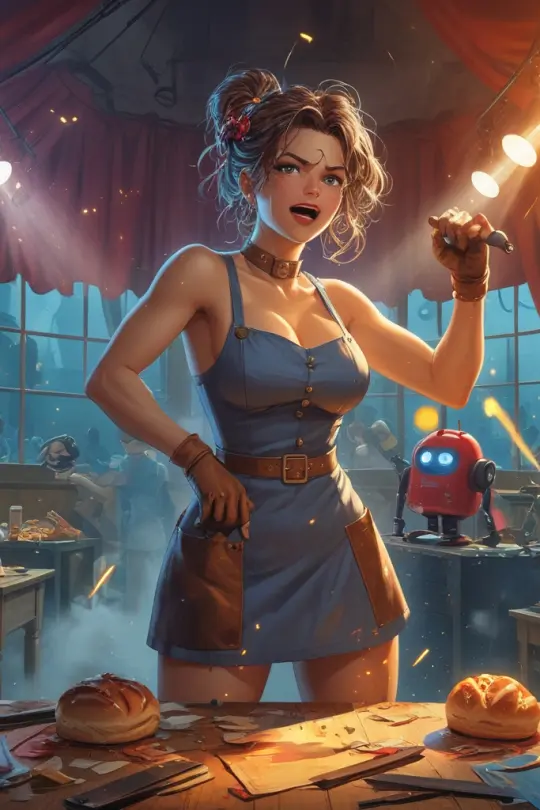
Smoke, Mirrors, and Rubber Chickens
Join the conversation! Readers are sharing their thoughts:
About the Story
In a rain-slick small town, a perfectionist props master faces the arrival of a chatty automated stage system—Aggie—that promises flawless shows. As opening night for a regional festival nears, mechanical quirks and a firmware-driven hiccup force hands-on ingenuity. Tensions between automation and craft build in the cluttered backstage of the Sunnyside Playhouse where rosemary buns, knitted lamppost cosies, and a limerick-spouting bus conductor set a lively scene.
Chapters
Story Insight
Smoke, Mirrors, and Rubber Chickens follows Elliot Marlow, a meticulous props master whose pride lives in hand-stitched sandbags, knot-work, and the muscle memory of late-night repairs. When a donor rolls up the Sunnyside Playhouse’s loading bay with a gleaming automated stage system—Astra, who soon acquires the crew’s nickname “Aggie”—what begins as a flattering gift becomes an acute choice: accept an elegant, guaranteed technical solution that could bring a coveted festival spotlight, or protect the messy, human choreography that makes their small-town theatre sing. The arrival of Aggie is played for comedy from the first moment—otasters of citrus that smell faintly of someone’s lunch, a kazoo fanfare, and a mechanical dove that dispenses confetti shaped like tiny question marks—but those absurdities sit beside real technical stakes. A sequence of rehearsals, a misfired set-piece, and a flagged firmware update push Elliot and the company into negotiations about access, agency, and how to keep the hands that build a show in the loop. This is a workplace comedy rooted in an intimate knowledge of stagecraft: the narrative treats rigging, counterweights, and fly-tower choreography not as props for exposition but as a lived language. Scenes vibrate with practical specificity—the four-rope differential, a slip-clutch jury-rigged from a sewing-machine crank, and the painstaking choreography of a carriage reveal—so the book feels authentic whether it’s showing a last-second rescue or the slow patience of teaching an apprentice. The emotional arc is quietly precise: Elliot’s ambition for recognition rubs against his loyalty to craft and community, and that tension drives both the jokes and the stakes. Humor comes from affectionate absurdity (machines with personality sliders, town rituals like knitted lamppost cozies and a limerick-spouting bus driver) while the drama hinges on a moral choice that must play out through action, not through a single epiphany. At its center are people learning to teach and to share authority—mentorship, compromise, and the gentle arithmetic of safety in live performance. The reading experience includes lively dialogue, warm ensemble dynamics, and a steady build toward a climax solved by practical skill rather than revelation. The tone mixes quick comic beats with scenes that reward attention to craft: small domestic details—rosemary buns, taped-up blueprints, and a rubber chicken repurposed as a metronome—anchor the absurdist moments and make practical rescues feel both tense and humanly satisfying. The six-chapter structure gives the story room to escalate from installation and small failures to a high-pressure showcase, all while keeping an eye on the town’s peculiar rhythms and the daily labor that actually runs a theatre. Fans of backstage comedies, workplace camaraderie, and stories that treat manual expertise with respect will find a blend of humor and care here: the book celebrates messy ingenuity, shows how technology can be negotiated rather than simply accepted, and keeps the pleasure of theatrical mishap alive through wit and well-crafted practical action.
Related Stories
Whisk Takers
After a televised baking whirlwind, a small neighborhood bakery juggles offers, public scrutiny, and a returned notebook while a community rallies to save a threatened lease. The tone blends slapstick mishaps with warm, cluttered camaraderie as Maya decides what to keep, and what to let go.
The Trophy That Walked Off
On a sunlit small-town green, June Baxter—fastidious events coordinator—loses the town’s ceremonial Cup just before the big anniversary. As the object becomes the heart of impromptu chaos, June must step into the crowd, speak honestly, and recover more than an artifact: a livelier festival and a new, unexpected tradition.
Main Street Mayhem
A spirited small town scrambles to keep its beloved Founders' Day parade alive when a glossy city launch and a developer's proposal threaten Main Street’s character. Sammy, an over-caffeinated volunteer coordinator, must turn viral chaos into documented civic strength to win an inspector’s favor and protect the street’s noisy warmth.
The Kindness Lumen Caper
A comedic urban caper about Cass, a young elevator-fixer with grease on her hands and a knack for softening edges, who must retrieve the city's stolen kindness beacon. With a motley crew, a talking cat, an old engineer, and a coaxer that rewards sincerity, they restore warmth to a city flirting with efficiency.
Leo Kettle and the Town Without Taste
Ten year old Leo loves cooking at his aunt’s diner, until a mysterious Advisor turns Puddleford’s food bland. With a talking cat, a pun loving friend, and enchanted kitchen tools, he quests for Laughing Yeast and Whispering Peppercorns to foil a flavor stealing machine and restore Soup Day with laughter.
The Great Grin Heist
A light-hearted caper in the city of Grinbridge where a young repairman, a knotter, and a whistling teapot reclaim stolen laughter from a faceless corporation. A comedic tale about community, small inventions, and the odd jobs of keeping joy alive.
Other Stories by Victor Selman
Frequently Asked Questions about Smoke, Mirrors, and Rubber Chickens
What is Smoke, Mirrors, and Rubber Chickens about and where is it set ?
A comedic backstage tale about Elliot, a props master at Sunnyside Playhouse, who must balance handcraft and a chatty automated stage system named Aggie.
Who is the protagonist in the story and what is their profession ?
Elliot Marlow is the protagonist: a meticulous props master who specializes in rigging, practical effects, and last‑minute rescues that keep shows running.
How does Aggie, the AutoStage, affect the theatre's dynamics ?
Aggie brings automation, cue optimization, and quirky personality features, creating tension as technical promises collide with the theater's embodied, human craft.
What central conflict drives the plot between technology and people ?
A personal moral choice: accept automation for festival exposure and guarantees or preserve the messy, human craftsmanship and communal control of the theatre.
Is the climax resolved by a revelation or by the protagonist's skills ?
The climax is solved through Elliot's professional skill: a live, physical stagecraft intervention in the fly tower that prevents disaster and saves the show.
What tone and emotion can readers expect from this comedy ?
Warm, witty, and slightly absurd: expect playful mechanical mishaps, affectionate ensemble banter, and an emotional arc from ambition toward acceptance and collaboration.
Who should read this story and what similar works will fans enjoy ?
Readers who enjoy backstage comedies, workplace ensemble stories, and gentle satire of tech culture; fans of theatre-set fiction and witty, practical humor will appreciate it.
Ratings
I’ll admit I smirked at the title and stayed for the sandbag superstition, but ultimately this reads like a warmed-over backstage sitcom. The beats are predictable: introduce quirky town, set up machine-vs-craft tension, have a charming hiccup, let humanity save the day. The Aggie firmware failure is treated as a charming obstacle rather than a believable disaster — convenient timing, convenient solution. Characters are sketched more by their props than by real depth, and the quirk catalogue (chip-scones, knitted beanies, rosemary buns) becomes background noise. If you want a cozy, lightly amusing read with a handful of smiles, fine. If you’re after something edgy or surprising, you’ll be disappointed. 🙃
Cute and affectionate, but too often reliant on theatre-story clichés. The narrative leans on familiar tropes: the obsessive props master, the well-meaning chorus of town eccentrics, the quirky food stall, and (of course) a sentient-seeming machine whose hiccup teaches everyone a lesson. The limerick-spouting bus conductor and knitted lamppost cosies border on twee rather than memorable. There are also pacing issues: setup takes its sweet time while the climax — the firmware failure and its manual fix — feels compressed. A few conveniences felt like plot holes: who installed Aggie and why is there no tech support on call? Why is a regional festival dependent on a single untested automated system? These questions could be used to deepen the story instead of skim past them. That said, the prose has charm in places (Elliot’s stitch-count superstition is lovely), and the sensory details are vivid. With tighter plotting and fewer tropes, this could have been stronger.
I wanted to love this because the premise is great, but it kept tripping over its own fondness for quirk. The small-town details are charming at first — chip-scones, knitted pigeons, rosemary buns — but after a while they start to feel like checklist items rather than meaningful texture. The conflict between Elliot and Aggie is interesting, yet the arc is fairly predictable: machine goes wrong, humans prove their worth, curtain call. The firmware hiccup is handled well in terms of hands-on ingenuity, but it resolves without raising larger stakes or consequences. Pacing is another problem. Several scenes linger on atmosphere when they should be tightening plot momentum toward opening night. I enjoyed bits of dialogue (June’s line about spectacular vs safe is great), but the story could use a sterner edit to sharpen focus. Good in parts, uneven overall.
I fell for the characters. Elliot is the kind of perfectionist you can’t help root for — the way he measures, counts, and whispers stitches is intimate and strangely poetic. June, Tess, Rafi, and Doris form a tiny, believable ensemble; Doris bringing tea and a scowl felt like a lived-in moment. The scene where the crew confronts Aggie’s firmware hiccup is the heart of the piece: it’s not just about tech failing, it’s about people rediscovering pride in what they do. The writing has a lovely sensory richness (rosin, lemon oil, rosemary buns) and the community atmosphere — knitted lamppost cosies, chip-scones — is charming without becoming twee. I loved that the comedy never flattened to mockery; it respects its characters. This left me grateful for theatre people and their messy, beautiful craft.
Delightfully daft in all the right ways. This felt like someone shook up a prop shop, sprinkled in a dash of folklore, and let the whole mess improvise its way to the punchline. The rubber chickens in the title aren’t just props — they’re a promise of the story’s tone — and it delivers. Aggie’s mechanical quirks + Elliot’s obsessive rituals = comedy gold, especially when the team has to MacGyver a solution mid-show. Tess’s flourish that makes Elliot wince? Perfect. The limerick bus conductor is my favorite bit of silliness — I laughed out loud. If you’re after a warm, witty take on why humans still matter in an automated world, this one’s for you. Feels like a backstage hug. 😉
Quietly lovely. The town comes alive in smells and small rituals — chip-scones, knitted beanies with papier-mâché pigeons, that municipal diesel tang — and Elliot is an instantly sympathetic anchor. The balance between comedy and affection is just right: you chuckle at the limerick-spouting bus conductor, then feel the tension when the firmware hiccup threatens opening night. Short, thoughtful, and warm. A gentle recommendation for anyone who loves theatre microcosms.
What a smart little meditation on automation versus craft. Elliot is written with such specificity — his superstition about hand-stitched sandbags, the ritualized counting of stitches, the physical work of re-splicing a cord — that his tension with Aggie, the chatty automated stage system, becomes more than a gimmick. The story stages a believable conflict: technology promises flawless shows, but firmware quirks and mechanical oddities expose an overreliance on convenience. I appreciated the pacing in the middle where the crew’s practical ingenuity is foregrounded. The sequence where they jury-rig a solution after a firmware hiccup felt tactile and earned; you could almost feel the rope hum under Elliot’s palm. Small touches — knitted lamppost cosies, rosemary buns, the Tuesday hat crowd — build a convincing atmosphere without dragging. If I have one reservation, it’s that Aggie’s personality could have been pushed further (a little more on how the system interacts with the human crew would have heightened the thematic contrast). Still, this is an engaging, well-crafted short with heart and wit.
I read this in one breath and then smiled for the next hour. The little details — Elliot whispering each stitch like a prayer over his sandbags, the rosin-and-lemon-oil smell, vendors hawking greasy chip-scones — make Sunnyside feel alive. I loved the way the story treats craft as a kind of superstition and a religion: Tess's impromptu flourish that makes Elliot wince, June watching from the bridge like a worried parent, and Doris with her knitting needle scowl. When Aggie hiccups on opening night and the crew has to rely on hands and heart, it felt like the best kind of theatre fable: messy, loving, and honest. The humor lands — the limerick-spouting bus conductor is a tiny riot — and the stakes never feel overwritten. This is comedy that’s warm rather than mean, and I appreciated how the author balanced affection for small-town rituals with the smart critique of automation. A cozy, clever read. 😊