
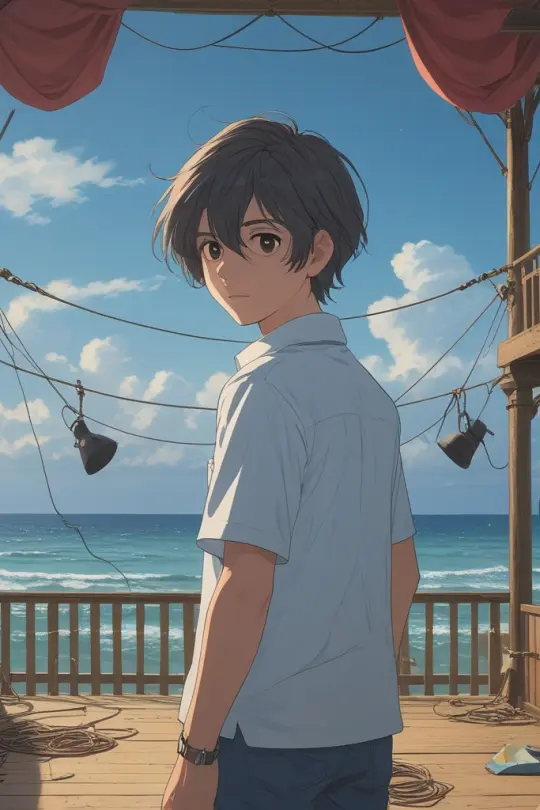
Cues and Counterweights
Join the conversation! Readers are sharing their thoughts:
About the Story
Nico, a young stage technician in a seaside playhouse, navigates urgency and proving competence when a visiting festival panel arrives after a near-disaster. The town’s rituals and Gertrude the mechanical goose punctuate tense moments as Nico compiles proof, demonstrates fixes, and faces a final test.
Chapters
Story Insight
Set at the weathered Old Wharf Playhouse, Cues and Counterweights follows Nico Vega, a seventeen-year-old apprentice stage technician whose love for knots and pulley logic is as precise as anyone’s devotion to an art. The town is small and tactile — mornings scented with rope oil and sugar from anchor-shaped scones, an attic full of patched backdrops, and a knotboard nailed into a beam where apprentices leave their marks. The inciting tension arrives as a visiting adjudicator announces a youth workshop slot: an opportunity that could launch Nico beyond the wharf. When a rehearsal exposes worn rigging and triggers a sequence of practical crises, the stakes become immediate and personal. The plot hinges not on an abstract conspiracy but on a concrete, time-pressured moral choice: pursue a visible, risky shortcut to win recognition, or steward the theater and its people through careful, accountable work. Alongside Nico are Theo, the seasoned stage manager who embodies steady craft; Lina, the charismatic actor whose safety depends on Nico’s hands; Jenna, a meticulous peer who becomes an uneasy ally; and Marigold, the theater’s eccentric owner who keeps a mechanical goose named Gertrude as a comic talisman. The presence of an absurd, affectionate element like Gertrude threads lightness through tense scenes and reminds readers that community rituals both deflate fear and bind people together. The novel treats stagecraft as more than setting: it is the central metaphor and engine of plot. The narrative renders knots, counterweights, harness geometry, and load testing with tactile specificity, translating technical procedure into drama. Readers encounter moments of real practical procedure — splicing a splice, documenting a double-static test, rerouting headline loads to reclaimed trunks, and preparing chain-of-custody records — all portrayed with an authenticity that honors the labor behind theatrical illusion. That focus gives the story a rarer kind of YA energy: coming-of-age through apprenticeship and responsibility rather than through rebellion alone. Themes weave through the action with deliberate weight: ambition versus responsibility, mentorship and transfer of craft, belonging through shared labor, and how small-town economies of favors and humor shape moral choices. The emotional arc arcs from the thrill of ambition to a quieter, steadier acceptance; Nico’s growth is shown through decisions and deeds — not merely introspection. Humor and warmth keep the tone balanced, using the town’s rituals and Marigold’s offbeat sensibilities to diffuse tension while strengthening bonds among the company. For readers who appreciate grounded, people-first YA, this story delivers a compact, immersive experience: the pacing moves from intimate workshops to an urgent public test, and the climax is resolved through technical skill and leadership rather than a last-minute epiphany. The prose privileges sensory detail — the grit of rope, the tang of repair tea, the creak of a truss — so those who enjoy craft-focused narratives will find satisfying concreteness. At the same time, the book remains emotionally accessible: friendships and mentorships feel earned, consequences feel realistic, and accomplishments come from sustained effort and clear accountability. Cues and Counterweights is especially compelling for anyone curious about what keeps a theater running behind the curtain, for those who like stories about learning a trade, and for readers who want a coming-of-age tale where choices have tangible, communal consequences. The novel keeps surprises intact while laying out the kinds of dilemmas and small, vivid pleasures that make the theater — and its people — worth watching.
Related Stories
Names in the Water
When Marin Hale’s name vanishes from the Wheel of Naming, the harbor city unmoors her identity. She follows a silver thread into a hidden market and the Registry’s glass Archive, bargaining memories and coaxing lost syllables back into being. A tale of small trades, stubborn courage, and naming what belongs to us.
Unwritten Lines
June Harlow finds a peculiar blank journal that makes written lines come true. As she uses it to mend fractures after her sister’s death, memories begin to fray for others. When the cost becomes clear, she confesses, faces the fallout, and tries to rebuild truth by human work rather than quick fixes.
Signals in the Static
A community radio volunteer unearths archived tapes tying a powerful developer to past land deals. As broadcasts stir the neighborhood, stolen evidence, legal threats, and moral dilemmas force her to choose how to use a voice that can reshape her town.
Signs for Strangers
The neighborhood smells of pastry and varnish; a young apprentice sign painter navigates a commission that could humiliate a classmate. June uses craft, timing and a small crew of friends to alter a public moment and then opens her workbench to the community, turning skilled hands into a shared resource.
Contact
Rowan follows a hidden trail of photographs and letters into a public reckoning. In a town where silence kept people safe and secrets kept others forgotten, the discovery of negatives leads to confrontations, a return that had been deferred, and a choice between protection and truth.
A Small Reckoning
Seventeen-year-old Etta uncovers a boxed confession and a small, telling piece of evidence that ties her missing brother to a night the town prefers to forget. As irony, loyalty, and power collide, she must decide whether to expose a hidden truth that will unsettle a whole community.
Other Stories by Ronan Fell
Frequently Asked Questions about Cues and Counterweights
What is the central plot and setting of Cues and Counterweights ?
Set in the Old Wharf Playhouse, the novel follows Nico Vega, a teen stage technician who must prove technical competence after a near-miss. The story blends practical theater work, a visiting festival panel, and small-town life.
How does stagecraft function as a metaphor in the story ?
Stagecraft drives plot and theme: knots, counterweights, and rigging embody responsibility, mentorship, and the unseen labor that supports performance. Technical choices mirror moral decisions and growth.
Who is Nico Vega and what challenges do they face in the book ?
Nico is a talented, ambitious 17-year-old apprentice who must balance the desire for recognition with the duty to keep colleagues safe, leading hands-on fixes, documentation, and leadership under pressure.
How does the seaside town and its rituals influence the narrative ?
Local rituals, trades, and humor—like repair tea and the mechanical goose Gertrude—create community texture. Town favors, bakeries, and informal economies shape stakes and how solutions are sourced.
Is the climax resolved through action rather than revelation ?
Yes. The opening-night crisis is resolved through Nico’s technical skill and decisive action: splicing, load redistribution, and live rigging work, demonstrating competence instead of a last-minute epiphany.
Will readers learn technical details about rigging and safety in the story ?
Readers encounter authentic, accessible technical detail—splicing, counterweight geometry, load tests—explained through scenes and demonstrations, enhancing realism without turning into a manual.
Ratings
I wanted to love this because the setting is lovely and the idea of a stagehand’s coming-of-age is promising, but the execution left me frustrated. The book leans heavily on charming small-town tropes (quirky bakeries, sympathetic fishmongers, eccentric mechanical goose) without fully committing to anything deeper. Gertrude the mechanical goose, for example, pops up as a supposed poignancy device but never gets integrated meaningfully into the plot; it feels like ornamentation. Pacing is another issue. The opening is gorgeously written, but the middle stretches as Nico compiles proof for the visiting festival panel. Those scenes should build tension, yet they often read like procedural checklists rather than rising stakes. When the final test arrives it’s predictable — you can see the beats coming a mile off: doubt, a last-minute fix, approval. There weren’t any surprises, and the resolution smoothed over potential conflicts too neatly. Characters aside from Theo are lightly sketched; the community feels more like a backdrop than a living network. If you prefer quiet, slice-of-life YA with a cozy vibe, this may work for you. If you want sharper conflict, surprises, or fully realized supporting characters, you’ll probably be disappointed.
A solid, reflective coming-of-age set against the industrious heart of a seaside playhouse. The book doesn’t rush Nico’s development; instead it accumulates trust in tiny, tactile victories — a hitch tied well, a braid finished, a belay checked. Those moments feel earned. The festival panel and the near-miss provide enough external pressure to reveal character without derailing the story’s quieter pleasures: the smells, the rituals, the steady mentorship from Theo. Gertrude the mechanical goose is an inspired piece of set dressing that becomes symbolic of tradition and the Playhouse’s personality. If you like stories where craft and community shape a protagonist’s coming-of-age, this will land well. It’s thoughtful, earnest, and quietly satisfying.
Cues and Counterweights is one of those quiet, well-crafted stories that lingers after you close it. The author trusts small gestures to carry emotional weight: a thumb on a carabiner, the sound of a bell, the knotboard’s scratched names. That restraint pays off in the sequences where Nico must compile proof and demonstrate fixes to a skeptical festival panel — the stakes feel real because they’re grounded in craft and safety rather than melodrama. The interplay between tradition and ingenuity is a theme I enjoyed. The town’s rituals (the fishmonger, anchor-shaped scones) show how community supports the Playhouse, while Gertrude the mechanical goose injects an offbeat local mythology that humanizes the space. Theo’s mentorship is nuanced; he scolds and soothes in equal measure, setting Nico up for a believable final test. My favorite moment is the quiet confidence that comes when a knot 'answers right' — it’s a small piece of mastery that stands in for personal growth. This is YA that respects young readers’ intelligence and gives real craft a starring role.
I loved this — proper warm, salty, and clever. Nico is such a great protagonist: hands-on, unshowy, and a bit nervy in the best way. The scene with the braid on the knotboard? Chef’s kiss. You can feel the rhythms of the place: everyone knows their part, from the fishmonger to the bakery, and it creates this lovely small-town safety net. Also, Gertrude the mechanical goose is an icon. That thing stealing scenes in my head. The tension with the visiting festival panel is believable because it’s not grand-slam drama; it’s about proving competence and keeping people safe. Nicely done, very human. 👍
This story reads like a salted memory. The language is quietly beautiful — 'salty planks exhaled in the dawn' is one of those lines I bookmarked. I loved the sensory accumulation: rope dust bright on fingers, the chorus of clamps hanging like 'small, earnest planets', the bakery’s tiny anchor scones. These details build a world that feels tactile and true. Nico’s arc is tender and believable. The tension around the festival panel and the aftermath of the near-disaster is handled with restraint: the drama lives in the exactness of knots and the slow approval of a mentor. Theo’s steady presence gives Nico the room to prove themselves without theatrics. Gertrude the mechanical goose is a brilliant touch — a monument to the Playhouse’s history and eccentricity, and a lovely counterpoint to the human apprenticeship. This is a coming-of-age I’ll reread when I need a quiet reminder that competence can be its own kind of bravery.
I didn’t expect to be charmed by stage rigging, but here we are. The book sells the mundanity of theatre craft as heroic — and it works. The bit where Nico thinks of the knotboard as scripture had me grinning; it’s the kind of small, nerdy reverence that’s irresistible. Yes, Gertrude the mechanical goose is delightfully absurd, and yes, the town’s rituals (sea-sugar scones included) are quaint as hell. But that’s the point — it’s a story about finding dignity in small things. There were moments I rolled my eyes (too many adorable townspeople tropes?), but the core relationship between Nico and the Playhouse kept me invested. Also: 'counterweight couture' is peak stagehand comedy. 😂
Such a cozy, earnest read. The Playhouse felt like a whole life; I could practically hear the gulls and feel rope dust under my nails. Nico’s hands-on moments — checking a belay, tracing a braid on the knotboard — are where the story shines. Theo’s offhand lines are lovely too, especially the 'counterweight couture' joke. The festival panel and the near-disaster raise the stakes without turning things melodramatic. I liked the balance between community rituals and the technical side of theatre work. Short, sharp, and very satisfying.
Cues and Counterweights is a cleverly constructed YA tale that balances technical detail with emotional beats. The author doesn’t patronize the reader: the knotwork, belays, and counterweights are described precisely enough to feel authentic without bogging down the narrative. The knotboard as a 'private kind of scripture' is a neat device — it externalizes apprenticeship and legacy in a way that meshes well with the playhouse’s rituals. Structurally, the playhouse becomes a character. The opening paragraph alone — gulls arguing with a buoy bell, salty planks exhaling — establishes atmosphere and sensory stakes. Theo functions as an effective mentor figure; his dry, steady voice anchors Nico during moments of doubt, particularly when the festival panel arrives after the near-disaster. That confrontation sequence is handled well: tension is maintained through small actions (tightening a hitch, running a hand along a braid) rather than exposition. I also appreciated how the story interleaves community — the bakery, the fishmonger — with professional rigor. The inclusion of Gertrude, the mechanical goose, adds a folkloric edge that punctuates serious moments with whimsy. Overall this is a satisfying, well-paced apprenticeship story that respects both craft and character.
I fell into this story the way Nico climbs the catwalk — with a small, steady thrill. The Old Wharf Playhouse is so vividly drawn: the smell of salty planks, the knotboard like a private scripture, and that moment when Nico thumbs a carabiner and feels everything answer right. I loved the small rituals (sea-sugar scones! the fishmonger’s leftover scales) that make the town feel lived-in and warm. Nico’s quiet pride and nervous competence during the panel visit felt painfully real. The scene where they braid a knot until it 'fits the rhythm in their palm' gave me actual goosebumps — the prose treats craft like a kind of intimacy. Theo’s voice is a perfect foil: steady, lighthouse-like, equal parts scold and comfort. Gertrude the mechanical goose is an absolute delight — quirky, poignant, and oddly symbolic of the Playhouse’s stubborn old heart. This is a tender coming-of-age with real stakes and real tools; it celebrates workmanship as much as youth. I’ll be thinking about this one for a while.