
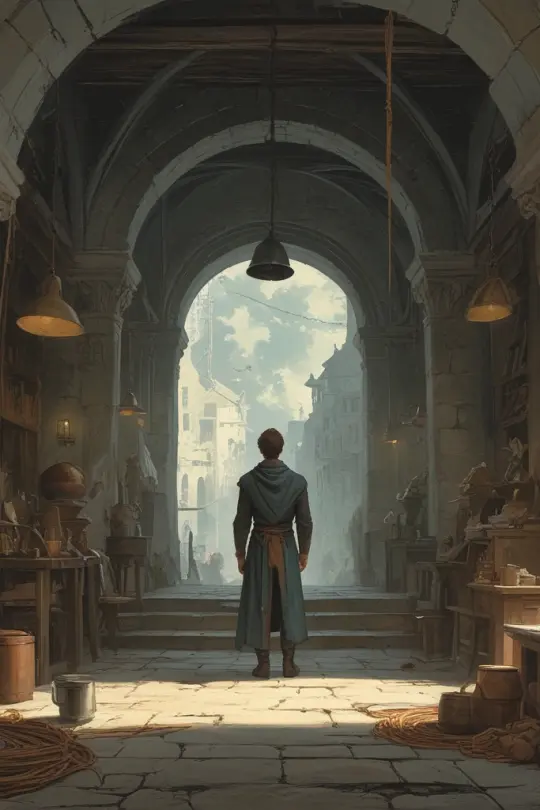
The Tunewright and the Confluence Bell
Join the conversation! Readers are sharing their thoughts:
About the Story
A tunewright who shapes private atmospheres faces a crisis when a once-secret motif leaks into the city’s Confluence Bell, warping communal rhythms. To stop the spreading dissonance, Corin must physically sacrifice his prized technique and braid it into the Bell — an irreversible, expert act that forces him from solitude into a life threaded with neighbors and apprentices.
Chapters
Story Insight
Corin Vale is a tunewright: a practical, solitary craftsman who shapes private atmospheres by carving and setting tiny intervals of tone into rooms and chimes. His work reads like an artisan’s signature, a sequence of micro-notes sold to people who want homes that feel exclusively tuned to them. When a subtle, contagious distortion begins to thread through the city’s rhythms — kettles breaking into unexpected arias, wind chimes shivering in the wrong weather, pigeons forming absurd harmonies on a signboard — Corin is pulled from his workshop. The public instrument at the heart of the market, the Confluence Bell, fails its downbeat and a web of small consequences begins to fray everyday life. Evidence points not to malice but to craft: a variant of Corin’s own private motif has spread into the Bell’s metal. The dilemma he faces is not a courtroom drama or a political coup but a moral and professional one: preserve the exclusive technique that underwrites his livelihood and solitude, or use that very skill in a visible, irreversible way to repair the communal instrument and risk losing his professional advantage. The narrative stays intimate and tactile while it escalates: the plot unfolds across three compact acts that move from precise private work to unavoidable public repair. The story privileges hands-on problem solving over metaphysical revelation; the crisis is resolved through technical skill, measured timing and artisanship rather than through a single epiphany. Scenes luxuriate in sensory detail — the rasp of a tool against bronze, mallets whose voices seem almost human, the steam-snarled commentary of an indignant teapot named Pip — and the city is built from the small rituals of trade: vendors who insist their tarts rise to a particular chime, seamstresses who tie cords for steadiness, bakers who share starter dough. Humor and quiet absurdity thread through the pages (a pigeon quartet, a bell that briefly chirps the market’s grocery list), softening the stakes and humanizing a cast that includes Jun, an eager apprentice, Marella, a neighbor who measures weather by shawls, and Basso, a grumpy mallet with personality. Themes explore craft as ethical language: proprietary artistry versus public good, the social ripple of technical choices, and the shape of solitude when a trade becomes a communal obligation. The tone balances warmth and practical intelligence; readers who appreciate grounded urban fantasy will find the payoff in how the protagonist’s professional competence — not a sudden confession — resolves the central danger. The work pays careful attention to how everyday culture and small details anchor larger choices, portraying a city where obligations are negotiated through tools, tea, and shared labor. For anyone drawn to stories about makers, the everyday mechanics of repair, and the quiet consequences of putting a personal skill into common use, this tale offers a compact, humane exploration of responsibility, community, and the funny, absurd moments that make public life tolerable.
Related Stories
The Bridge That Laughed
Corin Nalle, a meticulous bridgewright, races storm and stubborn hardware to tune a bridge that must both uphold trade and respect a fen community’s nights of solitude. In a brittle gale he uses rope-song, splice craft, and inventive mechanics to save the span and create a hybrid that answers to ritual and load. Warm humor, market life, and small, human rituals thread through the rescue.
The Loom of Lost Places
A young glassworker from a floating city must retrieve stolen fragments of place to mend her home. She gains strange allies, faces a collector who curates memories, and pays a costly sacrifice to return what was lost. A tale of craft, courage, and the price of remembering.
The Doorwright's Choice
Juniper Alvar, a pragmatic doorwright in Hewnwell, chooses between a lucrative vault commission and repairing the failing Season Gate. The final chapter resolves with Juniper using her craft to secure the town’s threshold, blending humor, community rituals, and practical heroism.
The Fraying
In a market square at the Heartring, Avela presents a stolen reliquary as proof of stolen names and confronts Magistrate Corvax. Rather than accept a single sacrificial donor, she proposes an ancient composite binding that asks many to give small name-sparks willingly. The people consent, the ritual is performed, the Heartstone steadies, and the magistrate’s hold on anonymous trades is broken—Seamhold begins to stitch itself together in public again.
The Glass Orchard of Tarrin
A young keeper of a strange orchard of memory-glass must recover her village’s stolen heart. She bargains with a broker of forgetting, trades a cherished memory, and returns home to rebuild a community that heals rather than sells its sorrow.
Oath of the Seasonkeeper
Beneath a failing heart of seasons, an apprentice discovers that the core of her world's cycles has been secretly plundered. As the living stone thins, she must enter a liminal realm, confront the steward who has hoarded weather, and decide whether to hollow herself to seed a shared, fragile stewardship.
Other Stories by Anton Grevas
- Stitches Between Stars: A Hullsmith’s Tale
- Where Sleep Grows
- The Stone That Kept the Dawn
- Spectral Circuit
- The Remitted Hour
- When the Horizon Sings
- Hollowbridge Nocturne
- Greenwell
- Margin Notes
- The Belfry Key
- Frames of Silence
- The Binder of Tides
- The Spring of Sagebrush Hollow
- Threads and Windows
- The Quiet Map
- Whalesong Under Static
Frequently Asked Questions about The Tunewright and the Confluence Bell
Who is the protagonist and what exactly does a tunewright craft and repair in the story ?
Corin Vale is a tunewright — a hands‑on craftsman who carves micro‑intervals and installs signature notes to shape private atmospheres, and who repairs large communal instruments like the Confluence Bell.
What triggers the central conflict in The Tunewright and the Confluence Bell ?
A subtle variant of Corin's private motif migrates into the city's Confluence Bell, creating a micro‑phase that distorts local rhythms and produces cascading, everyday disruptions across neighborhoods.
How is the Confluence Bell's dissonance ultimately resolved — through skillful action or revelation ?
The crisis is solved by Corin's craft: a technical, irreversible repair that physically integrates his motif into the Bell. The climax depends on precise tunewright techniques rather than a single epiphany.
What role do secondary characters like Jun, Marella and Pip play in Corin's transformation ?
Jun is an eager apprentice who provides practical help and moral nudges; Marella represents the neighborhood's steady care; Pip (the teapot) supplies comic commentary. Together they enable Corin's shift from solitude to communal work.
What themes does the story explore and how are craft, community, and solitude portrayed ?
The tale examines craft as ethical language, the tension between proprietary art and public good, and how a maker's professional choices ripple through a city. Solitude gives way to collaborative responsibility and shared routines.
Is there humor or absurdity in the narrative, and how does it affect tone and pacing ?
Yes — recurring absurd moments (a pigeon quartet, a vocal teapot, a mallet with personality) puncture tension, humanize the repair work and keep the tone warm while the plot moves through technical, pacey scenes.
Ratings
I appreciated the charm and craft but left a little unsatisfied. The writing sings in places — the tactile tuning scenes are terrific — and the humor (Pip!) lands well. My main complaint is a narrative one: the sacrifice trope is handled earnestly but predictably. Corin’s decision feels like a foregone conclusion rather than an agonized choice; the story ducks deeper moral questions about identity and ownership of technique. There are also small plot holes: if private motifs can leak into the Confluence Bell, why is security or oversight not already part of the city’s design? Still, the atmosphere and characters carry it; readers who prioritize mood over plot logic will enjoy this.
Clever concept, but pacing and stakes let it down. There are delightful lines — the mallet that grumbles, the teapot with an ‘audacity of a conductor’ — and the initial scenes are lovingly done. However, the main conflict escalates too quickly and resolves too politely. The Confluence Bell warping a city’s rhythm sounds huge, yet the response is oddly intimate and underpowered; the civic-wide implications are glossed over in favor of domestic warmth. If the story had probed the political or social ripples of a shared motif gone wrong, it could have been richer. As it stands, pleasant but lightweight.
I wanted to love this more than I did. The premise is neat — a tunewright who must stitch his private motif into a city bell — and the worldbuilding through craft is the story’s shining asset. But the plot feels a bit predictable: once the motif leaks, the only logical path is Corin’s sacrifice, and there aren’t enough obstacles or moral ambiguity to make that choice feel truly difficult. Also, the aftermath of such a monumental act is lightly sketched; we’re told Corin is thrust into a life with neighbors and apprentices, but the emotional consequences (loss of solitude, new obligations) are treated as almost immediately positive. I wanted more friction, more fallout. Stylistically, the prose is lovely, and I liked Pip and Jun, but narratively the book leans toward neatness where I hoped for mess.
A beautiful meditation on skill, sacrifice, and the messy business of joining community. The prose listens — to planks, to mallets, to teapots — and because of that the Confluence Bell episode hits with surprising emotional resonance. The climax, where Corin braids his technique into the Bell, is technically fascinating and ethically compelling: it’s not about wiping away his identity but transforming it into shared rhythm. I loved Jun’s eager hands and Pip’s indignation; they make the cost of Corin’s choice feel human and recoverable. This one stayed with me for days.
Whimsical and wise. The scene where Corin converses with Basso and Pip made me laugh and then choke up two paragraphs later when the Consequence of the Confluence Bell is revealed. The stakes are handled intelligently: it’s not a doomsday alarm but a disruption of communal life that requires an artisan’s hard choice. The author balances worldbuilding with intimacy — you know the city only by its sounds, which is fitting — and the found-family payoff (neighbors, apprentices) feels earned. Highly recommend if you like craft-centered fantasy with a human core.
Long, thoughtful piece that stuck with me. The opening cadence — ‘finished like a man trimming a stubborn bonsai’ — immediately establishes Corin as someone who tends, refines, and hesitates to lose the imperfect beauty of things. The narrative roots its magic in craft: the mallet Basso, the tactile tuning shims, and Pip’s comic interruptions make the workshop feel lived-in. The Confluence Bell conceit is brilliant because it literalizes how private habits leak into public life; when the motif contaminates communal rhythm, the answer isn’t violence or banishment but a masterful, sacrificial reweaving. I loved the apprenticeship thread and the idea that becoming part of a community can itself be a kind of art. My only small gripe is the occasional rush in the middle chapters — some transitions felt skimmed — but overall this is a generous, humane story that treats art as life and vice versa.
Restrained, focused, and quietly moving. The story’s strength is in the small moments: the mallet’s ‘disgruntled thrum,’ Pip’s squeaky authority, Jun’s metaphors for scent. The Confluence Bell plot functions less as spectacle and more as a moral engine that propels Corin out of solitude. I appreciated that the sacrifice required is technical and irreversible; that feels earned rather than sentimental. The only slight reservation would be a wish for more on the city’s reaction after the braiding — but the ending’s emphasis on apprenticeship and neighbors fits the story’s core values. A compact, well-crafted fantasy about vocation and community.
This story made me grin out loud. Corin’s hands, Basso’s grumble, Pip’s sass — such a delightful trio. I especially loved the scene where Corin wipes the mallet on his sleeve and listens for the settling note; that quiet, domestic precision sold me on the whole premise. The stakes feel intimate rather than apocalyptic: the city’s rhythms warp because a private motif leaks, and the solution asks Corin to give up what he does best. It’s bittersweet and oddly hopeful — and there’s actual humor (Pip!). 10/10 for mood and heart 😊
Technically impressive and thematically coherent. The author uses the tunewright profession not just as window dressing but as an extended metaphor for privacy, labor, and communal life. Specific moments stand out: the tactile description of Corin testing Basso, the personified teapot Pip offering comic counterpoint, and Jun’s exuberant presence that softens Corin’s edges. The leak into the Confluence Bell is a clever plot device — it externalizes the private motif and forces a public reckoning. The choice to have Corin braid his technique into the Bell is narratively satisfying because it’s irreversible and skill-dependent; it reframes sacrifice as craft rather than self-abnegation. If there’s a critique, it’s that some expository beats feel neat—almost too tidy—when dealing with city-wide dissonance, but the book compensates with rich sensory detail and a consistent tone. Recommended for readers who like thoughtful urban fantasy anchored in a single, lovingly rendered profession.
I fell in love with Corin the minute he finished like a man trimming a stubborn bonsai. That opening line — meticulous, reluctant — set the whole tone for me. The way the prose listens to sound (palms that feel vibration, a mallet that grumbles like a retired tenor) is just exquisite. Pip the teapot’s indignant puff and Jun’s cinnamon-ash metaphors made the quieter scenes sparkle; they feel like real, messy companionship, and I rooted for that found-family arc. The moral choice — braiding his technique into the Confluence Bell — landed hard and bittersweet. I loved the imagery of an art so intimate that its loss forces Corin out of solitude and into community. This story treats craft as a living thing, and the climax is both skill-driven and deeply humane. Warm, clever, and oddly tender — exactly the sort of urban-fantasy I want more of.