
Crossing the Unseen Spans
Join the conversation! Readers are sharing their thoughts:
About the Story
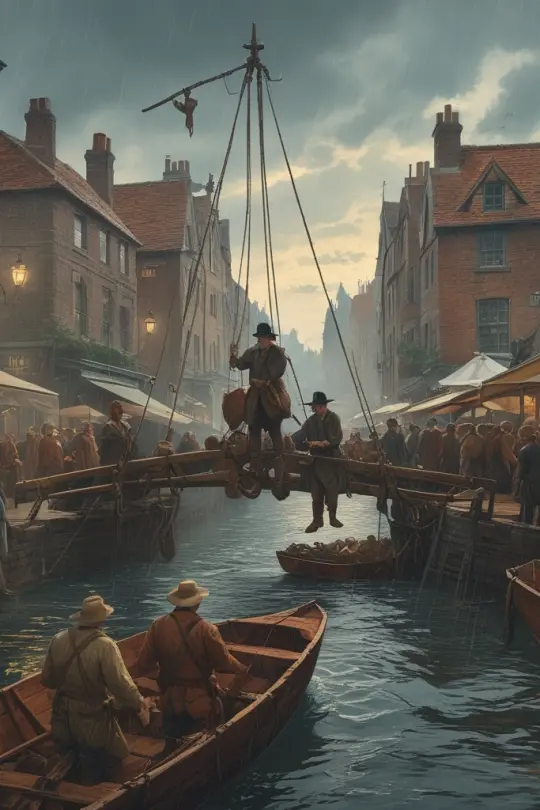
A tense, rain-driven rescue across a market span where an apprentice spanwright must use craft, timing and improvised gear to steady a swinging carriage and save people and cargo. The scene mixes technical rescue, small-market absurdities and practical teamwork in a crowded quay.
Chapters
Story Insight
Crossing the Unseen Spans follows Aden Tiller, a young apprentice who keeps the rope-and-cable network that knits a busy quay market together. The town’s spans are practical lifelines: routes for carts, vendors, and neighbors that hum under load and demand constant attention. One morning a sudden gale tears the market’s main span free, leaving a laden cart, its cargo of herbs, and several people stranded above the water. With his mentor injured and the official guild delayed by distance and procedure, Aden faces an urgent decision—whether to wait for protocol or to improvise a rescue with the little skill and scant materials at hand. The premise is spare and immediate: survival hinges on timing, trust, and hands-on craft rather than conspiracies or grand reveals. Alongside the strain of the storm, the story keeps its feet in small, often comic human details—the market’s preserved-breeze jars, ceremonial repair hats, a crow that steals inconvenient objects, and the half-serious whistle of a brass tuner wrench—that give the setting a lived, slightly absurd flavor. The narrative is tactile in its focus and precise in its technical instincts. Threads of tension are resolved through concrete techniques: running lines and temporary pulleys, splices and shock-absorbing leather belts, counterweights and careful re-tensioning of catenary curves. Those terms are used to illuminate, not to baffle—the story shows the mechanics in clear, sensory terms so the stakes feel real and achievable. The drama centers on Aden’s work: measuring angles, choosing knots, timing ratchets and bracing his body against a swinging carriage. This emphasis on skilled action shapes the climax, where a rescue is attempted and the outcome turns on craft, coordination, and quick physical thinking. Emotional arcs sit beside the engineering: a reserved technician learns to ask for help and to share control with practical allies, and the community’s improvised collaboration becomes as crucial as any tool. Humor and warmth are threaded through the scenes—market banter, small absurdities, and human rituals that persist even in rain—so the tension never becomes only dread. For readers who value grounded adventure and the moral force of work, the story offers a close-up of labor as both vocation and language. It treats everyday expertise with respect: the gestures of a splice, the rhythm of a ratchet, the calming effect of precise commands are shown as forms of courage. The pacing is lean, built around three distinct stages that move from inspection to improvisation to execution, and the prose privileges doing over abstract reflection. The result is a compact, satisfying tale that highlights community improvisation and the dignity of practical problem solving. If a narrative that blends mechanical ingenuity, human detail, and moments of gentle absurdity appeals, this is an adventure that presents craft as both a means of survival and a way of binding people together.
Related Stories
Beneath the Glass Sky
At a coastal harbor where a crystalline Beacon keeps a memory-eating storm at bay, a salvage worker named Asha hunts the thieves who stole a shard of the Beacon’s heart. As she follows Maren Thorne inland with her friend Kellan and scholar Sera, they discover the shards are being collected for an engine that could reassign the Beacon’s power. The final chapter culminates in a desperate plan: sabotage at the forge, a public ritual at the Beacon, and Asha’s choice to offer a living memory as the seal’s keystone. Tension swells into a confrontation that reshapes the village and the cost of protecting what is remembered.
The Anchorsmith's Voyage
A decaying network of ancient stabilization engines — the Anchorholds — keeps a scattered archipelago of drifting islands habitable. When Mira Calder's younger brother disappears during an engineered storm, Mira is pulled from small-scale repairs into a fight over whether those machines should be used to freeze the islands into a controllable order or dismantled to restore natural freedom at great cost.
Juniper and the Pearls of Brine Hollow
When the luminous Lodepearls that steady her seaside town are stolen, ten-year-old inventor Juniper Rook sets out with a clockwork gull, a loyal friend, and a handful of odd helpers to recover them. On fog-slick nights and in caves of glass, she must outwit a grieving collector, mend machines, and learn that repair often means sharing light, not hoarding it.
The Lantern of Tethys
In the archipelago of Ventancia, young mechanic Asha takes a lantern stolen by tide and greed back to life. Given a strange brass “Aequor Eye” and a small automaton, she must outwit a salvage baron, learn to read the sea, and return the lamp to the Harbor Spire—restoring trade and teaching a town to listen to tides.
High Tension
A vertical neighborhood festival teeters on the edge of disaster when a marginal splice threatens a main crossing. Asha, a seasoned rigger, moves from cautious cynicism to a practical, communal resolve: she executes a tense live splice under load, weaving skill, humor, and neighborly improvisation to hold the span and schedule a proper replacement.
Keystone of the Drift
An adventure in a shifting archipelago where an ancient anchoring device is tampered with and a cordwright apprentice must choose between institutional deferment and personal quest.
Other Stories by Lucia Dornan
Frequently Asked Questions about Crossing the Unseen Spans
What is Crossing the Unseen Spans about and what sets it apart ?
A tense, hands-on adventure in a quay market where an apprentice spanwright must improvise a rescue after a gale severs a main span. It emphasizes craft, timing and community over spectacle, with vivid sensory detail.
Who is Aden Tiller and how does his role drive the story forward ?
Aden is a quietly skilled apprentice spanwright. His knowledge of splices, tensioning and pulley systems becomes the practical lifeline; his shift from solitary technician to team leader propels both plot and emotional arc.
Is the story's climax resolved through practical skill or through revelation ?
The climax is resolved through practical skill. Aden’s hands-on expertise—rigging running lines, tying secure splices and timing ratchets—directly determines the rescue’s success under storm conditions.
How realistic and accessible are the technical rescue details in the narrative ?
Technical elements are grounded and explained in sensory, intuitive terms. Pulleys, catenary behavior and knots are shown through action and feeling, keeping mechanics clear without heavy jargon.
What tone, atmosphere and community detail do the market scenes convey ?
A mix of urgency and warmth: storm-driven tension sits alongside market rituals, small trades, and local absurdities. The setting feels lived-in—vendors, preserved-breeze jars and lamplighters add texture.
Are there recurring humorous or absurd elements that lighten the tension ?
Yes. Running comic beats include Knot the crow stealing items, a whistling brass tuner wrench, ceremonial repair hats and quirky stall oddities, which inject warmth and relief amid the danger.
Ratings
Cute imagery — listening to wires, a crow that steals gloves — but honestly it felt like a checklist of 'quirky apprentice story' tropes. Young, skilled underdog + gruff mentor + comic bird = predictability. The big rescue? Sure, tense on paper, but the way Aden calmly improvises and saves everyone felt scripted rather than earned. Also: a lot of engineering jargon thrown in for flavor without any real consequence; where’s the mess, the sweat, the near-miss that actually shows stakes instead of telling us they’re high? Nice prose moments, but I wanted grit. Felt a bit too polished for a market quay rescue.
I wanted to love this more than I did. The setting and small details (figs, flatbreads, Knot the crow) are charming, but the rescue sequence leans too heavily on convenience. Aden the apprentice is impressively adept for someone still learning — tightening a frayed cable and then calmly stabilizing a swinging carriage amid a crowded quay felt a bit too heroic without enough shown training or failed attempts to make it earned. Some technical beats also ring dubious: the ratchet and tuner wrench 'whining' like a song is poetic but skirts the line into romanticizing what should be tense, blunt mechanical procedure. The crowd’s reaction is mostly background noise; I wanted more on how the market’s chaos concretely impeded or aided the rescue — which would make the improvisation feel more consequential. In short, beautiful texture and atmosphere, but the pacing and credibility of the central action need tightening to move it from nice vignette to fully convincing adventure.
Really enjoyed this one — atmospheric and a bit cheeky in the right places. Aden’s calm competence and Halver’s grumpy fondness are great foil; the crow, Knot, stealing the show with a soggy glove is such a brilliant comic beat 😂. The moment where the carriage is swinging over the market had me picturing crates, flying bread, and panicked vendors while Aden rigs something with the tuner wrench — excellent visual. The blending of technical rescue details with small-market absurdities is what sells it: you feel the weight of the cargo and the silliness of a bird stealing breakfast at the same time. A fun, human adventure that respects craft and community.
This was quietly beautiful. Aden’s ritual of listening to the wires gives the whole trade a kind of folklore, and the little touches — Halver’s cane, Knot dropping a glove, the market smells — make the quay feel lived-in. The rescue scene had a breathless practicality to it: no deus ex machina, just skill, timing and improvisation. I appreciated that the heroism is rooted in craft rather than melodrama. Short, sharp, and very satisfying.
As someone who geeks out over mechanical detail, this excerpt hit all the right notes. The descriptions of the cable work — three-turn binds, rolling hitches, the tuner wrench muttering — read like a love letter to practical craft. The author clearly did their homework or has a good ear for how a spanwright moves and thinks; Aden’s ritual of listening to wire tension is both character and method. Beyond the nuts-and-bolts, the rescue choreography is solid. The way improvised gear and timing are foregrounded makes the moment of steadying the swinging carriage plausible and gripping: you can picture who holds what, who shouts, and how the market’s absurdities (Knot the crow, sugar-roasted figs, flatbreads) collide with life-or-death work. The crowded quay setting adds interesting constraints that force creative solutions — a nice reminder that engineering is often social as much as technical. If I have one nit, some transitions between the tender, small moments and the high-tension rescue could be tightened for pacing. But overall, a smart, affectionate adventure about craft, community, and quick thinking.
I loved the sensory detail here — Aden listening to the wire like it’s a musical instrument is a lovely, intimate image that stayed with me. The scene where he tightens the ratchet and the tuner wrench ‘whines’ felt tactile enough that I could almost smell the sea salt and figs. And then Knot dropping that soggy glove? Perfect little absurdity that humanizes the whole rescue. The rescue itself is tense in a very satisfying way: improvised gear, quick thinking, and teamwork on a crowded quay make the stakes feel real. I was on the edge of my seat when Aden and Halver steadied the swinging carriage; the timing and the market chaos around them — shouting vendors, stalls, the creak of cables — made it cinematic without ever feeling overblown. Aden’s quiet competence and Halver’s gruff mentorship are well-drawn, and the humor (the crow, the brass-topped wrench) keeps the tone from getting grim. This is a small but rich adventure that balances craft and community beautifully.